Loading…
UNICEF · Completeness of Birth Registration
Birth registration by country
What share of young children have their birth registered?
Of the 167 countries compared in the 2025 edition, 52 countries shared the highest reading, 100.0%, and Ethiopia had the lowest reading, 2.7%. In the middle country the figure was 98.4%. 18 readings from before 2015 are listed but not compared.
Birth registration · the 2025 edition
Context statistic
52 countries share the highest value, 100.0% — no single country is named first.
01the 2025 edition · values only
Who leads
The three countries at the highest end of 167 compared, the three at the other end, and the first on each continent.
Highest in the 2025 edition · shared
52 countries share the highest reading, 100.0%
No single country is named first: picking one from a shared value would be a choice the data does not make.
 Andorra
 United Arab Emirates
 Australia
 Austria
 Azerbaijan
 Belgium
 Bulgaria
 Bahrain
 Belarus
 Botswana
 Canada
 Switzerland
 Cook Islands
 Cyprus
 Czechia
 Germany
 Denmark
 Spain
Spain Estonia
 Finland
 France
 United Kingdom
 Greece
 Croatia
 Hungary
 Ireland
 Iceland
 Israel
 Italy
Italy Japan
Japan Liechtenstein
 Lithuania
 Luxembourg
 Latvia
 Monaco
 Malta
Malta Montserrat
 Netherlands
 Norway
 New Zealand
- and 12 more — every one is in the list below
Lowest in the 2025 edition
 Ethiopia2.7%
 Zambia7.9%
 Papua New Guinea13.4%
Where a country sits says how it compares with the others measured, and nothing about why.
02Every measured country
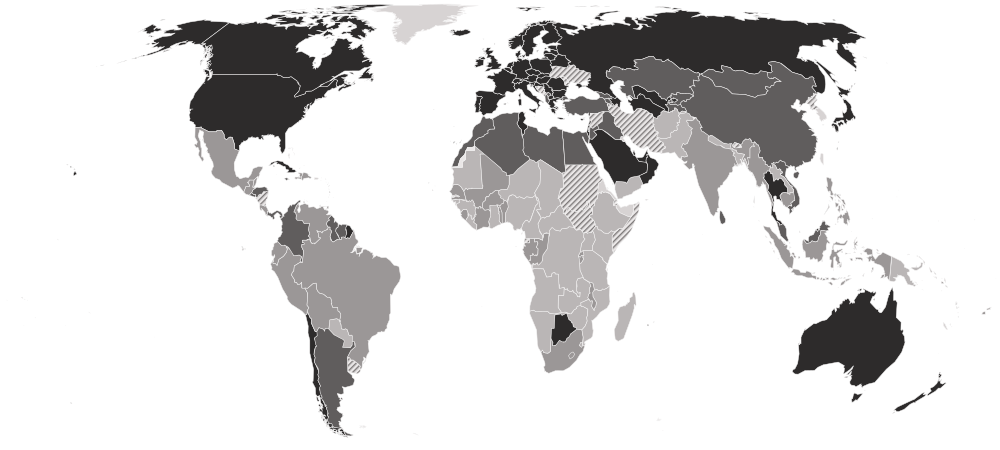
Birth registration on a map
Each country is shaded by its value, in five groups holding the same number of countries. Hover a country for its value, or select it to open its profile. Below the map, each continent’s middle country.
Darker is a higher value — the better end.
- 2.7–78.1%
- 78.2–96.4%
- 96.7–99.7%
- 99.8–100.0%
- Hatched: a reading from before 2015, listed but not compared (18)
- No reading in the 2025 edition
- Europe
100.0%
the middle country, of 40 measured · 49 members
36 share 100.0%
 Kosovo98.1%
Highest and lowest reading in Europe.
- Asia
98.9%
the middle country, of 42 measured · 52 members
9 share 100.0%
 Yemen29.4%
Highest and lowest reading in Asia.
- Americas
96.7%
the middle country, of 27 measured · 48 members
3 share 100.0%
 Paraguay71.6%
Highest and lowest reading in Americas.
- Oceania
88.0%
the middle country, of 13 measured · 21 members
3 share 100.0%
Papua New Guinea13.4%Highest and lowest reading in Oceania.
- Africa
78.1%
the middle country, of 45 measured · 55 members
Botswana100.0%Ethiopia2.7%Highest and lowest reading in Africa.
- Every region
22 sub-regions, highest middle country first
- Eastern Europe
100.0%
the middle country, of 8 measured · 10 members
8 share 100.0%
8 share 100.0%
Highest and lowest reading in Eastern Europe.
- Northern Europe
100.0%
the middle country, of 10 measured · 13 members
10 share 100.0%
10 share 100.0%
Highest and lowest reading in Northern Europe.
- Southern Europe
100.0%
the middle country, of 13 measured · 17 members
9 share 100.0%
Kosovo98.1%Highest and lowest reading in Southern Europe.
- Western Europe
100.0%
the middle country, of 9 measured · 9 members
9 share 100.0%
9 share 100.0%
Highest and lowest reading in Western Europe.
- Western Asia
99.8%
the middle country, of 16 measured · 19 members
7 share 100.0%
Yemen29.4%Highest and lowest reading in Western Asia.
- Central Asia
99.7%
the middle country, of 5 measured · 5 members
 Uzbekistan100.0%
 Tajikistan96.8%
Highest and lowest reading in Central Asia.
- Northern Africa
99.6%
the middle country, of 5 measured · 6 members
 Tunisia99.8%
 Morocco96.9%
Highest and lowest reading in Northern Africa.
- Caribbean
99.1%
the middle country, of 7 measured · 24 members
Montserrat100.0% Haiti84.8%
Highest and lowest reading in Caribbean.
- Central America
96.4%
the middle country, of 7 measured · 8 members
 El Salvador99.0%
 Mexico93.9%
Highest and lowest reading in Central America.
- South America
96.4%
the middle country, of 11 measured · 12 members
 Chile99.8%Paraguay71.6%
Highest and lowest reading in South America.
- South-eastern Asia
94.0%
the middle country, of 11 measured · 11 members
2 share 99.9%
 Timor-Leste60.4%
Highest and lowest reading in South-eastern Asia.
- Southern Africa
80.1%
the middle country, of 5 measured · 5 members
Botswana100.0% Eswatini65.7%
Highest and lowest reading in Southern Africa.
- Western Africa
74.5%
the middle country, of 15 measured · 16 members
 Côte d’Ivoire95.5%
 Nigeria39.7%
Highest and lowest reading in Western Africa.
- Southern Asia
73.2%
the middle country, of 7 measured · 9 members
 Sri Lanka98.9%
 Pakistan42.2%
Highest and lowest reading in Southern Asia.
- Eastern Africa
70.8%
the middle country, of 12 measured · 19 members
 Comoros95.1%Ethiopia2.7%
Highest and lowest reading in Eastern Africa.
- Middle Africa
53.3%
the middle country, of 8 measured · 9 members
 São Tomé and Príncipe98.6%
 Chad25.7%
Highest and lowest reading in Middle Africa.
- Australia and New Zealand
2 of 2 measured — too few for a middle: Australia, New Zealand.
2 share 100.0%
2 share 100.0%
Highest and lowest reading in Australia and New Zealand.
- Eastern Asia
3 of 8 measured — too few for a middle: China, Japan, Mongolia.
Japan100.0% China96.7%
Highest and lowest reading in Eastern Asia.
- Melanesia
4 of 5 measured — too few for a middle: Fiji, Papua New Guinea, Solomon Islands, Vanuatu.
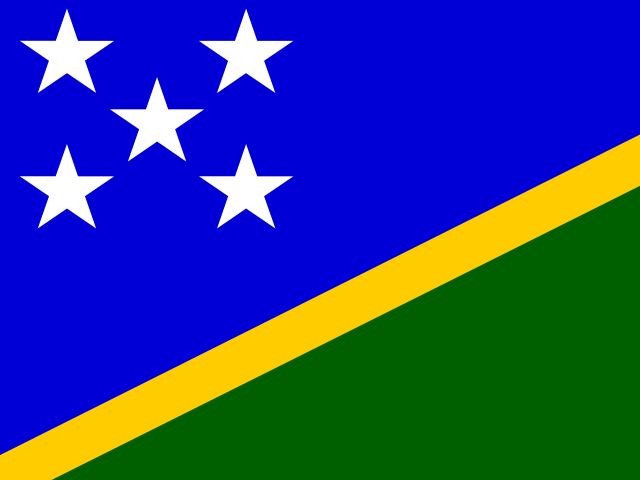 Solomon Islands88.0%Papua New Guinea13.4%
Highest and lowest reading in Melanesia.
- Micronesia
3 of 7 measured — too few for a middle: Kiribati, Marshall Islands, Nauru.
 Nauru99.1%
 Marshall Islands83.8%
Highest and lowest reading in Micronesia.
- Northern America
2 of 4 measured — too few for a middle: Canada, United States.
2 share 100.0%
2 share 100.0%
Highest and lowest reading in Northern America.
- Polynesia
4 of 7 measured — too few for a middle: Cook Islands, Samoa, Tonga, Tuvalu.
Cook Islands100.0%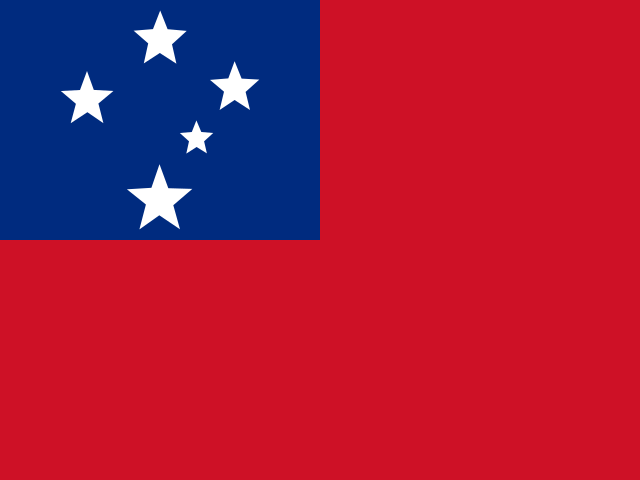 Samoa66.9%
Highest and lowest reading in Polynesia.
03The whole field at once
The spread
167 countries, one dot each, on one scale — further right is a higher value. Half the countries are above 98.4%; a quarter are above 100.0%, and a quarter below 84.3%. The bar in each row marks that continent’s middle country.
04All 185 ever measured
Every country
In order, highest value first. No rank or position is shown: too many countries share the same value for an order to mean anything. Registration is universal across the rich world, so 53 countries share 100% and no position is shown — the interesting half of this table is the bottom. Note also that being registered is not the same as holding a certificate: some children are recorded but have no document to show.
Showing 25 of 185 countries














Values for the 2025 edition.
05In this edition
Birth registration in records
The extremes of the statistic. A record reached by more than one country names none of them.
Highest reading
Reached 52 times by 52 countries — shared, so no holder is named
100.0%
Children under 5 whose birth is registered (%)
Lowest reading
2.7%
Children under 5 whose birth is registered (%)
06By sex
Inside the number
UNICEF also publishes separate female and male readings. The gap between them, where both exist.
Of the 153 countries with both readings, the girls reading is higher in 35, the boys reading in 57, and they are equal in 61. The widest gaps each way:
16 countries' readings are too old to compare and are left out; they are still listed under Every country.
07The measure
About birth registration
Birth registration is whether a child's existence is recorded by a civil authority. It is the document every other entitlement is claimed with — school, healthcare, inheritance, a passport, a vote — and a child without it is invisible to the state.
What the number is: Children under 5 whose birth is registered (%).
08Where it fits
Connections
Its part in the Country Index, the statistics whose values line up most closely with it across countries, and others on the same subject.
In the Country Index
Context, with no vote
This statistic is published in full under Governance & Institutions and Development & Human Capital, but does not help decide any Country Index standing.
Governance & InstitutionsDevelopment & Human CapitalWhich statistics vote, and why
Moves with
Where birth registration is higher, these tend to be higher too.
- Inequality-adjusted Human Development IndexUNDP Human Development Report Office · 148 countries in commonρ 0.88
- Human Development IndexKeyUNDP Human Development Report Office · 162 countries in commonρ 0.88
- Human Capital IndexWorld Bank Group · 148 countries in commonρ 0.87
Moves against
Where birth registration is higher, these tend to be lower.
- Maternal Mortality RatioKeyMMEIG · 163 countries in commonρ −0.87
- Gender Inequality IndexKeyUNDP Human Development Report Office · 152 countries in commonρ −0.87
- Under-Five Mortality RateKeyUN IGME · 166 countries in commonρ −0.86
Rank correlation (ρ, from −1 to 1) across countries, on each statistic’s newest edition, out of 122 statistics sharing at least 80 countries with this one. Two statistics that move together do not cause each other.
09Keep reading
Explore further
The data, edition by edition
The countries at either end
10Questions
Birth registration: questions and answers
Which country has the highest birth registration?
52 countries share the highest reading, 100.0%, among the 167 compared in the 2025 edition, so no single country is named.
Which country has the lowest birth registration?
Ethiopia, at 2.7%, among the 167 countries compared in the 2025 edition.
How many countries does the Completeness of Birth Registration cover?
167 in the 2025 edition, and 185 at least once across all editions.
What is the world average birth registration?
This site does not calculate a world average, which would depend on how countries are weighted. In the middle country of the 167 compared in the 2025 edition, the figure was 98.4%.
Is this UNICEF’s own ranking?
No ranking is shown. UNICEF publishes values only, and too many countries share the same value for an ordering to mean anything, so none is derived.
How often is the Completeness of Birth Registration published?
This site holds one edition, describing 2025.
Where does the data come from, and can I download it?
From UNICEF, under CC BY 3.0 IGO. Read from UNICEF's own data warehouse rather than the World Bank's copy, which rounds the same figure to zero or one decimal. Every edition is available on this site’s Datasets pages as a full table, unrounded.
11Method
Sources, method and citation
Source
Completeness of Birth Registration — UNICEF
Read from UNICEF's own data warehouse rather than the World Bank's copy, which rounds the same figure to zero or one decimal.
Newest edition
Report year 2025Data year not recorded
Cite the source as: UNICEF. UNICEF Data Warehouse. New York: UNICEF.
Licence: CC BY 3.0 IGO, checked 2026-09-10.
How this page reads the numbers
- No rank or position is shown: UNICEF publishes values only, and too many countries share the same value for an ordering to mean anything.
- Which end is better follows the publisher’s own reading of the measure.
- A country is named at an end only when it holds that value alone. Where several share it, the page says how many and names none first.
- The file gives each country’s most recent reading, so the rows are from different years. Readings from before 2015 are listed but left out of every comparison on this page.
- Values are stored exactly as published and trimmed only for display. “The middle country” is the median of the countries measured, not a world average.
The full note on this data
185 countries, each from its own most recent reading (2006–2025), from UNICEF's own SDMX warehouse (PT_CHLD_Y0T4_REG), with the figures for girls and boys stored beside the headline. Legal identity is the document every other entitlement is claimed with, and nothing else on this site measures it. ⚠ READ FROM UNICEF, NOT THE WORLD BANK. The Bank redistributes this as SP.REG.BRTH.ZS ROUNDED to zero or one decimal — 291 of its 591 values carry no decimal at all, and 40 of the 59 countries in its 2017 edition share a single value. Checked and rejected on 2026-09-10 under AGENTS.md's pre-flight; this is the producer's own route. ⚠ ONE READING PER COUNTRY, from whenever that country last surveyed, with the year on every row. ⚠ NO POSITION IS DERIVED: 53 countries sit at exactly 100%, which is 28.6% of the field.
Cite this page
Nations Inquiry (2026). Birth registration by country: Completeness of Birth Registration, data from UNICEF. https://nationsinquiry.com/statistics/birth-registration