 India
 United Kingdom
 France
 Pakistan
 Indonesia

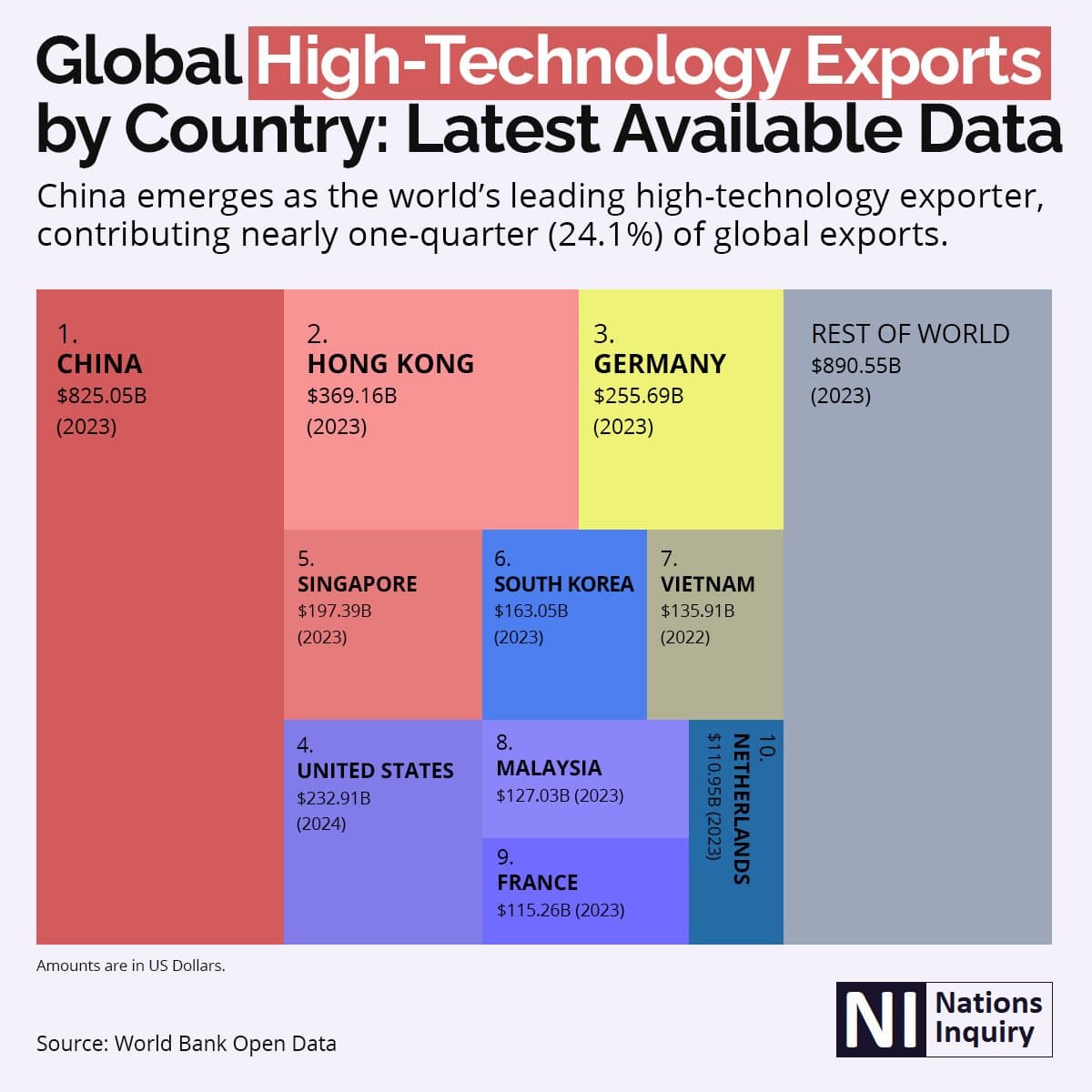
China Leads Global High-Technology Exports
The world’s ten largest high-technology exporters as a treemap, with the rest of the world beside them. Each country’s figure is its own most recent year, between 2022 and 2024.
Read the analysis
Independent rankings built from public data — every figure traceable to the body that published it.
Country Index 2026
Nations Inquiry visualizes global data and country rankings to highlight strengths, challenges, and progress to drive informed global change.
01Country Index 2026
183 countries placed on 16 topics, each topic carrying exactly one vote. Choose a continent to see its highest-placed countries. A position here is this site’s own — never a publisher’s rank.
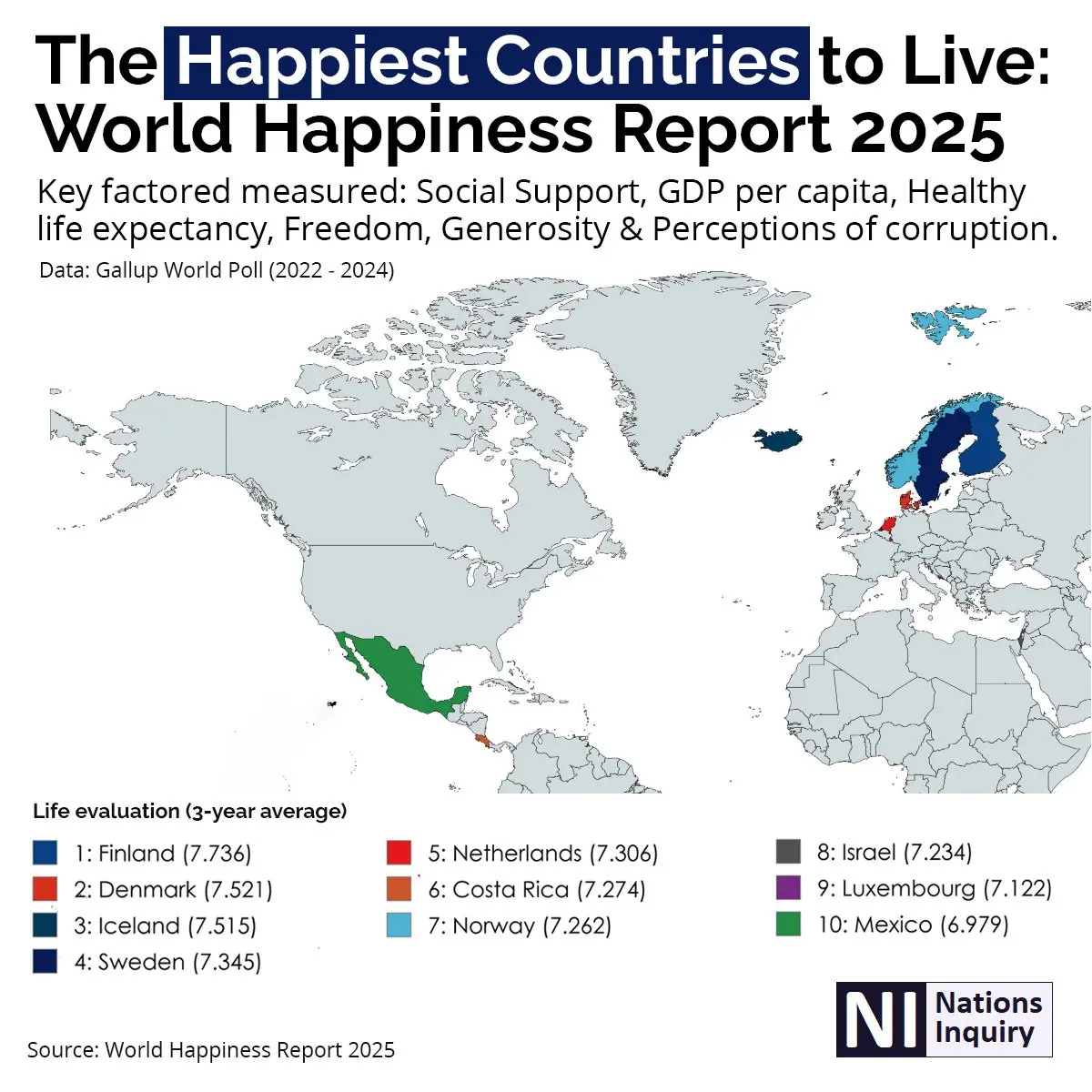
The top 10 of 183 countries placed.
1
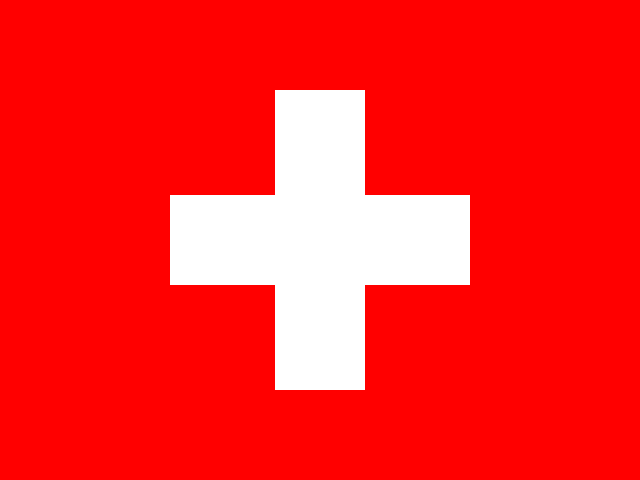
of 183 countries placed · Western Europe
Strongest: Governance & Institutions, 6th of 194
15 of 16 topics with a standing
2
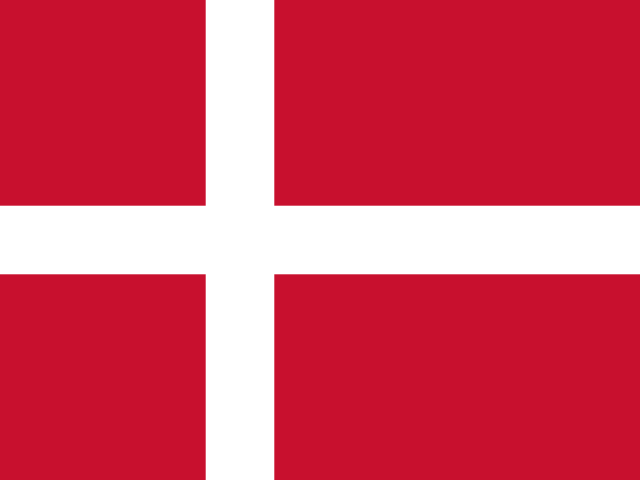
of 183 countries placed · Northern Europe
Strongest: Governance & Institutions, 1st of 194
16 of 16 topics with a standing
3
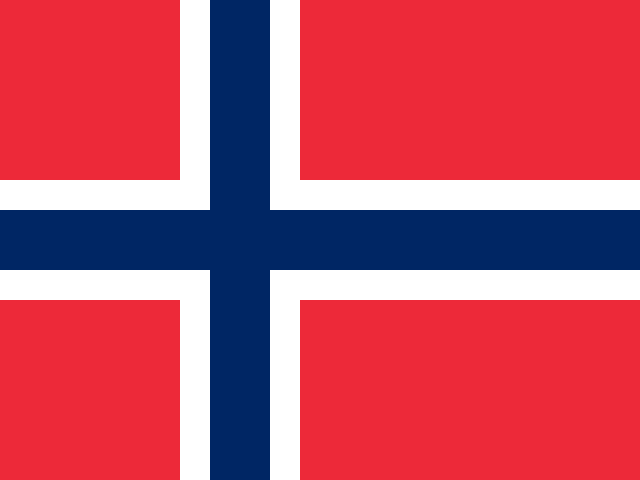
of 183 countries placed · Northern Europe
Strongest: Democracy & Civil Liberties, 1st of 198
16 of 16 topics with a standing
 FinlandStrongest: Governance & Institutions, 5th
 SwedenStrongest: Governance & Institutions, 3rd
 AustriajointStrongest: Economy & Innovation, 1st
 LuxembourgjointStrongest: Risk & Resilience, 2nd
 GermanyStrongest: Development & Human Capital, 4th
 NetherlandsStrongest: Development & Human Capital, 9th
 CzechiaStrongest: Risk & Resilience, 6th
Africa: 54 of 55 countries placed. Positions are out of all 183 countries worldwide, not a ranking within the continent.
45
of 183 countries placed · Eastern Africa
Strongest: Digital & Technology, 20th of 198
16 of 16 topics with a standing
46joint
of 183 countries placed · Eastern Africa
Strongest: Peace & Security, 4th of 177
14 of 16 topics with a standing
93
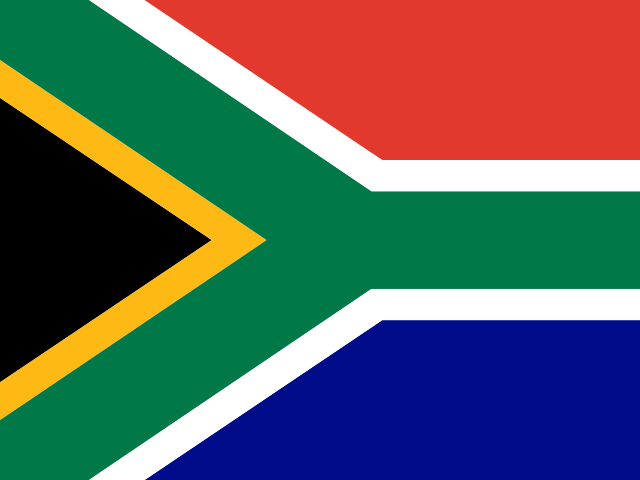
of 183 countries placed · Southern Africa
Strongest: Mobility & Trade, 39th of 177
15 of 16 topics with a standing
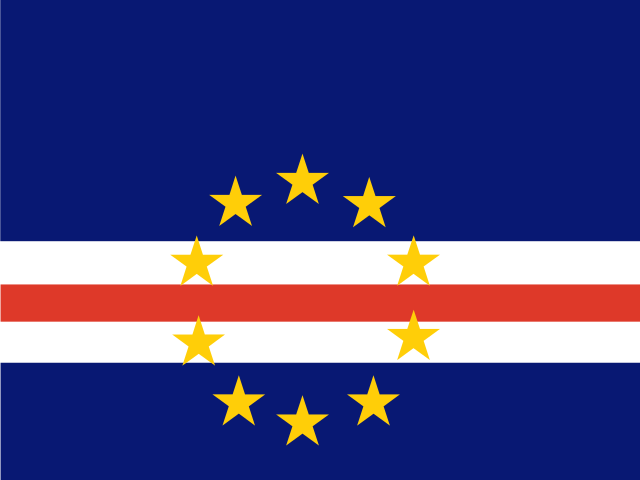 Cabo VerdeStrongest: Peace & Security, 6th
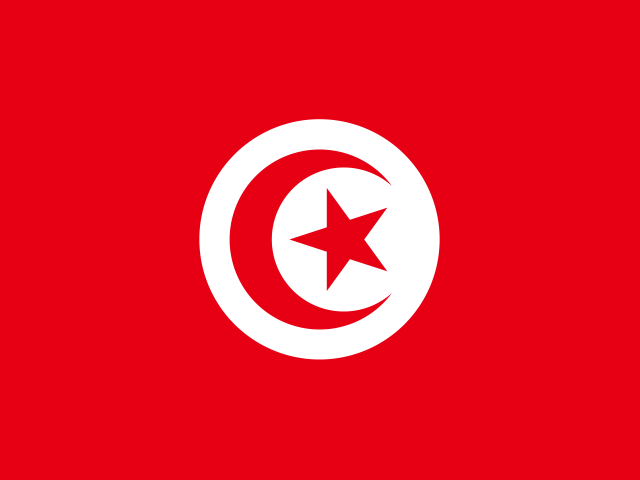 TunisiajointStrongest: Poverty & Inequality, 43rd
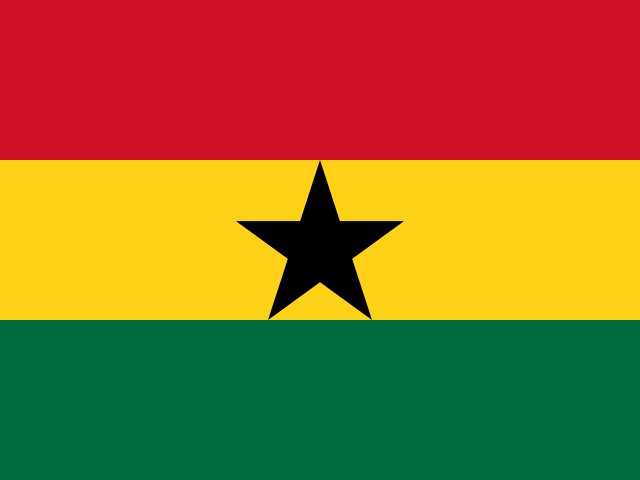 GhanajointStrongest: Environment & Sustainability, 34th
 MoroccojointStrongest: Education & Knowledge, 61st
 NamibiajointStrongest: Energy, 39th
 São Tomé and PríncipeStrongest: Environment & Sustainability, 2nd
 EgyptStrongest: Digital & Technology, 47th
Americas: 33 of 48 countries placed. Positions are out of all 183 countries worldwide, not a ranking within the continent.
24
of 183 countries placed · Northern America
Strongest: Governance & Institutions, 8th of 194
15 of 16 topics with a standing
35
of 183 countries placed · South America
Strongest: Energy, 10th of 165
16 of 16 topics with a standing
37
of 183 countries placed · Northern America
Strongest: Digital & Technology, 8th of 198
16 of 16 topics with a standing
 Costa RicaStrongest: Peace & Security, 2nd
 ChileStrongest: Governance & Institutions, 23rd
 BrazilStrongest: Digital & Technology, 4th
 ArgentinaStrongest: Peace & Security, 30th
 PeruStrongest: Education & Knowledge, 19th
 BarbadosStrongest: Peace & Security, 7th
 Saint LuciaStrongest: Risk & Resilience, 23rd
Asia: 48 of 52 countries placed. Positions are out of all 183 countries worldwide, not a ranking within the continent.
13
of 183 countries placed · Eastern Asia
Strongest: Health & Wellbeing, 5th of 200
15 of 16 topics with a standing
15
of 183 countries placed · Eastern Asia
Strongest: Health & Wellbeing, 7th of 200
15 of 16 topics with a standing
25
of 183 countries placed · South-eastern Asia
Strongest: Mobility & Trade, 1st of 177
15 of 16 topics with a standing
 CyprusStrongest: Education & Knowledge, 4th
 IsraelStrongest: Development & Human Capital, 10th
 United Arab EmiratesStrongest: Education & Knowledge, 1st
 Hong KongStrongest: Mobility & Trade, 3rd
 ChinaStrongest: Food & Agriculture, 6th
 ThailandStrongest: Mobility & Trade, 10th
 BhutanStrongest: Energy, 1st
Europe: 39 of 49 countries placed. Positions are out of all 183 countries worldwide, not a ranking within the continent.
1
of 183 countries placed · Western Europe
Strongest: Governance & Institutions, 6th of 194
15 of 16 topics with a standing
2
of 183 countries placed · Northern Europe
Strongest: Governance & Institutions, 1st of 194
16 of 16 topics with a standing
3
of 183 countries placed · Northern Europe
Strongest: Democracy & Civil Liberties, 1st of 198
16 of 16 topics with a standing
FinlandStrongest: Governance & Institutions, 5thSwedenStrongest: Governance & Institutions, 3rdAustriajointStrongest: Economy & Innovation, 1stLuxembourgjointStrongest: Risk & Resilience, 2ndGermanyStrongest: Development & Human Capital, 4thNetherlandsStrongest: Development & Human Capital, 9thCzechiaStrongest: Risk & Resilience, 6thOceania: 9 of 21 countries placed. Positions are out of all 183 countries worldwide, not a ranking within the continent.
17joint
of 183 countries placed · Australia and New Zealand
Strongest: Governance & Institutions, 7th of 194
15 of 16 topics with a standing
19joint

of 183 countries placed · Australia and New Zealand
Strongest: Governance & Institutions, 2nd of 194
15 of 16 topics with a standing
64
of 183 countries placed · Melanesia
Strongest: Peace & Security, 19th of 177
16 of 16 topics with a standing
 SamoaStrongest: Environment & Sustainability, 25th
 TongajointStrongest: Poverty & Inequality, 15th
 VanuatujointStrongest: Environment & Sustainability, 18th
 KiribatiStrongest: Poverty & Inequality, 12th
 Solomon IslandsStrongest: Environment & Sustainability, 7th
 Papua New GuineaStrongest: Environment & Sustainability, 14th
02Every placed country
Darker is placed higher. Hover a country for its position, or select it to open its profile. Below the map, each continent and its sub-regions.
55 countries · 54 placed
HighestMauritius45th
48 countries · 33 placed
HighestCanada24th
52 countries · 48 placed
HighestSouth Korea13th
49 countries · 39 placed
HighestSwitzerland1st
21 countries · 9 placed
HighestAustralia17th, joint
03The subjects
A standing is never one number with a mystery inside it. These are the topics it is built from — each with the statistics that decide it, and the country currently placed first.
4 keys · 194 countries placed
FirstDenmark
4 keys · 176 countries placed
FirstAustria
4 keys · 182 countries placed
First Iceland
4 keys · 198 countries placed
FirstUnited Arab Emirates
4 keys · 200 countries placed
First San Marino
3 keys · 196 countries placed
First Cook Islands
4 keys · 186 countries placed
First Angola
4 keys · 183 countries placed
First Latvia
4 keys · 198 countries placed
FirstNorway
4 keys · 177 countries placed
FirstIceland
4 keys · 193 countries placed
First Liechtenstein
4 keys · 177 countries placed
FirstSingapore
4 keys · 184 countries placed
First Serbia
3 keys · 159 countries placed
First Belarus
0 keys
Published as a dashboard — too few keys to rank
3 keys · 165 countries placed
FirstBhutan
4 keys · 198 countries placed
First, joint Estonia
0 keys
Published as a dashboard — too few keys to rank
04The world in records
One country at the extreme of each statistic, read from its newest edition. Where countries tie at the top, no record is named.
Longest life expectancy at birth
86.37
years
Lowest child mortality
1.26
deaths before age five per 1,000 births
Largest share of land under forest
94.45
% of land area
Largest population
1,438,069,596
people
Best connected by container shipping
1,319
on UNCTAD’s connectivity index
Highest human development
0.972
on the 0–1 index
05Latest editions
The biggest moves between each report’s two newest editions, in the publisher’s own ranks. A report whose field of countries changed by more than 5% is left out, because its ranks would no longer be comparable.
Ranks as published by Transparency International in the Corruption Perceptions Index: the 2024 edition (180 countries ranked) → the 2025 edition (182 ranked).
 Azerbaijan154 → 130+24
 Sri Lanka121 → 107+14
 El Salvador130 → 120+10
Ranks as published by UNDP Human Development Report Office in the Human Development Index: reference years 2022 (192 countries ranked) → 2023 (193 ranked), both from its 2025 report.
United Arab Emirates23 → 15+8 Guyana95 → 89+6
 Andorra37 → 32+5
Ranks as published by World Intellectual Property Organization in the Global Innovation Index: the 2024 edition (133 countries ranked) → the 2025 edition (139 ranked).
 Bosnia and Herzegovina80 → 92−12
 Mongolia67 → 78−11
 Bolivia100 → 111−11
Ranks as published by Oxford Insights in the Government AI Readiness Index: the 2024 edition (188 countries ranked) → the 2025 edition (195 ranked).
 Tanzania139 → 93+46
 Côte d’Ivoire140 → 95+45
 Nepal150 → 106+44
 Saint Kitts and Nevis102 → 170−68
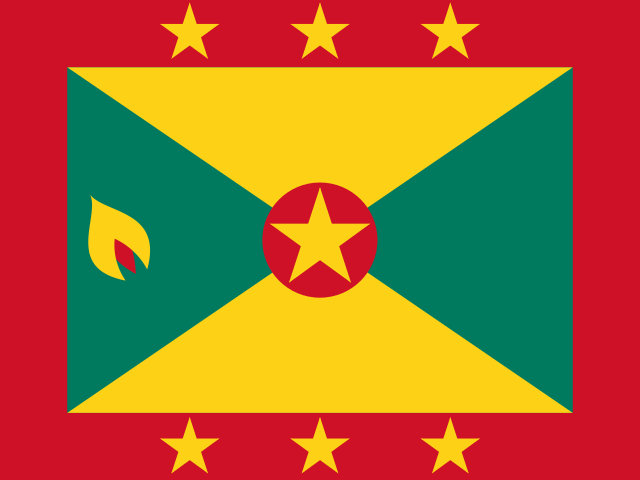 Grenada121 → 176−55
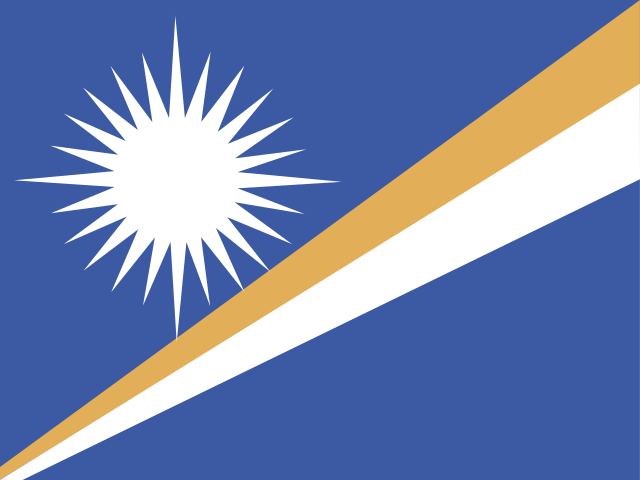 Marshall Islands123 → 177−54
06Analysis
What the numbers add up to, in prose: each piece answers one question from the statistics on this site, names every source it uses, and is dated the day its figures were read.
People & Population
The middle country’s fertility rate fell from 5.8740 children per woman in 1950 to 1.9617 in 2023, and 120 of 222 countries now read below 2.1.
Democracy & Civil Liberties
Academic freedom fell in 93 of 176 countries in 2025 and rose in 57. The middle country read 0.619, its lowest since 1990. Czechia is highest, at 0.978.
Poverty & Inequality
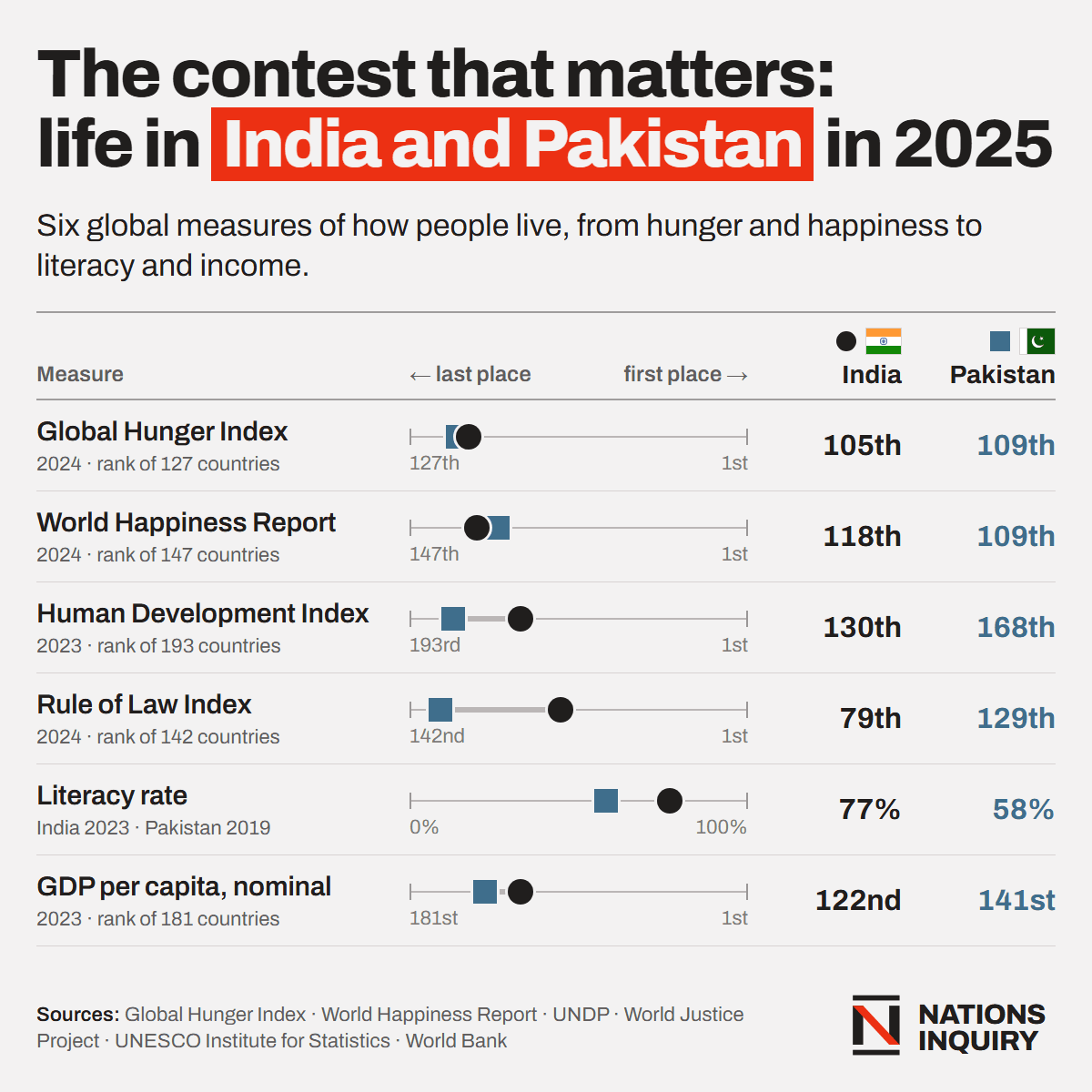
India reads lowest in the 2023 Gini file, at 23.00, on a consumption survey; the next two are income-based. Why survey type, year and coverage matter.
08Fresh from the source
Newest first. The date is the day the numbers were read from the publisher — a re-import moves a statistic up this list even when its figures did not change.
| Imported | Statistic | Edition | |||
|---|---|---|---|---|---|
| Prevalence of Severe Food Insecurity | Food and Agriculture Organization of the United Nations (FAO) | 2024 | 125 | Health & Wellbeing | |
| Adult Mortality (Probability of Dying Between 15 and 60) | UN DESA Population Division | 2023 | 222 | Health & Wellbeing | |
| Adults Who Have Been Too Anxious or Depressed to Carry On | Wellcome Trust | 2020 | 112 | Health & Wellbeing | |
| Agricultural Emissions Intensity | Food and Agriculture Organization of the United Nations (FAO) | 2023 | 190 | Environment & Sustainability | |
| Annual Forest Area Change Rate | Food and Agriculture Organization of the United Nations (FAO) | 2025 | 193 | Environment & Sustainability | |
| Bachelor's or Higher Attainment | UNESCO Institute for Statistics (UIS) | 2023 | 90 | Education & Knowledge |
09Method
What a position means, where the numbers come from, and the questions readers ask most.
61 key statistics from 25 publishers, each stored exactly as it was released.
A country’s reading on each statistic becomes its place among the countries that statistic covers — between 120 and 222 of them — so being measured in a smaller field is no advantage.
The statistics are grouped into 16 topics, and each topic has exactly one vote. The 183 countries with standings on at least 12 topics are given a position.
Bonn International Centre for Conflict Studies (BICC) · CIVICUS · Electoral Integrity Project (EIP) · Ember · European Commission Joint Research Centre, with the Inter-Agency Standing Committee · Food and Agriculture Organization of the United Nations (FAO) · Global Carbon Project · Global Footprint Network · Growth Lab at Harvard University · Institute for International Law of Peace and Armed Conflict (IFHV), Ruhr University Bochum · International Labour Organization (ILO) · Notre Dame Global Adaptation Initiative (ND-GAIN), University of Notre Dame · OECD · Oxford Insights · Transparency International · UN DESA Population Division · UN Inter-agency Group for Child Mortality Estimation (UN IGME) · UN Maternal Mortality Estimation Inter-Agency Group (MMEIG) · UN Trade and Development (UNCTAD) · UNDP Human Development Report Office · UNESCO Institute for Statistics (UIS) · UNICEF, WHO and World Bank Group (Joint Malnutrition Estimates) · V-Dem Institute, University of Gothenburg · World Bank Group · World Energy Council
The Country Index is Nations Inquiry’s own. It is built from 61 key statistics published by 25 organisations — United Nations agencies, the World Bank and independent research institutes — but none of them produced this ranking or endorses it. Where a publisher prints its own rank for a statistic, that rank is shown separately and credited to the publisher.
How the Country Index is builtA country needs a standing on at least 12 of the 16 topics to be given a position, so that no position rests on a handful of readings. 41 countries have some data but fall short of that. They are listed on the full ranking with how many topics they reach, rather than being placed on a guess, and each still has a profile with every statistic we hold for it.
See the full Country Index 2026From the organisations that publish them. Each statistic is read from its publisher’s own release and stored exactly as published — nothing is rounded on the way in. The 2026 edition uses, for each source, the edition describing 2013–2025. Every table on the site can be traced to its publisher’s release, with the edition, the licence and the date it was imported.
Browse every statisticBecause a score would claim more than the method knows. The Index combines very different measures, and any single number built from them would read like a measurement nobody actually took. A position with its field — “12th of 183” — states exactly what is known: where a country stands relative to the others.
The Country Index is published once a year and named for the year of publication; an edition is kept unchanged once a newer one replaces it. The statistics underneath are updated whenever their publishers release a new edition, and the date each edition was imported is shown with its data.
Yes. The Country Index 2026 is published under CC BY-SA 4.0. Some key inputs are ShareAlike, so this derived ranking carries the same licence. Each underlying statistic keeps its publisher’s own licence, which is shown with its data.
CC BY-SA 4.0One email when a new index edition, dataset or analysis goes up. No more than that.