
Photo: chensiyuan · CC BY-SA 4.0 · via Wikimedia Commons, shown in greyscale
Topic 01 of 18 · Country Index 2026

Austria: Governance & Institutions
How well is the state actually run?
Austria is placed 15th of 194 countries on governance & institutions in the Country Index 2026, from 4 of its 4 key statistics. Readings behind it: Government Effectiveness 1.544 (2025); Statistical Performance Indicators 89.35 (2024).
Share
Governance & Institutions
15th
of 194 countries placed
Placed from 4 of 4 key statistics
- 1.544Government Effectiveness, 2025Governance estimate (−2.5 weak to 2.5 strong)
- 89.35Statistical Performance Indicators, 2024SPI overall score (0–100)
- 69Corruption Perceptions Index, 2025CPI score (0–100, where 100 is very clean)
- 0.916Judicial Constraints on the Executive Index, 2025Judicial constraints on the executive index (0–1)
01The evidence
The 4 key statistics that decide it
Only these place Austria on governance & institutions — one vote each. Every value is the publisher’s own, read at the edition the Country Index 2026 used; the grey ticks are every other country it was compared with, lowest on the left.
1.544
Governance estimate (−2.5 weak to 2.5 strong)
Higher is better
Austria: 1.544. Across the 209 countries in this edition, values run from -2.251 (South Sudan) to 2.092 (Singapore); the world median is 0.101.
- World median
- 0.101
- Best in Western Europe
- 1.977 Luxembourg
- Land neighbours
- Switzerland 1.969 · Czechia 1.241 · Germany 1.49 · Hungary 0.47 · Italy 0.925 · Liechtenstein 1.635 · Slovakia 0.582 · Slovenia 1.104
Key 2 of 4
Statistical Performance Indicators
World Bank Group
2024 edition · data for 2024 · CC BY 4.0
89.35
SPI overall score (0–100)
Higher is better
Austria: 89.35. Across the 188 countries in this edition, values run from 27.12 (South Sudan) to 94.14 (Norway); the world median is 69.3.
- World median
- 69.3
- Best in Western Europe
- 90.06 Germany
- Land neighbours
- Switzerland 88.71 · Czechia 87.01 · Germany 90.06 · Hungary 87.87 · Italy 90.93 · Slovakia 83.25 · Slovenia 91.09
Key 3 of 4
Corruption Perceptions Index
Transparency International
2025 edition · data for 2025 · CC BY 4.0 (the data), CC BY-ND 4.0 (the website and report)
69
CPI score (0–100, where 100 is very clean)
Higher is better
Ranked 21st of 181 by Transparency International
Austria: 69. Across the 182 countries in this edition, values run from 9 (Somalia) to 89 (Denmark); the world median is 39.
- World median
- 39
- Best in Western Europe
- 80 Switzerland
- Land neighbours
- Switzerland 80 · Czechia 59 · Germany 77 · Hungary 40 · Italy 53 · Slovakia 48 · Slovenia 58
Key 4 of 4
Judicial Constraints on the Executive Index
V-Dem Institute, University of Gothenburg
2025 edition · data for 2025 · CC BY-SA 4.0
0.916
Judicial constraints on the executive index (0–1)
Higher is better
Austria: 0.916. Across the 176 countries in this edition, values run from 0.003 (Nicaragua) to 0.988 (Australia); the world median is 0.676.
- World median
- 0.676
- Best in Western Europe
- 0.982 Switzerland
- Land neighbours
- Switzerland 0.982 · Czechia 0.962 · Germany 0.934 · Hungary 0.678 · Italy 0.773 · Slovakia 0.811 · Slovenia 0.763
02Over time
Which way Austria is moving
Each key’s published value, edition by edition, beside the world median. The Country Index 2026 is the first edition of the standing, so the standing itself has no history to chart yet.
Government Effectiveness
Governance estimate (−2.5 weak to 2.5 strong) · higher is better
AustriaWorld median
Austria fell from 1.985 in 2000 to 1.544 in 2025; the world median went from -0.397 to 0.101.
Every year’s figures
Year Austria World median 2025 1.544 0.1006 2024 1.504 0.0098 2023 1.612 -0.0408 2022 1.643 -0.0305 2021 1.694 -0.0158 2020 1.743 -0.0171 2019 1.728 0.0150 2018 1.592 0.0159 2017 1.630 0.0158 2016 1.646 0.0225 2015 1.600 0.0038 2014 1.679 0.0194 2013 1.551 -0.0758 2012 1.531 -0.0839 2011 1.550 -0.1221 2010 1.668 -0.1145 2009 1.625 -0.1609 2008 1.713 -0.2134 2007 1.721 -0.3260 2006 1.723 -0.3310 2005 1.900 -0.3706 2004 1.825 -0.3140 2003 1.880 -0.4369 2002 1.970 -0.3366 2000 1.985 -0.3969 Statistical Performance Indicators
SPI overall score (0–100) · higher is better
AustriaWorld median
Austria rose from 86.32 in 2016 to 89.35 in 2024; the world median went from 56.25 to 69.3.
Every year’s figures
Year Austria World median 2024 89.3 69.30 2023 92.6 68.86 2022 90.1 67.99 2021 91.0 69.96 2020 88.5 62.91 2019 86.8 61.19 2018 87.8 61.17 2017 86.2 59.55 2016 86.3 56.25 Corruption Perceptions Index
CPI score (0–100, where 100 is very clean) · higher is better
AustriaWorld median
Austria was at 69 in both 2012 and 2025; the world median went from 37 to 39.
Every year’s figures
Year Austria World median 2025 69 39.0 2024 67 40.0 2023 71 40.0 2022 71 39.5 2021 74 39.0 2020 76 40.0 2019 77 39.5 2018 76 38.0 2017 75 38.5 2016 75 38.0 2015 76 37.0 2014 72 38.0 2013 69 38.0 2012 69 37.0 Judicial Constraints on the Executive Index
Judicial constraints on the executive index (0–1) · higher is better
AustriaWorld median
Austria rose from 0.914 in 2000 to 0.916 in 2025; the world median went from 0.647 to 0.676.
Every year’s figures
Year Austria World median 2025 0.916 0.6760 2024 0.938 0.6645 2023 0.938 0.6590 2022 0.925 0.6600 2021 0.925 0.6580 2020 0.900 0.6645 2019 0.925 0.6560 2018 0.891 0.6485 2017 0.906 0.6550 2016 0.906 0.6520 2015 0.906 0.6700 2014 0.906 0.6515 2013 0.906 0.6550 2012 0.922 0.6750 2011 0.922 0.6680 2010 0.922 0.6640 2009 0.922 0.6580 2008 0.922 0.6590 2007 0.922 0.6630 2006 0.914 0.6590 2005 0.914 0.6580 2004 0.914 0.6480 2003 0.914 0.6480 2002 0.914 0.6470 2001 0.914 0.6530 2000 0.914 0.6465
03In context
Austria beside its neighbours
A position reads best beside the countries around it. Every position below is a place among all 194 countries on governance & institutions, never a place within the region.
Austria and the countries it borders
Standing among all 194; the key columns are the publishers’ own values.
| Country | Standing | Government EffectivenessGovernance estimate (−2.5 weak to 2.5 strong) | Statistical Performance IndicatorsSPI overall score (0–100) | Corruption Perceptions IndexCPI score (0–100, where 100 is very clean) | Judicial Constraints on the Executive IndexJudicial constraints on the executive index (0–1) |
|---|---|---|---|---|---|
 Switzerland | 6th | 1.969 | 88.71 | 80 | 0.982 |
 Germany | =13th | 1.49 | 90.06 | 77 | 0.934 |
| Austria | 15th | 1.544 | 89.35 | 69 | 0.916 |
 Czechia | 22nd | 1.241 | 87.01 | 59 | 0.962 |
 Slovenia | 33rd | 1.104 | 91.09 | 58 | 0.763 |
 Italy | 34th | 0.925 | 90.93 | 53 | 0.773 |
 Slovakia | 44th | 0.582 | 83.25 | 48 | 0.811 |
 Hungary | 52nd | 0.47 | 87.87 | 40 | 0.678 |
 Liechtenstein | not placed | 1.635 | — | — | — |
“—”: no published reading in that edition. What a standing is
Across Western Europe
Every country in the sub-region, by its place among all 194.




Placed either side on governance & institutions
The countries immediately above and below Austria in the topic’s list.


04Context, no vote
Where Austria is ahead of the world, and behind
38 more statistics filed under governance & institutions, published in full and deliberately given no vote in the standing. Select a row for the publisher, the rank and the links.
Ahead of the world median32
Statistics on which Austria does better than the middle country measured.
State Capacity IndexJonathan K. Hanson (University of Michigan) and Rachel Sigman (Naval Postgraduate School) · 2015 · world median 0.4872.4790.487▲ Improved since 2005
Austria: 2.479 · world median 0.487 · Latent estimate of state capacity (≈ −2.3 to +3.0, centred near 0); higher = a more capable state. Jonathan K. Hanson (University of Michigan) and Rachel Sigman (Naval Postgraduate School), 2015 edition, data for 2015.
Published values in that edition run from -2.096 to 2.697; higher is better.
Position 3rd of 166 · derived.
Global Indicators of Regulatory Governance ScoreWorld Bank Group · 2018 · world median 2.2552.25No earlier reading
Austria: 5 · world median 2.25 · Regulatory governance score (0–5, where 5 is the most transparent rule-making). World Bank Group, 2018 edition, data for 2018.
Published values in that edition run from 0 to 5; higher is better.
Rule of LawWorld Bank Group · 2025 · world median -0.1021.651-0.102No real change since 2015
Austria: 1.651 · world median -0.102 · Rule of Law estimate (−2.5 to 2.5). World Bank Group, 2025 edition, data for 2025.
Published values in that edition run from -2.199 to 2.012; higher is better.
Position 10th of 211 · derived.
Social Protection CoverageILO · 2025 · world median 52.110052.1No earlier reading
Austria: 100 · world median 52.1 · Population covered by at least one social protection benefit (%). International Labour Organization (ILO), 2025 edition, data for 2025.
Published values in that edition run from 0 to 100; higher is better.
Climate Readiness (ND-GAIN)Notre Dame Global Adaptation Initiative (ND-GAIN), University of Notre Dame · 2024 · world median 0.3870.6790.387▲ Improved since 2014
Austria: 0.679 · world median 0.387 · ND-GAIN Readiness (0–1, where 1 is the most ready). Notre Dame Global Adaptation Initiative (ND-GAIN), University of Notre Dame, 2024 edition, data for 2024.
Published values in that edition run from 0.137 to 0.749; higher is better.
Ranked 10th of 192 by Notre Dame Global Adaptation Initiative (ND-GAIN), University of Notre Dame.
Voice and AccountabilityWorld Bank Group · 2025 · world median -0.0221.42-0.022No real change since 2015
Austria: 1.42 · world median -0.022 · Voice and Accountability estimate (−2.5 to 2.5). World Bank Group, 2025 edition, data for 2025.
Published values in that edition run from -2.348 to 1.825; higher is better.
Position 14th of 206 · derived.
Equal Protection IndexV-Dem Institute, University of Gothenburg · 2025 · world median 0.6510.9230.651No real change since 2015
Austria: 0.923 · world median 0.651 · Equal protection index (0–1); higher = rights and freedoms protected more equally across social groups and classes. V-Dem Institute, University of Gothenburg, 2025 edition, data for 2025.
Published values in that edition run from 0.027 to 0.986; higher is better.
Position 13th of 176 · derived.
GovTech Maturity IndexWorld Bank Group · 2025 · world median 0.630.9290.63▼ Worsened since 2022
Austria: 0.929 · world median 0.63 · GTMI score (0–1). World Bank Group, 2025 edition, data for 2025.
Published values in that edition run from 0.01 to 0.997; higher is better.
Position 16th of 196 · derived.
Child and Family Benefit CoverageILO · 2024 · world median 23.7510023.75No earlier reading
Austria: 100 · world median 23.75 · Children or households with children receiving child or family cash benefits (%). International Labour Organization (ILO), 2024 edition, data for 2024.
Published values in that edition run from 0 to 100; higher is better.
State Fiscal Source of RevenueV-Dem Institute, University of Gothenburg · 2025 · world median 1.1792.6671.179No real change since 2015
Austria: 2.667 · world median 1.179 · Original latent estimate (≈ −2.9 to +3.1); higher = broader taxation. V-Dem Institute, University of Gothenburg, 2025 edition, data for 2025.
Published values in that edition run from -1.716 to 3.135; higher is better.
Position 16th of 176 · derived.
V-Dem Electoral Democracy IndexV-Dem Institute, University of Gothenburg · 2025 · world median 0.4970.8390.497No real change since 2015
Austria: 0.839 · world median 0.497 · Electoral democracy index (0–1). V-Dem Institute, University of Gothenburg, 2025 edition, data for 2025.
Published values in that edition run from 0.016 to 0.913; higher is better.
Position 17th of 176 · derived.
Government AI Readiness IndexOxford Insights · 2025 · world median 40.1969.7240.19▲ Improved since 2020
Austria: 69.72 · world median 40.19 · AI readiness score (0–100). Oxford Insights, 2025 edition, data for 2025.
Published values in that edition run from 12.12 to 88.36; higher is better.
Ranked 20th of 195 by Oxford Insights.
Liberal Democracy IndexV-Dem Institute, University of Gothenburg · 2025 · world median 0.3530.7570.353No real change since 2015
Austria: 0.757 · world median 0.353 · Liberal democracy index (0–1). V-Dem Institute, University of Gothenburg, 2025 edition, data for 2025.
Published values in that edition run from 0.009 to 0.884; higher is better.
Position 19th of 176 · derived.
Control of CorruptionWorld Bank Group · 2025 · world median -0.1971.302-0.197No real change since 2015
Austria: 1.302 · world median -0.197 · Control of Corruption (−2.5 to 2.5). World Bank Group, 2025 edition, data for 2025.
Published values in that edition run from -2.096 to 2.259; higher is better.
Position 24th of 211 · derived.
Women, Business and the LawWorld Bank Group · 2025 · world median 81.2596.8881.25No real change since 2015
Austria: 96.88 · world median 81.25 · WBL Index (0–100, where 100 is full legal parity). World Bank Group, 2026 edition, data for 2025.
Published values in that edition run from 3.125 to 100; higher is better.
Position 22nd of 190 · derived.
Rigorous and Impartial Public AdministrationV-Dem Institute, University of Gothenburg · 2025 · world median 0.3332.1530.333▼ Worsened since 2015
Austria: 2.153 · world median 0.333 · Original latent estimate (≈ −3.6 to +4.0); higher = a more rigorous and impartial administration. V-Dem Institute, University of Gothenburg, 2025 edition, data for 2025.
Published values in that edition run from -3.552 to 3.99; higher is better.
Position 24th of 176 · derived.
Government Funding per Primary StudentUIS · 2022 · world median 17.8123.1917.81▲ Improved since 2012
Austria: 23.19 · world median 17.81 · Government funding per primary student (% of GDP per capita). UNESCO Institute for Statistics (UIS), 2022 edition, data for 2022.
Published values in that edition run from 3.771 to 34.57; higher is better.
Position 10th of 68 · derived.
Regulatory QualityWorld Bank Group · 2025 · world median -0.0931.067-0.093▼ Worsened since 2015
Austria: 1.067 · world median -0.093 · Regulatory Quality (−2.5 to 2.5). World Bank Group, 2025 edition, data for 2025.
Published values in that edition run from -2.106 to 2.113; higher is better.
Position 29th of 209 · derived.
Completeness of Birth RegistrationUNICEF · 2025 · world median 98.410098.4No earlier reading
Austria: 100 · world median 98.4 · Children under 5 whose birth is registered (%). UNICEF, 2025 edition, data for 2025.
Published values in that edition run from 2.7 to 100; higher is better.
State Authority over TerritoryV-Dem Institute, University of Gothenburg · 2025 · world median 95.399.8695.3▼ Worsened since 2015
Austria: 99.86 · world median 95.3 · Territory under effective state control (% of official territory). V-Dem Institute, University of Gothenburg, 2025 edition, data for 2025.
Published values in that edition run from 47.56 to 100; higher is better.
Disability Benefit CoverageILO · 2025 · world median 43.910043.9No earlier reading
Austria: 100 · world median 43.9 · People with severe disabilities receiving disability benefits (%). International Labour Organization (ILO), 2025 edition, data for 2025.
Published values in that edition run from 0 to 100; higher is better.
Old-Age Pension CoverageILO · 2025 · world median 80.810080.8No earlier reading
Austria: 100 · world median 80.8 · People above statutory pensionable age receiving an old-age pension (%). International Labour Organization (ILO), 2025 edition, data for 2025.
Published values in that edition run from 0 to 100; higher is better.
Neopatrimonial Rule IndexV-Dem Institute, University of Gothenburg · 2025 · world median 0.4450.0930.445▼ Worsened since 2015
Austria: 0.093 · world median 0.445 · Neopatrimonial rule index (0–1; higher = more personalised rule). V-Dem Institute, University of Gothenburg, 2025 edition, data for 2025.
Published values in that edition run from 0.008 to 0.989; lower is better.
Position 149th of 176 · derived, 1st = worst.
Political Corruption IndexV-Dem Institute, University of Gothenburg · 2025 · world median 0.5180.0950.518▼ Worsened since 2015
Austria: 0.095 · world median 0.518 · Political corruption index (0–1; higher = more corrupt). V-Dem Institute, University of Gothenburg, 2025 edition, data for 2025.
Published values in that edition run from 0.004 to 0.968; lower is better.
Position 148th of 176 · derived, 1st = worst.
Firms Expecting to Make Informal Payments to Public OfficialsWorld Bank Group · 2026 · world median 6.4031.1856.403No earlier reading
Austria: 1.185 · world median 6.403 · Firms saying firms like theirs pay officials informally to get things done (%). World Bank Group, 2026 edition, data for 2026.
Published values in that edition run from 0 to 55.03; lower is better.
Position 152nd of 178 · derived, 1st = worst.
Civic Space RatingsCIVICUS · 2025 · world median 50.4682.8350.46No earlier reading
Austria: 82.83 · world median 50.46 · Civic space score (0–100). CIVICUS, 2025 edition, data for 2025.
Published values in that edition run from 2.17 to 100; higher is better.
Position 33rd of 198 · derived.
Meritocratic Appointment in the State AdministrationV-Dem Institute, University of Gothenburg · 2025 · world median 0.3091.3020.309▲ Improved since 2015
Austria: 1.302 · world median 0.309 · Original latent estimate (≈ −2.9 to +3.6); higher = more appointments on merit. V-Dem Institute, University of Gothenburg, 2025 edition, data for 2025.
Published values in that edition run from -2.442 to 3.584; higher is better.
Position 40th of 176 · derived.
Agriculture Orientation IndexFAO · 2024 · world median 0.3050.630.305No real change since 2014
Austria: 0.63 · world median 0.305 · Agriculture orientation index (1.0 = spending matches sector size). Food and Agriculture Organization of the United Nations (FAO), 2024 edition, data for 2024.
Published values in that edition run from 0.03 to 5.38; higher is better.
Position 31st of 132 · derived.
Bribery IncidenceWorld Bank Group · 2026 · world median 7.2692.4667.269No earlier reading
Austria: 2.466 · world median 7.269 · Firms asked for a bribe at least once in six dealings with officials (%). World Bank Group, 2026 edition, data for 2026.
Published values in that edition run from 0 to 64.26; lower is better.
Position 137th of 175 · derived, 1st = worst.
Trade Union DensityILO · 2020 · world median 16.6826.2416.68No earlier reading
Austria: 26.24 · world median 16.68 · Employees who are trade union members (%). International Labour Organization (ILO), 2020 edition, data for 2020.
Published values in that edition run from 0.2 to 91.42; higher is better.
Position 35th of 139 · derived.
Open Data InventoryOpen Data Watch · 2024 · world median 597259▼ Worsened since 2016
Austria: 72 · world median 59 · ODIN overall score (0–100). Open Data Watch, 2024 edition, data for 2024.
Published values in that edition run from 19 to 90; higher is better.
Ranked 42nd of 168 by Open Data Watch.
Labour Inspectors per 10,000 Employed PersonsILO · 2024 · world median 0.5750.730.575No earlier reading
Austria: 0.73 · world median 0.575 · Labour inspectors per 10,000 employed persons. International Labour Organization (ILO), 2024 edition, data for 2024.
Published values in that edition run from 0.07 to 3.89; higher is better.
Behind the world median1
Statistics on which Austria does worse than the middle country measured.
Foundational ID OwnershipWorld Bank Group (ID4D) · 2024 · world median 94.458.3294.4No earlier reading
Austria: 58.32 · world median 94.4 · Adults who own a foundational ID (% of population aged 15+). World Bank Group (ID4D), 2024 edition, data for 2024.
Published values in that edition run from 42.62 to 100; higher is better.
No better end5
These describe the shape of a country — more is not better or worse, only different — so they are never ahead or behind.
Central Bank Independence IndexAna Carolina Garriga, University of Essex · 2023 · world median 0.6080.7960.608No real change since 2013
Austria: 0.796 · world median 0.608 · CBI index (0–1, where 1 is the most statutory independence). Ana Carolina Garriga, University of Essex, 2023 edition, data for 2023.
Published values in that edition run from 0.006 to 0.974.
General Government ConsumptionWorld Bank Group · 2025 · world median 16.2121.9116.21Moved since 2015
Austria: 21.91 · world median 16.21 · General government final consumption expenditure (% of GDP). World Bank Group, 2025 edition, data for 2025.
Published values in that edition run from 5.445 to 38.94.
Position 23rd of 132 · derived, counted from the highest value.
Public Sector EmploymentWorld Bank Group · 2022 · world median 15.0125.6215.01No earlier reading
Austria: 25.62 · world median 15.01 · Public sector employment (% of total employment). World Bank Group, 2022 edition, data for 2022.
Published values in that edition run from 1.672 to 47.1.
Position 29th of 135 · derived, counted from the highest value.
Public Sector Wage BillWorld Bank Group · 2022 · world median 7.97510.577.975Moved since 2012
Austria: 10.57 · world median 7.975 · Public sector wage bill (% of GDP). World Bank Group, 2022 edition, data for 2022.
Published values in that edition run from 0.977 to 42.65.
Position 49th of 168 · derived, counted from the highest value.
Senior Management Time Spent on Government RegulationWorld Bank Group · 2026 · world median 6.7958.0996.795No earlier reading
Austria: 8.099 · world median 6.795 · Senior management time spent dealing with government regulation (% of a typical week). World Bank Group, 2026 edition, data for 2026.
Published values in that edition run from 0.025 to 31.33.
No current reading for Austria
Business Ready: Operational Efficiency, Business Ready: Public Services, Business Ready: Regulatory Framework, Country Policy and Institutional Assessment, Debt Service on External Debt, External Debt Stocks (% of GNI) and Government Spending on Education (last 2022). Listed rather than hidden, so the page can be checked against it.
“Position · derived” is this site’s ordering of the published values, 1st = best unless the row says otherwise; the publisher ranks no country on it. Rank, position and standing
05Country Index 2026
Governance & Institutions among Austria’s 16 topics
Governance & Institutions is Austria’s 8th best-placed topic of 16. Strongest first, each marker at its share of that topic’s field.
- Economy & Innovation1st of 1764/4 keys
- Food & Agriculture2nd of 1844/4 keys
- Energy7th of 1653/3 keys
- Risk & Resilience9th of 1934/4 keys
- Mobility & Trade12th of 1772/4 keys
- Gender & Equality14th of 1834/4 keys
- Development & Human Capital15th of 1963/3 keys
- Governance & Institutions15th of 1944/4 keys
- Health & Wellbeing17th of 2003/4 keys
- Democracy & Civil Liberties25th of 1984/4 keys
- Education & Knowledge33rd of 1983/4 keys
- Work & Labourjoint 31st of 1824/4 keys
- Poverty & Inequality33rd of 1593/3 keys
- Digital & Technology46th of 1984/4 keys
- Peace & Security43rd of 1774/4 keys
- Environment & Sustainability113th of 1864/4 keys
06The top of the list
Who leads on governance & institutions
The three countries placed highest of 194, and the leaders Austria can most readily be measured against.
 1
 Denmark
Northern Europe
1st of 194 · 4 of 4 keys
Photo: User:Aconcagua · CC BY-SA 3.0, greyscale
 2
 New Zealand
Australia and New Zealand
2nd of 194 · 4 of 4 keys
Photo: Karora derivative work: Inkey · Public domain, greyscale
 3
 Sweden
Northern Europe
3rd of 194 · 4 of 4 keys
Photo: User:Pieter Kuiper · Public domain, greyscale
Placed highest nearby
Highest in Europe
Denmark1st4/4 keysHighest in Western Europe
Switzerland6th4/4 keysThis page
Austria15th4/4 keys
Positions out of 194 placed on the topic. A country needs readings on enough keys to be placed, and the top of the list is often held on fewer of them.
07Analysis
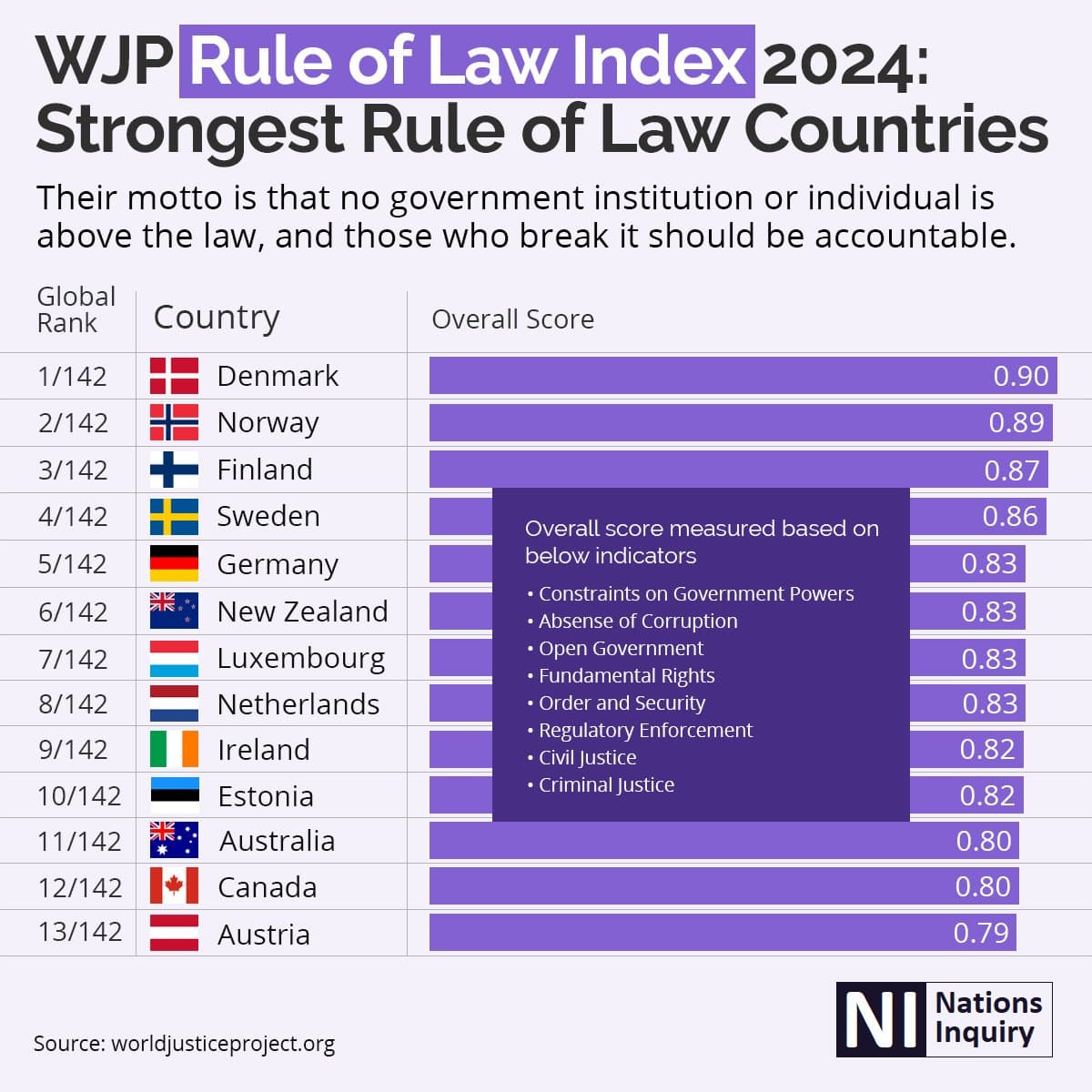
Charts and analysis about Austria and governance & institutions
08Questions
Austria on governance & institutions: questions answered
Every answer is built from the numbers on this page, so none can say something the page does not.
How does Austria rank on governance & institutions?
Austria is placed 15th of 194 countries on Governance & Institutions in the Country Index 2026, from 4 of its 4 key statistics (Government Effectiveness, Statistical Performance Indicators, Corruption Perceptions Index and Judicial Constraints on the Executive Index). The position is this site’s ordering of published statistics, not a rank any publisher printed.
What is the latest Government Effectiveness figure for Austria?
1.544 in 2025 (governance estimate (−2.5 weak to 2.5 strong)), according to World Bank Group. The world median in the same edition was 0.101.
What is the latest Statistical Performance Indicators figure for Austria?
89.35 in 2024 (sPI overall score (0–100)), according to World Bank Group. The world median in the same edition was 69.3.
How does Austria compare with Germany on governance & institutions?
Germany is placed joint 13th of 194, and Austria 15th. Government Effectiveness: Germany 1.49, Austria 1.544; Statistical Performance Indicators: Germany 90.06, Austria 89.35; Corruption Perceptions Index: Germany 77, Austria 69; Judicial Constraints on the Executive Index: Germany 0.934, Austria 0.916.
How have Austria’s governance & institutions figures changed?
Government Effectiveness fell from 1.985 in 2000 to 1.544 in 2025; Statistical Performance Indicators rose from 86.32 in 2016 to 89.35 in 2024; Corruption Perceptions Index was 69 in both 2012 and 2025; Judicial Constraints on the Executive Index rose from 0.914 in 2000 to 0.916 in 2025.
Which governance & institutions statistics are missing for Austria?
No current reading is published for Austria on Business Ready: Operational Efficiency, Business Ready: Public Services, Business Ready: Regulatory Framework, Country Policy and Institutional Assessment, Debt Service on External Debt, External Debt Stocks (% of GNI) and Government Spending on Education. They are listed rather than hidden, so the evidence on the page can be checked against it.
09Method
Method, sources and how to cite
What this topic does not measure
Governance is not democracy. Free elections, civil liberties and press freedom belong to the Democracy & Civil Liberties topic, and a country can place well on one and poorly on the other. How openly official data is published sits here as context, beside the statistical capacity that is a key. Nor does this topic measure the size of government or how much it spends — the share of the economy run by the state is published on this page as context, with no better end.
How the Governance & Institutions standing is decided
A standing is this site’s ordering, named with its edition — never a publisher’s rank. 4 key statistics vote, one vote each; every country’s published value becomes a place within that key’s own field, the places are averaged, and the average is never published. A country needs 2 of the 4 keys to be placed.
The governance & institutions method, step by stepHow every standing on this site is built
The key statistics and their licences
- Government Effectiveness — World Bank Group, CC BY 4.0
- Statistical Performance Indicators — World Bank Group, CC BY 4.0
- Corruption Perceptions Index — Transparency International, CC BY 4.0 (the data), CC BY-ND 4.0 (the website and report)
- Judicial Constraints on the Executive Index — V-Dem Institute, University of Gothenburg, CC BY-SA 4.0
The other 38 statistics on this page come from 13 publishers, each named beside its numbers, with every edition and licence on the datasets pages.
The standing itself is part of the Country Index 2026, published under CC BY-SA 4.0.
Photographs
Austria’s banner and the countries placed highest, from their profiles: Wikimedia Commons, shown in greyscale, each used under the licence named.
- Austria (banner) — chensiyuan, CC BY-SA 4.0
- Denmark — User:Aconcagua, CC BY-SA 3.0
- New Zealand — Karora derivative work: Inkey, Public domain
- Sweden — User:Pieter Kuiper, Public domain
Cite this page
Nations Inquiry (2026). Austria: Governance & Institutions — standing and statistics, Country Index 2026. https://nationsinquiry.com/countries/austria/governance