WJP Rule of Law Index 2024: Which Countries Lead in Justice and Accountability?
Denmark has the strongest rule of law in the world for 2024, on 0.9, ahead of Norway on 0.89.
The thirteen strongest of the 142 countries the World Justice Project measures, and the eight factors the overall score averages. Four countries are published at 0.83 and still carry separate ranks.
Published Article last edited
Share
These figures are from the 2024 edition, as they stood when this chart was published on . The chart is a snapshot and is never refreshed, so a newer edition may exist. What this site keeps current on the subject.
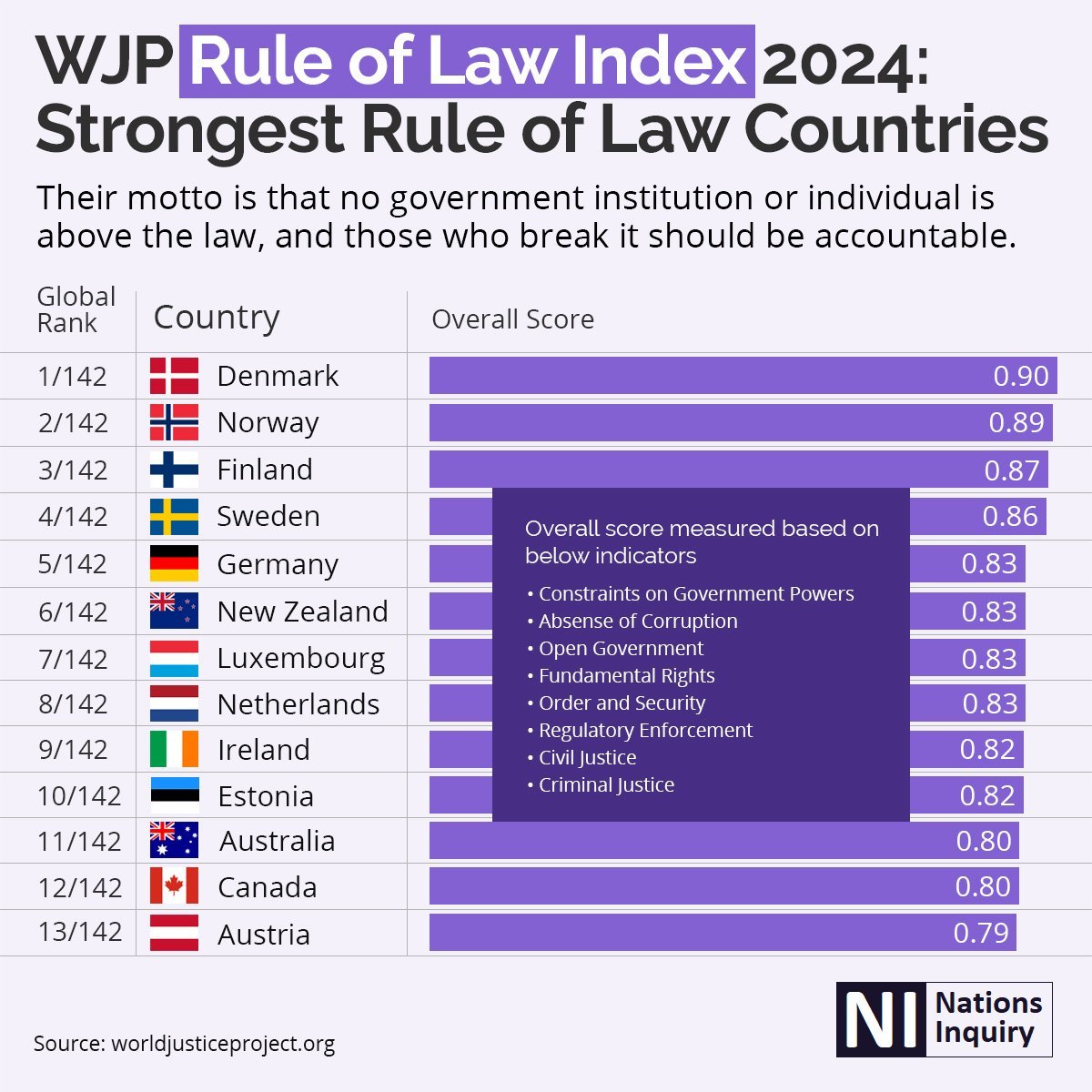
A ranked table of the thirteen countries with the strongest rule of law in the World Justice Project’s 2024 index, each with its rank out of 142 and its overall score drawn as a bar. Denmark leads on 0.90, then Norway on 0.89 and Finland on 0.87; Austria closes the list on 0.79. Four countries — Germany, New Zealand, Luxembourg and the Netherlands — are published at 0.83 and still carry separate ranks. An inset lists the eight factors the overall score is the average of.
What goes into the score
- Constraints on government powers
- Absence of corruption
- Open government
- Fundamental rights
- Order and security
- Regulatory enforcement
- Civil justice
- Criminal justice
From the publisher’s own method. On the poster this list is printed in a box over the data it explains; here it sits beside it.
01The figures
WJP Rule of Law Index score, 2024
Every row the chart prints, as text rather than pixels — 13 of them, exactly as World Justice Project published them. Country names link to their profiles.


The overall score is the average of the eight factors above. The publisher prints each rank out of the 142 countries it measures.
02Analysis
What the chart says
The Top Countries in the WJP Rule of Law Index 2024
The World Justice Project’s Rule of Law Index 2024, published in October 2024, scores 142 countries from 0 to 1. Denmark is first on 0.90, followed by Norway on 0.89, Finland on 0.87 and Sweden on 0.86, so the four Nordic countries take the first four ranks. Austria closes this chart in 13th place on 0.79. Most of the thirteen are in western Europe, with New Zealand, Australia and Canada the exceptions. Estonia, 10th, is the only one from central or eastern Europe. At the other end of the same table, Venezuela was ranked last.
Eight Factors, One Average
The principle is that nobody, including the government, stands above the law, the law is applied to everyone in the same way, and people can get disputes and crimes settled fairly. The WJP surveyed more than 214,000 households and 3,500 lawyers and other experts. Their answers are grouped into eight factors: constraints on government powers, absence of corruption, open government, fundamental rights, order and security, regulatory enforcement, civil justice and criminal justice.
The overall score is the plain average of the eight. It works like a household in which each member has a job: if one stops doing it, the whole house feels it. A country with fast, honest courts but a weak press or tight limits on protest loses points on those factors, and the average shows it.
Four Countries on 0.83, Four Separate Ranks
Germany, New Zealand, Luxembourg and the Netherlands are all printed at 0.83, yet they hold ranks 5 to 8 rather than a shared place. The same happens to Ireland and Estonia on 0.82 and to Australia and Canada on 0.80. The publisher prints two decimals but ranks on its unrounded scores, so these are not ties, only gaps too small to print.
The World Bank Puts the Same Countries Near the Top
Instead of the WJP index, this site holds the World Bank’s Rule of Law estimate, a different measure from a different publisher, built from many outside sources on a scale of −2.5 to 2.5. The two scores cannot be compared; only their orderings can, and carefully. In the Bank’s 2025 edition, all thirteen countries on this chart are among the 22 highest readings of 211. Finland has the highest, Denmark the second and Norway the third. Venezuela has the lowest, and it is also last in the WJP table. Some places the Bank scores above several of the thirteen, such as Liechtenstein, Monaco and Greenland, are not among the 142 countries the WJP surveys.
Strong Government, Limited Voice
Singapore has the highest government effectiveness reading of 209 in the Bank’s 2025 edition, yet it is not among these thirteen. The WJP average also counts constraints on government, open government and fundamental rights, and on the Bank’s voice and accountability estimate for the same year, Singapore’s reading is 113th of 206. The first four readings on that measure belong to Norway, Denmark, Finland and Sweden, the same four countries that open this chart. More of this evidence is on the governance and democracy subject pages.
A Snapshot From October 2024
This chart is not updated. The WJP found that overall scores fell in 57% of countries between 2023 and 2024, a majority for the seventh year running. It has published newer editions since. In this 2024 edition, India was 79th and Pakistan 129th of 142, as the India and Pakistan comparison chart records.
03Sources
Where these figures come from
Source
WJP Rule of Law Index 2024 — World Justice Project
Index producer
The figures are from the 2024 edition, read on . This page reproduces only the 13 rows the chart itself shows, not the publisher’s full table.
How this site reads a chart — what is stored as published, whose rank is whose, when a country is named at an end, and why a chart is never refreshed.
Cite this page
“WJP Rule of Law Index 2024: Which Countries Lead in Justice and Accountability?”, Nations Inquiry, 2025. https://nationsinquiry.com/charts/wjp-rule-of-law-index-2024
Published · article last edited · Found an error?
04More charts