UNICEF · Postnatal Care for Newborns Within Two Days
Postnatal care for newborns by country
What share of newborns are checked by a health worker within two days of birth?
2 countries shared first place of the 99 countries compared in the 2025 edition, all at 99.9%, and South Sudan last, at 7.3%. In the middle country the figure was 82.6%. 10 readings from before 2015 are listed but not compared.
Share
Part ofHealth & Wellbeing
Postnatal care for newborns · the 2025 edition
Context statistic
2 countries share the highest value, 99.9% — no single country is named first.
01the 2025 edition · position · derived
Who leads
The three countries at the highest end of 99 compared, the three at the other end, and the first on each continent.
Highest in the 2025 edition · shared
2 countries share the highest reading, 99.9%
No single country is named first: picking one from a shared value would be a choice the data does not make.
Lowest in the 2025 edition
- 109
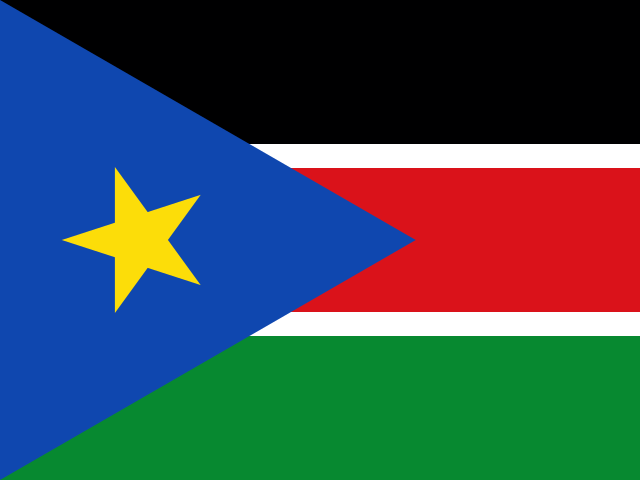 South Sudan7.3%
 - 108
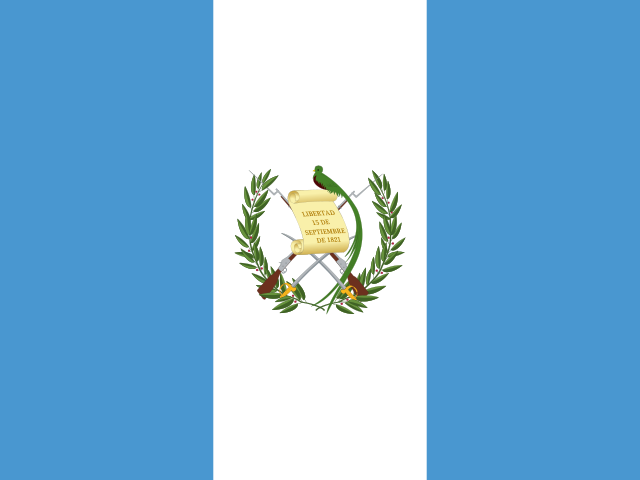 Guatemala8.1%
 - 107
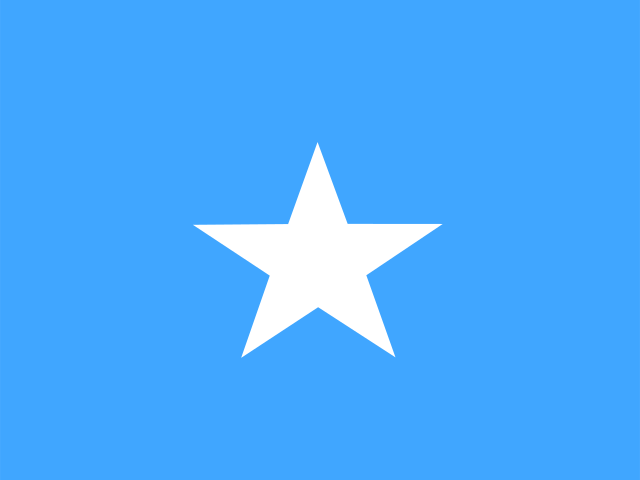 Somalia9.5%
Positions out of 109. Where a country sits says how it compares with the others measured, and nothing about why.
02Every measured country
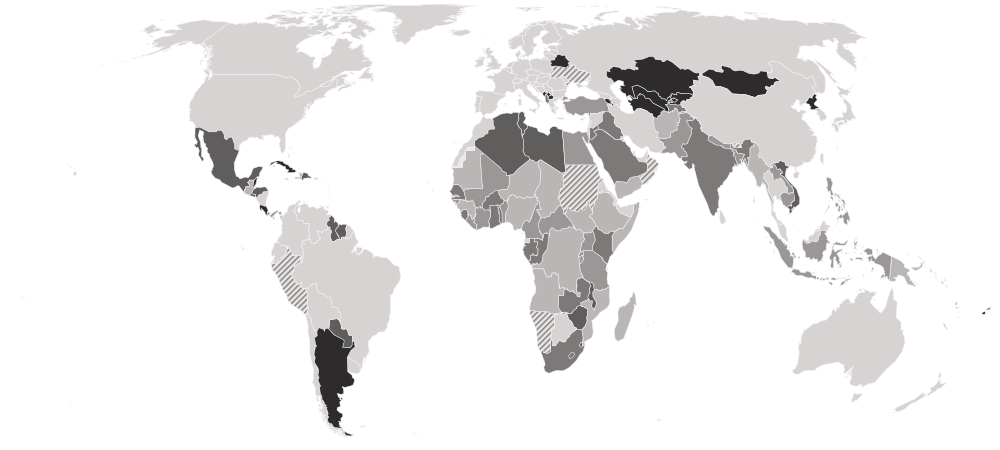
Postnatal care for newborns on a map
Each country is shaded by its value, in five groups holding the same number of countries. Hover a country for its value, or select it to open its profile. Below the map, each continent’s middle country.
Darker is a higher value — the better end.
- 7.3–45.1%
- 49.4–77.3%
- 77.5–86.9%
- 88.4–95.9%
- 96.1–99.9%
- Hatched: a reading from before 2015, listed but not compared (10)
- No reading in the 2025 edition
- Europe
97.7%
the middle country, of 5 measured · 49 members
 Belarus99.9%
 Albania86.2%
Highest and lowest reading in Europe.
- Americas
95.1%
the middle country, of 14 measured · 48 members
 Cuba99.9%Guatemala8.1%
Highest and lowest reading in Americas.
- Oceania
91.5%
the middle country, of 8 measured · 21 members
 Fiji99.1%
 Solomon Islands15.6%
Highest and lowest reading in Oceania.
- Asia
77.7%
the middle country, of 27 measured · 52 members
 Turkmenistan99.8%
 Timor-Leste30.6%
Highest and lowest reading in Asia.
- Africa
76.6%
the middle country, of 45 measured · 55 members
 Tunisia95.0%South Sudan7.3%
Highest and lowest reading in Africa.
- Every region
18 sub-regions, highest middle country first
- Central Asia
99.5%
the middle country, of 5 measured · 5 members
Turkmenistan99.8% Tajikistan85.1%
Highest and lowest reading in Central Asia.
- Central America
95.1%
the middle country, of 6 measured · 8 members
 Costa Rica97.4%Guatemala8.1%
Highest and lowest reading in Central America.
- Western Asia
77.7%
the middle country, of 7 measured · 19 members
 Armenia98.2%
 Yemen36.1%
Highest and lowest reading in Western Asia.
- Western Africa
76.4%
the middle country, of 16 measured · 16 members
 Cabo Verde91.1%
 Niger33.9%
Highest and lowest reading in Western Africa.
- South-eastern Asia
76.1%
the middle country, of 7 measured · 11 members
 Vietnam88.5%Timor-Leste30.6%
Highest and lowest reading in South-eastern Asia.
- Southern Asia
66.8%
the middle country, of 6 measured · 9 members
 Maldives81.9%
 Afghanistan34.2%
Highest and lowest reading in Southern Asia.
- Middle Africa
59.5%
the middle country, of 8 measured · 9 members
 São Tomé and Príncipe92.3%
 Angola15.0%
Highest and lowest reading in Middle Africa.
- Eastern Africa
57.9%
the middle country, of 14 measured · 19 members
 Zimbabwe90.9%South Sudan7.3%
Highest and lowest reading in Eastern Africa.
- Caribbean
4 of 24 measured — too few for a middle: Cuba, Dominican Republic, Haiti, Turks and Caicos Islands.
Cuba99.9% Haiti37.7%
Highest and lowest reading in Caribbean.
- Eastern Asia
2 of 8 measured — too few for a middle: Mongolia, North Korea.
 Mongolia99.4%
 North Korea98.6%
Highest and lowest reading in Eastern Asia.
- Eastern Europe
1 of 10 measured — too few for a middle: Belarus.
Belarus99.9%Highest and lowest reading in Eastern Europe.
- Melanesia
4 of 5 measured — too few for a middle: Fiji, Papua New Guinea, Solomon Islands, Vanuatu.
Fiji99.1%Solomon Islands15.6%Highest and lowest reading in Melanesia.
- Micronesia
1 of 7 measured — too few for a middle: Kiribati.
 Kiribati91.4%
Highest and lowest reading in Micronesia.
- Northern Africa
4 of 6 measured — too few for a middle: Algeria, Egypt, Libya, Tunisia.
Tunisia95.0% Egypt76.6%
Highest and lowest reading in Northern Africa.
- Polynesia
3 of 7 measured — too few for a middle: Samoa, Tonga, Tuvalu.
 Tonga98.0%
 Samoa85.0%
Highest and lowest reading in Polynesia.
- South America
4 of 12 measured — too few for a middle: Argentina, Guyana, Paraguay, Suriname.
 Argentina98.2%
 Suriname93.7%
Highest and lowest reading in South America.
- Southern Africa
3 of 5 measured — too few for a middle: Eswatini, Lesotho, South Africa.
 Eswatini90.3%
 Lesotho81.5%
Highest and lowest reading in Southern Africa.
- Southern Europe
4 of 17 measured — too few for a middle: Albania, Kosovo, Montenegro, North Macedonia.
 North Macedonia98.6%Albania86.2%
Highest and lowest reading in Southern Europe.
03The whole field at once
The spread
99 countries, one dot each, on one scale — further right is a higher value. Half the countries are above 82.6%; a quarter are above 93.9%, and a quarter below 59.5%. The bar in each row marks that continent’s middle country.
04All 109 ever measured
Every country
In order, highest value first. “=” marks a position shared with another country. UNICEF ranks nobody on this measure; the position is derived here by ordering the published values. The surveys this comes from are run mainly in low- and middle-income countries, so most wealthy countries are absent rather than low. The survey question changed in 2010, so no earlier reading is used.
Showing 25 of 109 countries





















Values for the 2025 edition.
05In this edition
Postnatal care for newborns in records
The extremes of the statistic. A record reached by more than one country names none of them.
Highest reading
Reached 2 times by 2 countries — shared, so no holder is named
99.9%
Newborns with a health check within 2 days of birth (%)
Lowest reading
7.3%
Newborns with a health check within 2 days of birth (%)
06The measure
About postnatal care for newborns
This is the share of newborns who were checked by a health worker within two days of birth. Most newborn deaths happen in the first days of life, and an early postnatal visit is when danger signs such as infection, breathing problems or feeding difficulties can be caught.
What the number is: Newborns with a health check within 2 days of birth (%).
07Where it fits
Connections
Its part in the Country Index, the statistics whose values line up most closely with it across countries, and others on the same subject.
In the Country Index
Context, with no vote
This statistic is published in full under Health & Wellbeing, but does not help decide any Country Index standing.
Moves with
Where postnatal care for newborns is higher, these tend to be higher too.
- Institutional DeliveriesUNICEF · 97 countries in commonρ 0.86
- Primary Completion RateUIS · 92 countries in commonρ 0.77
- Mean Years of SchoolingUNDP Human Development Report Office · 96 countries in commonρ 0.72
Moves against
Where postnatal care for newborns is higher, these tend to be lower.
- Stunting Prevalence in Children Under FiveKeyUNICEF, WHO and World Bank Group (Joint Malnutrition Estimates) · 94 countries in commonρ −0.82
- Global Multidimensional Poverty IndexOPHI · 86 countries in commonρ −0.81
- Children's Climate Risk IndexUNICEF · 86 countries in commonρ −0.76
Rank correlation (ρ, from −1 to 1) across countries, on each statistic’s newest edition, out of 262 statistics sharing at least 80 countries with this one. Two statistics that move together do not cause each other.
08Keep reading
Explore further
The subject
The data, edition by edition
The countries at either end
09Questions
Postnatal care for newborns: questions and answers
Which country has the highest postnatal care for newborns?
2 countries share the highest reading, 99.9%, among the 99 compared in the 2025 edition, so no single country is named.
Which country has the lowest postnatal care for newborns?
South Sudan, at 7.3%, among the 99 countries compared in the 2025 edition.
How many countries does the Postnatal Care for Newborns Within Two Days cover?
99 in the 2025 edition, and 109 at least once across all editions.
What is the world average postnatal care for newborns?
This site does not calculate a world average, which would depend on how countries are weighted. In the middle country of the 99 compared in the 2025 edition, the figure was 82.6%.
Is this UNICEF’s own ranking?
No. UNICEF publishes the values but ranks nobody; the position on this page is derived by Nations Inquiry by ordering the published values, and equal values share a position.
How often is the Postnatal Care for Newborns Within Two Days published?
This site holds one edition, describing 2025.
Where does the data come from, and can I download it?
From UNICEF, under CC BY 3.0 IGO. From UNICEF's Maternal and Newborn Health Coverage Database, read from UNICEF's own data warehouse. Where a country has several surveys, UNICEF's own priority flag decides which is used. Every edition is on this site’s Datasets pages as a full table, and downloads as a CSV file with every value unrounded.
10Method
Sources, method and citation
Source
Postnatal Care for Newborns Within Two Days — UNICEF
From UNICEF's Maternal and Newborn Health Coverage Database, read from UNICEF's own data warehouse. Where a country has several surveys, UNICEF's own priority flag decides which is used.
Newest edition
Report year 2025Data year not recorded
Cite the source as: UNICEF. Maternal and Newborn Health Coverage Database. New York: UNICEF.
Licence: CC BY 3.0 IGO, checked 2026-10-03.
How this page reads the numbers
- UNICEF ranks nobody on this measure. The position is derived by Nations Inquiry by ordering the published values; equal values share a position.
- Which end is better follows the publisher’s own reading of the measure.
- A country is named at an end only when it holds that value alone. Where several share it, the page says how many and names none first.
- The file gives each country’s most recent reading, so the rows are from different years. Readings from before 2015 are listed but left out of every comparison on this page.
- Values are stored exactly as published and trimmed only for display. “The middle country” is the median of the countries measured, not a world average.
The file itself, column by column — where it came from, what each column holds, and every edition as a CSV — is on its dataset page.
Cite this page
Nations Inquiry (2026). Postnatal care for newborns by country: Postnatal Care for Newborns Within Two Days, data from UNICEF. https://nationsinquiry.com/statistics/postnatal-care-newborns