Dataset · UIS
Minimum Proficiency in Mathematics, End of Lower Secondary
Minimum Proficiency in Mathematics, End of Lower Secondary, 2023 compilation · 103 countries · 3 measures
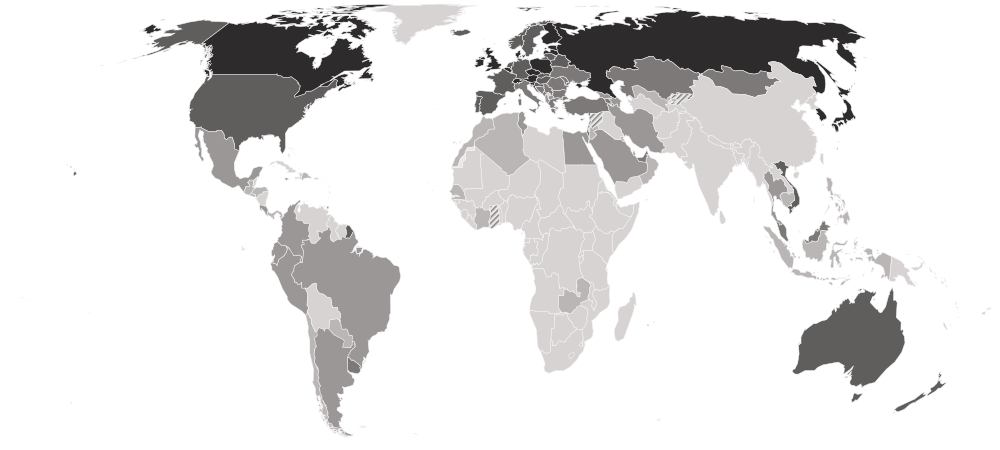
This is the share of students at the end of lower secondary school — around age 15 — who reach at least a minimum level in mathematics, SDG indicator 4.1.1. The readings come from the OECD’s PISA survey and, for some countries, the TIMSS study of eighth-graders.
This site holds one edition, Minimum Proficiency in Mathematics, End of Lower Secondary, 2023 compilation, read from UIS’s own data and stored exactly as published.
Minimum Proficiency in Mathematics, End of Lower Secondary · the file
- Newest
- Minimum Proficiency in Mathematics, End of Lower Secondary, 2023 compilation
- Held
- 1 edition · 103 rows
- Licence
- CC BY-SA 4.0
01One edition
Every edition
Newest first. Each opens the full table for that edition, and each downloads as a CSV.
| Edition | Countries | Change | Read | Download |
|---|---|---|---|---|
| Minimum Proficiency in Mathematics, End of Lower Secondary, 2023 compilation | 103 | — | September 29, 2026 | CSV |
Every edition in one file, one row per country per edition: maths-proficiency-lower-secondary-all-editions-nations-inquiry.csv
027 columns
What’s in the file
Every column, what it holds, how it is stored and what its values look like — what a reader needs before opening the file.
| Column | What it holds | Stored as | Range, 2023 | Distinct | Empty | Spread |
|---|---|---|---|---|---|---|
CountrycountryName | The country’s name, as this file spells it. | Text | — | 103 | 0 | |
ISO Codecountry_codeIdentifier | The ISO 3166-1 alpha-3 code, added by this site. Every table here joins on it. | Text · 3 letters | — | 103 | 0 | |
Students at the end of lower secondary reaching minimum proficiency in mathematics (%)maths_proficiency_lower_secondaryHeadline | The headline figure: Students at the end of lower secondary reaching minimum proficiency in mathematics (%). | Number · up to 15 decimals | 0.730 Côte d’Ivoire91.730 Côte d’Ivoire91.730 Japanmiddle 48.900 Japanmiddle 48.900 | 103 | 0 | |
FemalefemaleWomen | The same measure, for women. | Number · up to 15 decimals | 1.21Côte d’Ivoire91.61 Macaumiddle 51.06 Macaumiddle 51.06 | 99 | 4 | |
MalemaleMen | The same measure, for men. | Number · up to 15 decimals | 0.27Côte d’Ivoire91.97Japanmiddle 48.27 | 99 | 4 | |
Reference yearreference_yearReading year | The year this country’s reading describes. Readings from different years sit side by side. | Year | — | 9 | 0 | |
Assessment (UIS footnote)data_sourceLabel | UIS’s own footnote naming the learning assessment this reading comes from — its benchmark, the school grade tested, and any part of the country it is limited to. Readings from different assessments are not directly comparable. | Text | — | 7 | 0 |
Profiled from the newest file. Range: the lowest and highest value, with the country holding it when only one does. Spread: countries in ten equal steps from lowest to highest. A higher value is the better result.
03103 countries across every edition
Who is covered
How many countries each edition holds, continent by continent, who joined and who left, and which places this site covers that the dataset never has.
| 2023 | |
|---|---|
| Africa | 9 |
| Americas | 19 |
| Asia | 33 |
| Europe | 40 |
| Oceania | 2 |
| All | 103 |
One edition, covering 103 countries.
Not in this dataset · 122 places this site covers
UIS gives no figure for these in any edition held here. It is the publisher’s choice of scope, and each place’s profile shows what is measured.
 Afghanistan
 American Samoa
 Andorra
 Angola
 Anguilla
 Antigua and Barbuda
 Aruba
Aruba Bahamas
 Bangladesh
 Barbados
 Belize
 Benin
Benin Bermuda
 Bhutan
 Bolivia
 Botswana
 British Virgin Islands
 Burkina Faso
 Burundi
 Cabo Verde
 Cameroon
 Cayman Islands
 Central African Republic
 ChadChannel Islands
 China
China Comoros
 Cook Islands
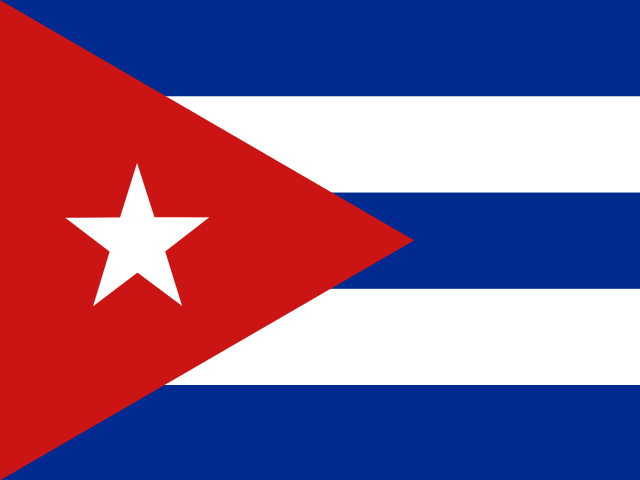 Cuba
Cuba Curaçao
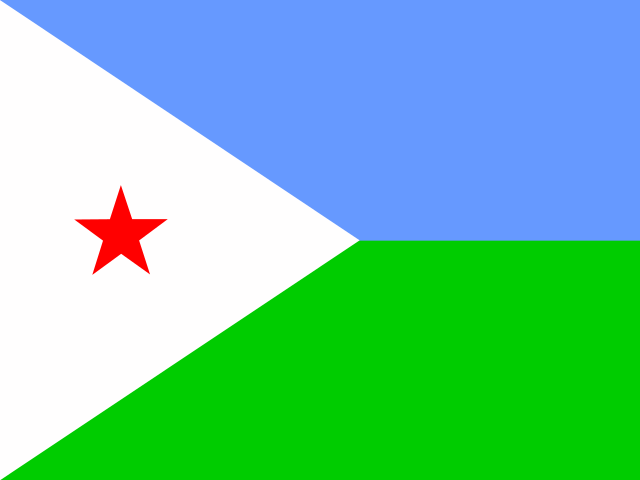 Djibouti
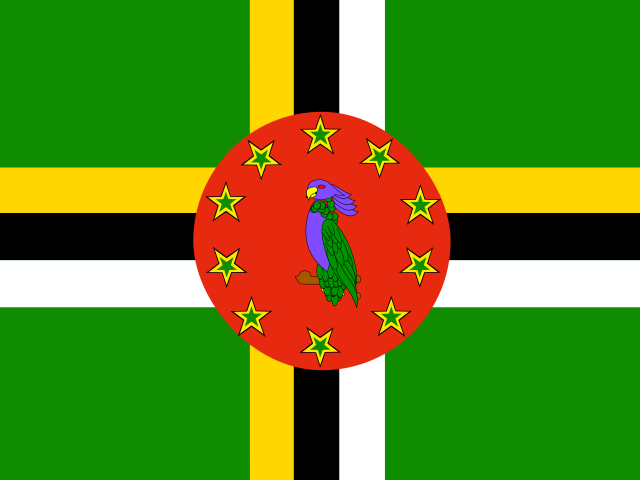 Dominica
 DR Congo
 Equatorial Guinea
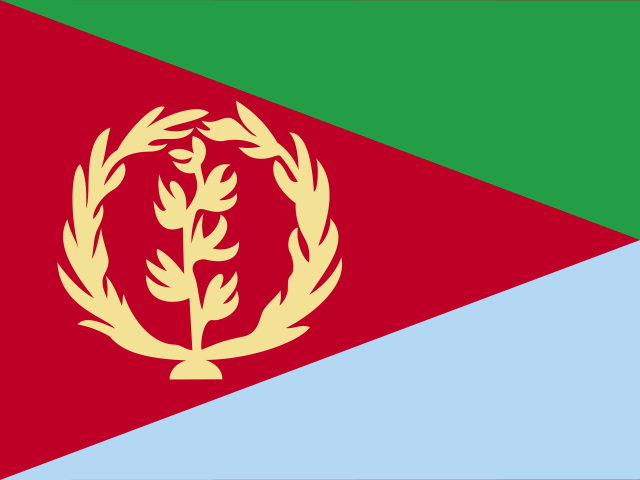 Eritrea
 Eswatini
 Ethiopia
 Faroe Islands
 Fiji
Fiji French Polynesia
 Gabon
Gabon Gambia
 Gibraltar
 Greenland
 Grenada
 Guam
Guam Guinea
 Guinea-Bissau
 Guyana
 Haiti
Haiti India
India Iraq
Iraq Isle of Man
 Kenya
Kenya Kiribati
 Kosovo
 Laos
Laos Lesotho
 Liberia
 Libya
Libya Madagascar
 Malawi
 Maldives
 Mali
Mali Marshall Islands
 Mauritania
 Micronesia
 Monaco
 Montserrat
 Mozambique
 Myanmar
 Namibia
 Nauru
Nauru Nepal
Nepal New Caledonia
 Nicaragua
 Niger
Niger Nigeria
 Niue
Niue North KoreaNorthern Cyprus
 Northern Mariana Islands
 Pakistan
 Palau
Palau Papua New Guinea
 Puerto Rico
 Republic of the Congo
 Rwanda
 Saint Kitts and Nevis
 Saint Lucia
 Saint Martin
 Saint Vincent and the Grenadines
 Samoa
Samoa San Marino
 São Tomé and Príncipe
 Seychelles
 Sierra Leone
 Sint Maarten
 Solomon Islands
 SomaliaSomaliland
 South Africa
 South Sudan
 Sri Lanka
 Sudan
Sudan Suriname
 Taiwan
 Tajikistan
 Tanzania
 Timor-Leste
 Togo
Togo Tonga
Tonga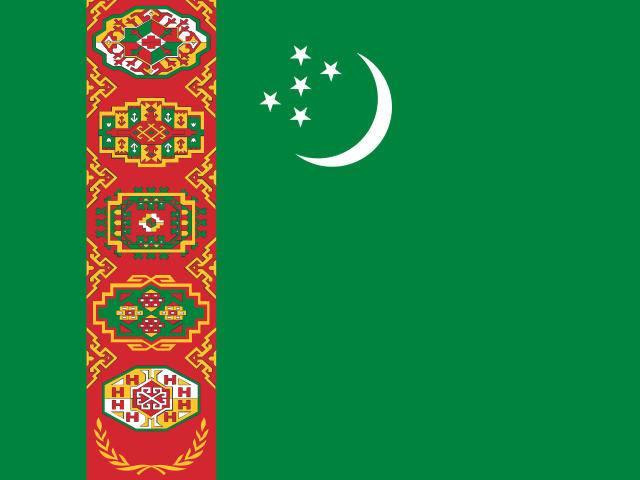 Turkmenistan
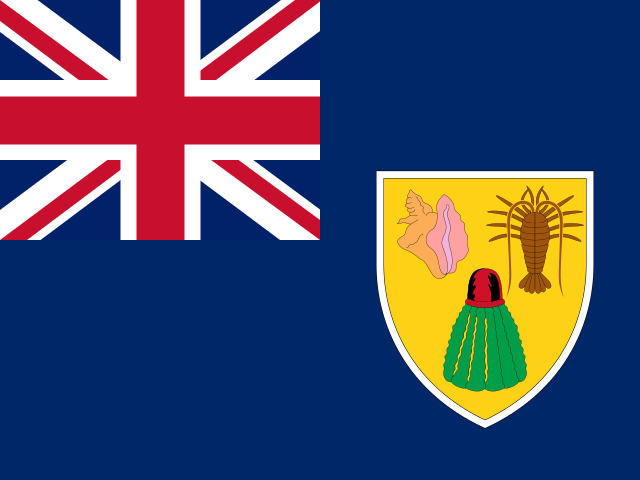 Turks and Caicos Islands
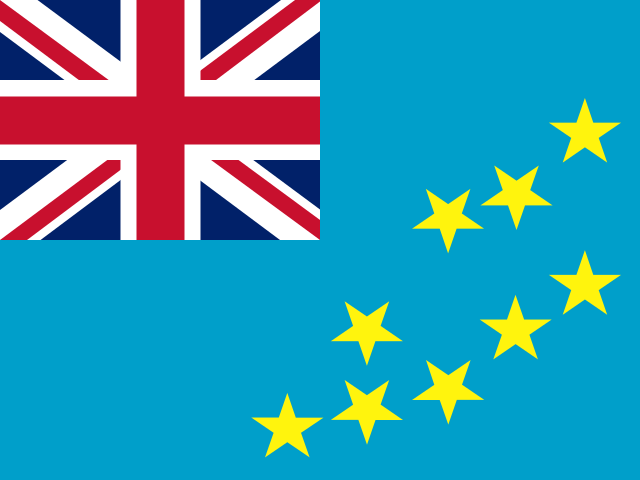 Tuvalu
 Uganda
 United States Virgin Islands
 Vanuatu
 Vatican City
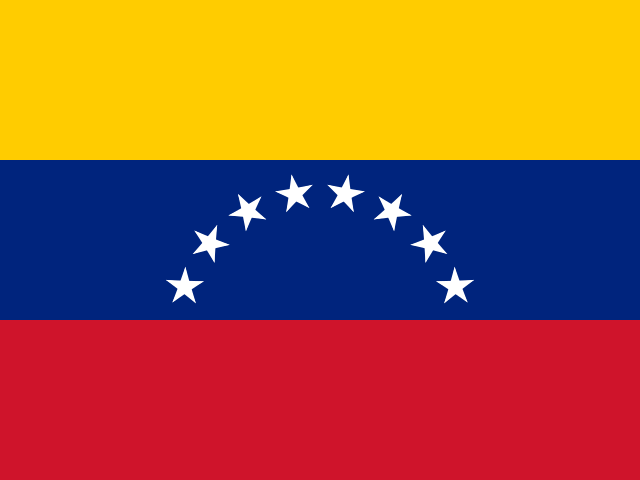 Venezuela
 Yemen
Yemen Zimbabwe
04Provenance
Where it comes from
The path from the publisher to this page, and what was checked and changed on the way.
1 · Publisher
UNESCO Institute for Statistics (UIS)
2 · Their file
Minimum Proficiency in Mathematics, End of Lower Secondary — UIS (readings to 2023)
3 · Read by this site
September 29, 2026
Imported by a script that parses each figure and writes it down unrounded.4 · Stored as
1 file, one per edition
It downloads as a CSV: maths-proficiency-lower-secondary-all-editions-nations-inquiry.csv5 · Used on
Its statistic page, and every profile it measures
Precision
The headline is stored to 15 decimals, as published.
Rounded by this site
Never. Tables on screen may show fewer decimals; the files never do.
Changed by this site
Reshaped into one row per country: regional and income-group totals are left out, only the columns listed are kept, each row gets its ISO 3166 code, and some country names are brought to one spelling. No value is recalculated, rescaled or rounded.
From the UNESCO Institute for Statistics data API (MATH.LOWERSEC), latest available reading per country, with UIS’s own footnote naming the assessment. Female and male shares are stored beside the headline.
05Reuse
Licence and credit
What the publisher’s licence lets you do, what it asks of you, and a credit line and citation ready to copy.
Licence · checked September 29, 2026
- Share and redistribute it
- Adapt it and build on it
- Use it commercially
- Credit the publisher
- Say what you changed
- Publish anything adapted from it under the same licence
Share, adapt and use commercially with credit — and anything you publish that adapts it must carry the same licence.
A credit line
Source: UNESCO Institute for Statistics (UIS), Minimum Proficiency in Mathematics, End of Lower Secondary, via Nations Inquiry.
Cite this dataset
UNESCO Institute for Statistics (UIS). Minimum Proficiency in Mathematics, End of Lower Secondary, Minimum Proficiency in Mathematics, End of Lower Secondary, 2023 compilation [data set]. As held by Nations Inquiry, https://nationsinquiry.com/datasets/maths-proficiency-lower-secondary
The publisher’s own citation: UNESCO Institute for Statistics. UIS Data Browser. Montreal: UNESCO Institute for Statistics.
Plain-language summary, not legal advice. The licence text is what binds.
06Where it is used
Around the site
Where these numbers appear on this site, and the datasets nearest to it.
Charted
Minimum Proficiency in Mathematics, End of Lower Secondary by countryWho is highest, the map, the spread, who rose and fell, and the records.
Subjects
Near neighbours
- Government Spending on EducationUIS · 51 held · 1971–2023
- Upper Secondary Completion RateUIS · 45 held · 1981–2025
- Out-of-School Rate, PrimaryUIS · 32 held · 1981–2024
07Questions
Minimum Proficiency in Mathematics, End of Lower Secondary: questions and answers
What is the Minimum Proficiency in Mathematics, End of Lower Secondary?
This is the share of students at the end of lower secondary school — around age 15 — who reach at least a minimum level in mathematics, SDG indicator 4.1.1. The readings come from the OECD’s PISA survey and, for some countries, the TIMSS study of eighth-graders.
Which editions of the Minimum Proficiency in Mathematics, End of Lower Secondary can I download?
One: Minimum Proficiency in Mathematics, End of Lower Secondary, 2023 compilation, as a CSV file.
Does UIS rank countries on it?
No, and this site does not order it either. The files hold values only.
Can I use it commercially?
Yes, under CC BY-SA 4.0, with credit to UIS. The licence text is linked on this page.