Loading…
UNICEF · Violent Discipline of Children
Violent discipline of children by country
What share of children experienced violent discipline at home?
Of the 87 countries compared in the 2025 edition, Qatar had the lowest reading, 37.6%, and Ghana had the highest reading, 94.0%. In the middle country the figure was 75.8%. 3 readings from before 2015 are listed but not compared.
Violent discipline of children · the 2025 edition
Context statistic

Lowest of 87Qatar
37.6%01the 2025 edition · position · derived
Who leads
The three countries at the lowest end of 87 compared, the three at the other end, and the first on each continent.
 1
1Photo: Haakon S. Krohn derivative work: JamesA · CC BY-SA 3.0, greyscale
 2
2Photo: Dmitry A. Mottl (original) This derivative work (cropped): SHB2000 · CC BY-SA 3.0, greyscale
 3
3Photo: Rastapopulous · CC BY-SA 3.0, greyscale
02Every measured country
Violent discipline of children on a map
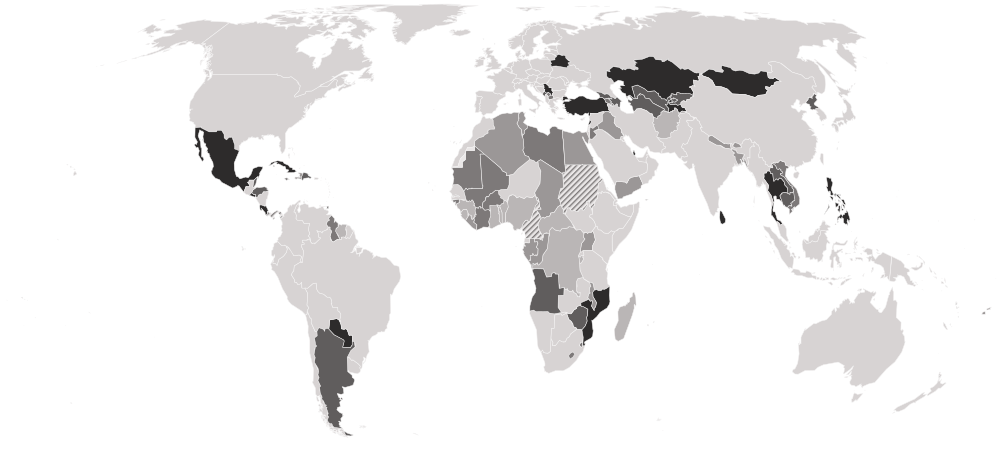
Each country is shaded by its value, in five groups holding the same number of countries. Hover a country for its value, or select it to open its profile. Below the map, each continent’s middle country.
Darker is a lower value — the better end.
- 86.0–94.0%
- 80.5–85.7%
- 68.9–80.0%
- 59.2–68.8%
- 37.6–58.8%
- Hatched: a reading from before 2015, listed but not compared (3)
- No reading in the 2025 edition
- Americas
63.5%
the middle country, of 15 measured · 48 members
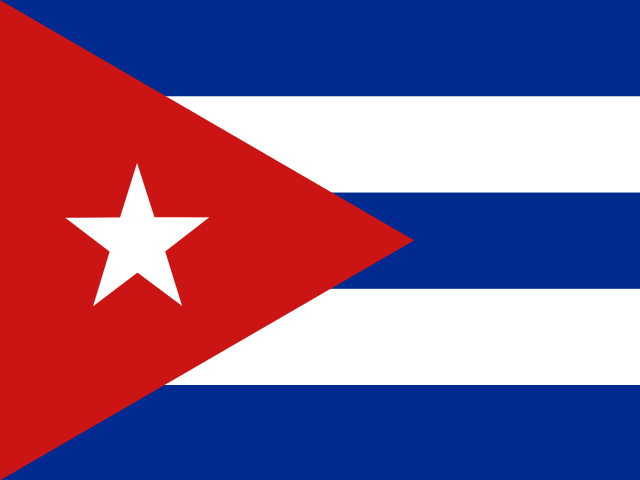 Cuba41.6%
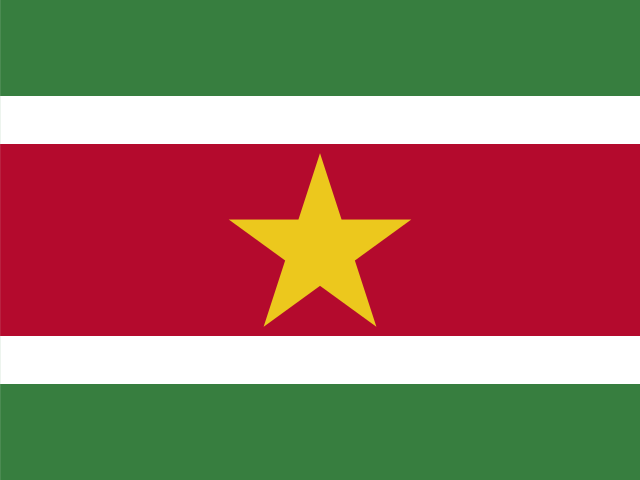 Suriname87.3%
Lowest and highest reading in Americas.
- Asia
64.9%
the middle country, of 27 measured · 52 members
Qatar37.6% Palestine90.1%
Lowest and highest reading in Asia.
- Europe
65.8%
the middle country, of 5 measured · 49 members
 Serbia44.5%
 North Macedonia73.1%
Lowest and highest reading in Europe.
- Africa
82.9%
the middle country, of 33 measured · 55 members
 Mozambique55.4%
 Ghana94.0%
Lowest and highest reading in Africa.
- Oceania
86.6%
the middle country, of 7 measured · 21 members
 Tuvalu79.7%
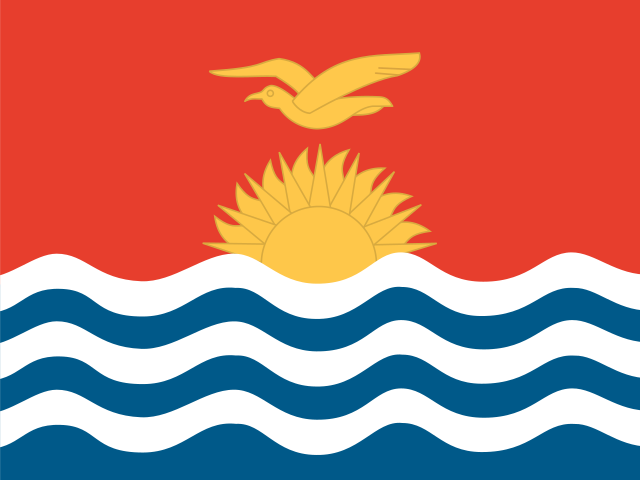 Kiribati92.1%
Lowest and highest reading in Oceania.
- Every region
18 sub-regions, lowest middle country first
- Central America
54.5%
the middle country, of 5 measured · 8 members
 Costa Rica49.3%
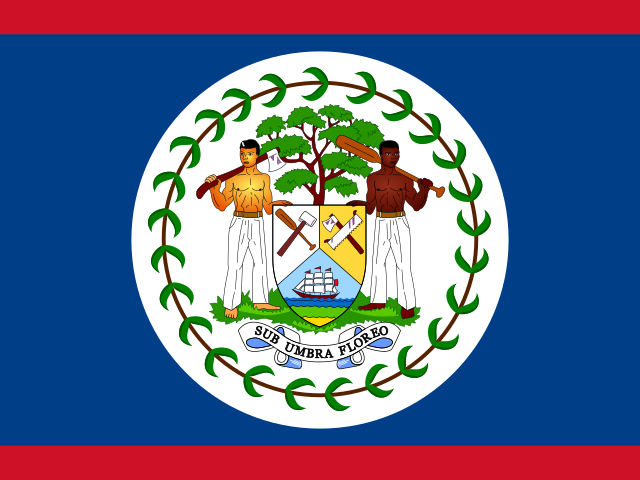 Belize65.1%
Lowest and highest reading in Central America.
- Central Asia
62.2%
the middle country, of 5 measured · 5 members
 Kazakhstan37.9%
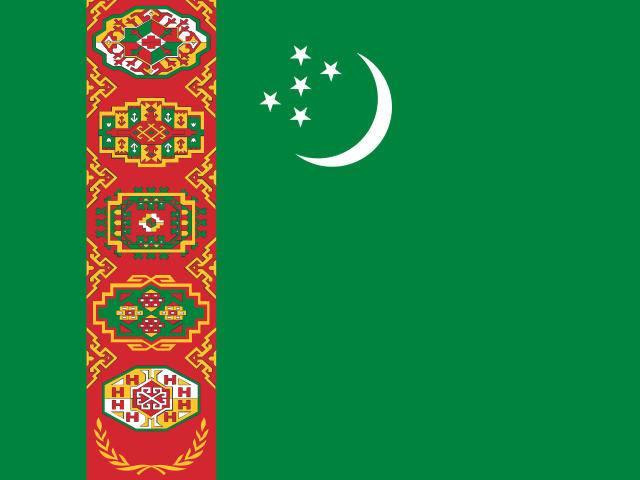 Turkmenistan66.5%
Lowest and highest reading in Central Asia.
- South-eastern Asia
62.3%
the middle country, of 5 measured · 11 members
 Thailand53.8%
 Vietnam72.4%
Lowest and highest reading in South-eastern Asia.
- Western Asia
68.9%
the middle country, of 10 measured · 19 members
Qatar37.6%Palestine90.1%Lowest and highest reading in Western Asia.
- Caribbean
71.6%
the middle country, of 6 measured · 24 members
Cuba41.6% Haiti83.2%
Lowest and highest reading in Caribbean.
- Eastern Africa
82.1%
the middle country, of 7 measured · 19 members
Mozambique55.4%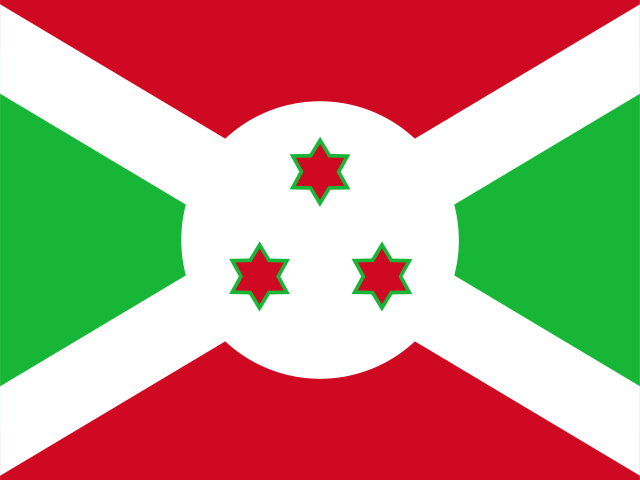 Burundi89.6%
Lowest and highest reading in Eastern Africa.
- Southern Asia
82.2%
the middle country, of 5 measured · 9 members
 Sri Lanka50.8%
 Afghanistan87.6%
Lowest and highest reading in Southern Asia.
- Middle Africa
83.5%
the middle country, of 7 measured · 9 members
 Angola67.3%
 Central African Republic90.0%
Lowest and highest reading in Middle Africa.
- Western Africa
86.5%
the middle country, of 13 measured · 16 members
 Mali72.7%Ghana94.0%
Lowest and highest reading in Western Africa.
- Eastern Asia
2 of 8 measured — too few for a middle: Mongolia, North Korea.
 Mongolia44.2%
 North Korea59.2%
Lowest and highest reading in Eastern Asia.
- Eastern Europe
1 of 10 measured — too few for a middle: Belarus.
 Belarus57.0%
Lowest and highest reading in Eastern Europe.
- Melanesia
2 of 5 measured — too few for a middle: Fiji, Vanuatu.
 Fiji80.5%
 Vanuatu88.7%
Lowest and highest reading in Melanesia.
- Micronesia
2 of 7 measured — too few for a middle: Kiribati, Nauru.
 Nauru80.6%Kiribati92.1%
Lowest and highest reading in Micronesia.
- Northern Africa
4 of 6 measured — too few for a middle: Algeria, Egypt, Libya, Tunisia.
 Libya78.2%
 Algeria84.1%
Lowest and highest reading in Northern Africa.
- Polynesia
3 of 7 measured — too few for a middle: Samoa, Tonga, Tuvalu.
Tuvalu79.7% Samoa90.8%
Lowest and highest reading in Polynesia.
- South America
4 of 12 measured — too few for a middle: Argentina, Guyana, Paraguay, Suriname.
 Paraguay52.1%Suriname87.3%
Lowest and highest reading in South America.
- Southern Africa
2 of 5 measured — too few for a middle: Eswatini, Lesotho.
 Lesotho75.8%
 Eswatini79.4%
Lowest and highest reading in Southern Africa.
- Southern Europe
4 of 17 measured — too few for a middle: Kosovo, Montenegro, North Macedonia, Serbia.
Serbia44.5%North Macedonia73.1%Lowest and highest reading in Southern Europe.
03The whole field at once
The spread
87 countries, one dot each, on one scale — further right is a higher value. Half the countries are above 75.8%; a quarter are above 85.1%, and a quarter below 62.8%. The bar in each row marks that continent’s middle country.
04All 90 ever measured
Every country
In order, highest value first — position 1 is the highest value, the way UNICEF’s own tables read. “=” marks a position shared with another country. UNICEF ranks nobody on this measure; the position is derived here by ordering the published values. The figures come from asking caregivers, so they record what adults will admit to and consider ordinary. Where hitting children is socially unacceptable the reported rate falls faster than the real one, and most high-income countries do not run this survey at all.
Showing 25 of 90 countries





























Values for the 2025 edition.
05In this edition
Violent discipline of children in records
The extremes of the statistic. A record reached by more than one country names none of them.
Highest reading
94.0%
Children aged 1-14 experiencing violent discipline (%)
Lowest reading
37.6%
Children aged 1-14 experiencing violent discipline (%)
06By sex
Inside the number
UNICEF also publishes separate female and male readings. The gap between them, where both exist.
Of the 87 countries with both readings, the girls reading is higher in 5, the boys reading in 81, and they are equal in 1. The widest gaps each way:
3 countries' readings are too old to compare and are left out; they are still listed under Every country.
07The measure
About violent discipline of children
This is the share of children aged 1 to 14 whose caregivers report using physical punishment or psychological aggression on them in the past month. It is the broadest available measure of violence against children in the home.
What the number is: Children aged 1-14 experiencing violent discipline (%).
08Where it fits
Connections
Its part in the Country Index, the statistics whose values line up most closely with it across countries, and others on the same subject.
In the Country Index
Context, with no vote
This statistic is published in full under Health & Wellbeing and Development & Human Capital, but does not help decide any Country Index standing.
Health & WellbeingDevelopment & Human CapitalWhich statistics vote, and why
Moves with
Where violent discipline of children is higher, these tend to be higher too.
- Maternal Mortality RatioKeyMMEIG · 85 countries in commonρ 0.61
- Net Official Development Assistance ReceivedOECD Development Assistance Committee · 81 countries in commonρ 0.55
- Under-Five Mortality RateKeyUN IGME · 87 countries in commonρ 0.55
Moves against
Where violent discipline of children is higher, these tend to be lower.
- Human Development IndexKeyUNDP Human Development Report Office · 84 countries in commonρ −0.59
- GDP per Capita (PPP)KeyWorld Bank Group · 81 countries in commonρ −0.58
- Life Expectancy at BirthKeyUN DESA Population Division · 87 countries in commonρ −0.58
Rank correlation (ρ, from −1 to 1) across countries, on each statistic’s newest edition, out of 60 statistics sharing at least 80 countries with this one. Two statistics that move together do not cause each other.
09Keep reading
Explore further
The data, edition by edition
10Questions
Violent discipline of children: questions and answers
Which country has the lowest violent discipline of children?
Qatar, at 37.6%, among the 87 countries compared in the 2025 edition.
Which country has the highest violent discipline of children?
Ghana, at 94.0%, among the 87 countries compared in the 2025 edition.
How many countries does the Violent Discipline of Children cover?
87 in the 2025 edition, and 90 at least once across all editions.
What is the world average violent discipline of children?
This site does not calculate a world average, which would depend on how countries are weighted. In the middle country of the 87 compared in the 2025 edition, the figure was 75.8%.
Is this UNICEF’s own ranking?
No. UNICEF publishes the values but ranks nobody; the position on this page is derived by Nations Inquiry by ordering the published values, and equal values share a position.
How often is the Violent Discipline of Children published?
This site holds one edition, describing 2025.
Where does the data come from, and can I download it?
From UNICEF, under CC BY 3.0 IGO. Read from UNICEF's own data warehouse. Coverage is concentrated in countries running MICS and DHS survey rounds. Every edition is available on this site’s Datasets pages as a full table, unrounded.
11Method
Sources, method and citation
Source
Violent Discipline of Children — UNICEF
Read from UNICEF's own data warehouse. Coverage is concentrated in countries running MICS and DHS survey rounds.
Newest edition
Report year 2025Data year not recorded
Cite the source as: UNICEF. UNICEF Data Warehouse. New York: UNICEF.
Licence: CC BY 3.0 IGO, checked 2026-09-10.
How this page reads the numbers
- UNICEF ranks nobody on this measure. The position is derived by Nations Inquiry by ordering the published values; equal values share a position.
- Which end is better follows the publisher’s own reading of the measure.
- A country is named at an end only when it holds that value alone. Where several share it, the page says how many and names none first.
- The file gives each country’s most recent reading, so the rows are from different years. Readings from before 2015 are listed but left out of every comparison on this page.
- Values are stored exactly as published and trimmed only for display. “The middle country” is the median of the countries measured, not a world average.
The full note on this data
90 countries, each from its own most recent reading (2013–2025), from UNICEF's own SDMX warehouse (PT_CHLD_1-14_PS-PSY-V_CGVR), with the figures for girls and boys beside the headline. The share of children aged 1 to 14 who experienced physical punishment or psychological aggression from a caregiver in the past month. ⚠ IT IS REPORTED BY CAREGIVERS, so it measures what adults are willing to DESCRIBE as discipline. That means the figure moves with what a society considers normal as well as with what happens to children — and a country where hitting children is taboo may under-report rather than under-do it. ⚠ ONE READING PER COUNTRY. ⚠ Coverage is 90 countries and skewed towards those running MICS and DHS survey rounds, so most of Europe and North America is absent. No rank is published; the POSITION is derived here and labelled as ours.
Photographs
The countries at the top of this statistic, from their profiles: Wikimedia Commons, shown in greyscale, each used under the licence named.
Cite this page
Nations Inquiry (2026). Violent discipline of children by country: Violent Discipline of Children, data from UNICEF. https://nationsinquiry.com/statistics/violent-discipline