
Photo: KlausFoehl derivative work: Jjtkk · CC BY-SA 3.0 · via Wikimedia Commons, shown in greyscale
Topic 11 of 18 · Country Index 2026
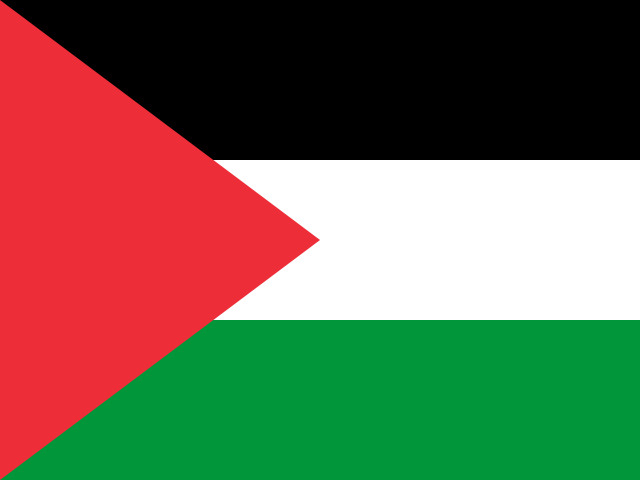
Palestine: Risk & Resilience
How exposed is a country to crisis, and how ready is it to cope?
Palestine is placed 125th of 193 countries on risk & resilience in the Country Index 2026, from 2 of its 4 key statistics. Readings behind it: INFORM Risk Index 6.4 (2025); Able to Raise Emergency Funds Within 30 Days 71.03 (2024).
Risk & Resilience
125th
of 193 countries placed
Placed from 2 of 4 key statistics
- —World Risk Index, 2025No reading for this country
- 6.4INFORM Risk Index, 2025INFORM Risk score (0–10, where 10 is the highest risk)
- —Climate Vulnerability (ND-GAIN), 2024No reading for this country
- 71.03Able to Raise Emergency Funds Within 30 Days, 2024Adults who could raise emergency funds within 30 days without great difficulty (% of population aged 15+)
01The evidence
The 4 key statistics that decide it
Only these place Palestine on risk & resilience — one vote each. Every value is the publisher’s own, read at the edition the Country Index 2026 used — or, for a survey-based key, each country’s latest reading; the grey ticks are every other country it was compared with, lowest on the left.
Key 1 of 4
World Risk Index
Institute for International Law of Peace and Armed Conflict (IFHV), Ruhr University Bochum
Why it is a key: Exposure to natural hazards set against the capacity a country has to cope with them.
2025 edition · data for 2025 · CC BY 4.0
No reading
WorldRiskIndex score (0–100, where 100 is the most at risk)
Lower is better
Institute for International Law of Peace and Armed Conflict (IFHV), Ruhr University Bochum publishes no 2025 figure for Palestine, so the standing rests on the other keys.
Across the 193 countries in this edition, values run from 0.18 (Monaco) to 46.56 (Philippines); the world median is 4.17.
- World median
- 4.17
- Best in Western Asia
- 0.87 Bahrain
- Land neighbours
- Egypt 18.91 · Israel 3.69 · Jordan 3.21
Each grey tick is one of 193 countries in the 2025 edition.
Key 2 of 4
INFORM Risk Index
European Commission Joint Research Centre, with the Inter-Agency Standing Committee
Why it is a key: Humanitarian crisis risk, which counts conflict and displacement that the hazard indices leave out. Correlates 0.468 with the World Risk Index.
2026 edition · data for 2025 · CC BY 4.0 (via the European Commission's reuse policy)
6.4
INFORM Risk score (0–10, where 10 is the highest risk)
Lower is better
Palestine: 6.4. Across the 191 countries in this edition, values run from 0.7 (Singapore) to 8.5 (South Sudan); the world median is 3.7.
- World median
- 3.7
- Best in Western Asia
- 1.4 Qatar
- Land neighbours
- Egypt 5 · Israel 3.2 · Jordan 4.4
Each grey tick is one of 191 countries in the 2026 edition.
Key 3 of 4
Climate Vulnerability (ND-GAIN)
Notre Dame Global Adaptation Initiative (ND-GAIN), University of Notre Dame
Why it is a key: How exposed and sensitive a country’s food, water, health, ecosystems, housing and infrastructure are to a changing climate, set against its capacity to adapt — the slow-onset climate risk the hazard and crisis indices do not isolate.
2024 edition · data for 2024 · CC BY 3.0 Unported
No reading
ND-GAIN Vulnerability (0–1, where 1 is the most vulnerable)
Lower is better
Notre Dame Global Adaptation Initiative (ND-GAIN), University of Notre Dame publishes no 2024 figure for Palestine, so the standing rests on the other keys.
Across the 190 countries in this edition, values run from 0.263 (Norway) to 0.655 (Mauritania); the world median is 0.45.
- World median
- 0.45
- Best in Western Asia
- 0.344 Israel
- Land neighbours
- Egypt 0.469 · Israel 0.344 · Jordan 0.429
Each grey tick is one of 190 countries in the 2024 edition.
Key 4 of 4
Able to Raise Emergency Funds Within 30 Days
World Bank Group
Why it is a key: Whether ordinary households could find money for an emergency within a month — the coping capacity of people themselves, where the other keys measure hazards and the state's readiness to meet them.
Latest reading per country, 2021–2024 · Palestine’s is from 2024 · CC BY 4.0
71.03
Adults who could raise emergency funds within 30 days without great difficulty (% of population aged 15+)
Higher is better
Palestine: 71.03. Across the 142 countries at their latest reading, values run from 16.49 (South Sudan) to 93.69 (Sweden); the world median is 53.85.
- World median
- 53.85
- Best in Western Asia
- 79.33 Saudi Arabia
- Land neighbours
- Egypt 41.43 · Israel 76.93 · Jordan 57.6
Each grey tick is one of 142 countries at its latest reading, 2021–2024.
02Over time
Which way Palestine is moving
Each key’s published value, edition by edition, beside the world median. The Country Index 2026 is the first edition of the standing, so the standing itself has no history to chart yet.
INFORM Risk Index
INFORM Risk score (0–10, where 10 is the highest risk) · lower is better
PalestineWorld median
Palestine rose from 5.4 in 2016 to 6.4 in 2025; the world median went from 3.6 to 3.7.
Every year’s figures
Year Palestine World median 2025 6.4 3.7 2024 6.3 3.5 2023 6.1 3.6 2022 5.9 3.6 2021 5.9 3.6 2020 5.5 3.6 2019 5.9 3.6 2018 5.7 3.5 2017 5.5 3.5 2016 5.4 3.6
03In context
Palestine beside its neighbours
A position reads best beside the countries around it. Every position below is a place among all 193 countries on risk & resilience, never a place within the region.
Palestine and the countries it borders
The standing is each country’s place among all 193 placed on the topic; the other columns are the publishers’ own values, read at the edition the standing used.
| Country | Standing | World Risk IndexWorldRiskIndex score (0–100, where 100 is the most at risk) | INFORM Risk IndexINFORM Risk score (0–10, where 10 is the highest risk) | Climate Vulnerability (ND-GAIN)ND-GAIN Vulnerability (0–1, where 1 is the most vulnerable) | Able to Raise Emergency Funds Within 30 DaysAdults who could raise emergency funds within 30 days without great difficulty (% of population aged 15+) |
|---|---|---|---|---|---|
 Israel Israel | 44th | 3.69 | 3.2 | 0.344 | 76.93 |
 Jordan Jordan | 93rd | 3.21 | 4.4 | 0.429 | 57.6 |
| Palestine | 125th | — | 6.4 | — | 71.03 |
 Egypt Egypt | 164th | 18.91 | 5 | 0.469 | 41.43 |
“—” means the publisher gives no reading for that country in that edition. A country needs readings on enough keys to be placed.
Across Western Asia
Every country in the sub-region, by its place among all 193.



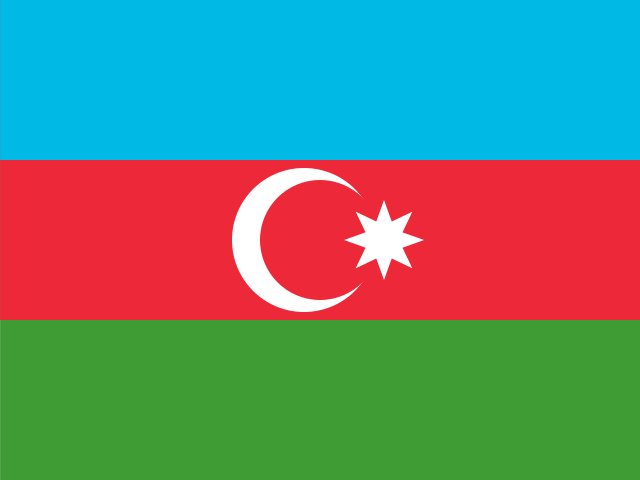
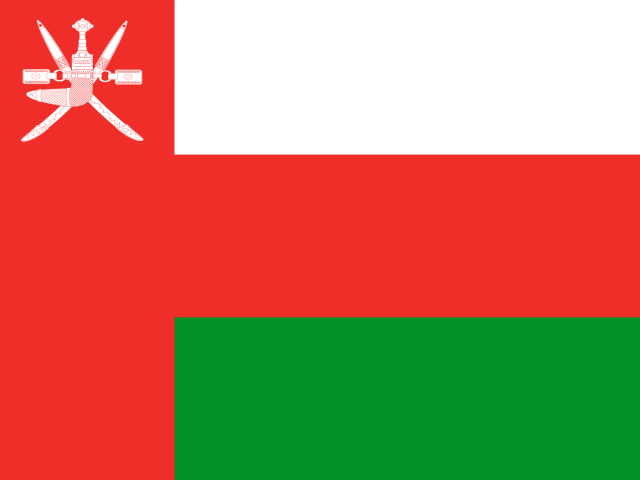
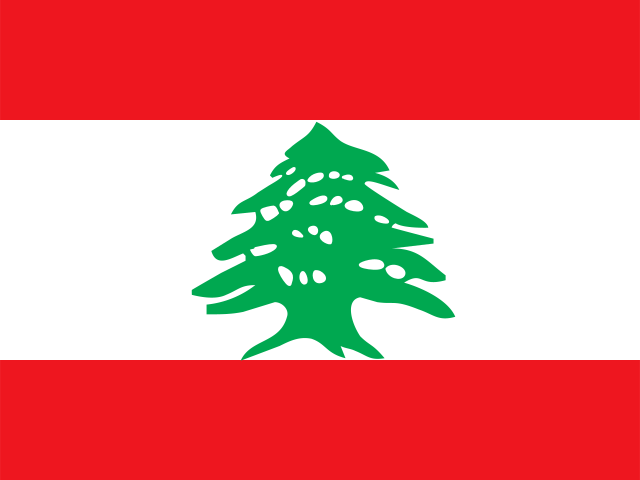
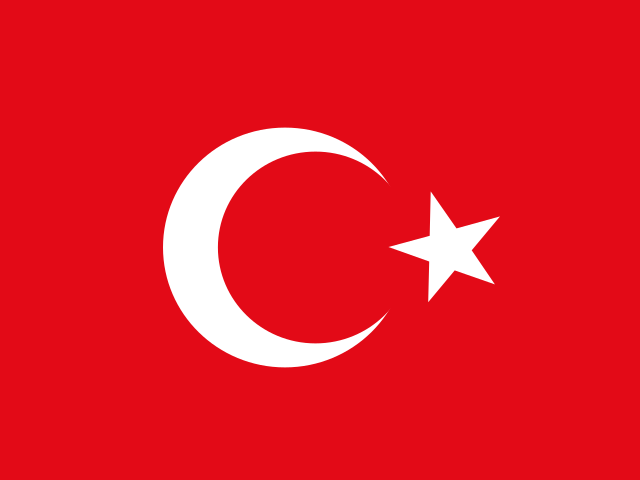

Placed either side on risk & resilience
The countries immediately above and below Palestine in the topic’s list.




04Context, no vote
Where Palestine is ahead of the world, and behind
6 more statistics filed under risk & resilience, published in full and deliberately given no vote in the standing. Select a row for the publisher, the rank and the links.
Behind the world median3
Statistics on which Palestine does worse than the middle country measured.
Adults Who Experienced a Natural Disaster or Severe WeatherWorld Bank Group · 2024 · world median 20.4631.820.46No earlier reading
Palestine: 31.8 · world median 20.46 · Adults who experienced a natural disaster or severe weather in the past three years (% of population aged 15+). World Bank Group, 2024 edition, data for 2024.
Published values in that edition run from 2.738 to 77.54; lower is better.
Position 25th of 98 — derived here by ordering the published values, 1st = worst. The publisher ranks no country on this.
INFORM Severity IndexACAPS · 2025 · world median 3.14.23.1▼ Worsened since 2020
Palestine: 4.2 · world median 3.1 · INFORM Severity (1–5, most severe crisis). ACAPS, 2025 edition, data for 2025.
Published values in that edition run from 1.3 to 4.7; lower is better.
Position 13th of 81 — derived here by ordering the published values, 1st = worst. The publisher ranks no country on this.
Political Stability and Absence of ViolenceWorld Bank Group · 2025 · world median 0.171-1.9110.171▼ Worsened since 2015
Palestine: -1.911 · world median 0.171 · Political Stability estimate (−2.5 to 2.5). World Bank Group, 2025 edition, data for 2025.
Published values in that edition run from -2.506 to 1.563; higher is better.
Position 202nd of 211 — derived here by ordering the published values, 1st = best. The publisher ranks no country on this.
No better end3
These describe the shape of a country — more is not better or worse, only different — so they are never ahead or behind.
Refugees by Country of OriginUNHCR, the UN Refugee Agency · 2025 · world median 1,27248,3231,272Moved since 2015
Palestine: 48,323 · world median 1,272 · Refugees under UNHCR's mandate from this country, end of year (people). UNHCR, the UN Refugee Agency, 2025 edition, data for 2025.
Published values in that edition run from 0 to 5,224,131.
Burned AreaGWIS · 2025 · world median 13,8241,11613,824Moved since 2015
Palestine: 1,116 · world median 13,824 · Burned area (hectares). European Commission Joint Research Centre — Global Wildfire Information System (GWIS), 2025 edition, data for 2025.
Published values in that edition run from 0 to 50,562,035.
Population Living Below 5 m ElevationCenter for International Earth Science Information Network (CIESIN), Columbia University · 2015 · world median 2.9540.2052.954No real change since 1990
Palestine: 0.205 · world median 2.954 · Population living below 5 m elevation (% of total population). Center for International Earth Science Information Network (CIESIN), Columbia University, 2015 edition, data for 2015.
Published values in that edition run from 0 to 78.48.
No current reading for Palestine
Asylum-Seekers by Country of Asylum, Baseline Water Stress (Aqueduct), Climate Readiness (ND-GAIN), Climate Vulnerability (ND-GAIN), Drought Risk (Aqueduct), Global Report on Food Crises, ND-GAIN Country Index, Refugee Population by Country of Asylum, Renewable Internal Freshwater Resources per Capita (last 2021), Riverine Flood Risk (Aqueduct), Stateless Persons by Country of Residence, Temperature Change on Land, Water Stress and World Risk Index. Listed rather than hidden, so the page can be checked against it.
05Country Index 2026
Risk & Resilience among Palestine’s 12 topics
Risk & Resilience is Palestine’s 7th best-placed topic of 12. Strongest first; each marker sits at the position divided by that topic’s field, so fields of different sizes compare fairly.
- Environment & Sustainability33rd of 1812/3 keys
- Energy78th of 1932/3 keys
- Poverty & Inequalityjoint 70th of 1592/3 keys
- Education & Knowledge105th of 1963/4 keys
- Digital & Technology108th of 1982/4 keys
- Development & Human Capital119th of 1963/3 keys
- Risk & Resilience125th of 1932/4 keys
- Health & Wellbeing138th of 2004/4 keys
- Governance & Institutions140th of 1942/4 keys
- Economy & Innovation156th of 1763/4 keys
- Democracy & Civil Liberties180th of 1982/4 keys
- Gender & Equality177th of 1833/4 keys
No standing on Work & Labour, Peace & Security, Mobility & Trade, Food & Agriculture: too few of those topics’ key statistics are published for this country.
06The top of the list
Who leads on risk & resilience
The three countries placed highest of 193, and the leaders Palestine can most readily be measured against.
 1
1 Liechtenstein
Western Europe
1st of 193 · 2 of 4 keys
Photo: Guido Radig,Inkey · CC BY 3.0, greyscale
 2
2 Luxembourg
Western Europe
2nd of 193 · 3 of 4 keys
Photo: Michal Osmenda from Brussels, Belgium · CC BY-SA 2.0, greyscale
 3
3 Denmark
Northern Europe
3rd of 193 · 4 of 4 keys
Photo: User:Aconcagua · CC BY-SA 3.0, greyscale
Placed highest nearby
Highest in Asia
 Singapore13th4/4 keys
Highest in Western Asia
 Qatar=16th3/4 keys
This page
Palestine125th2/4 keys
Positions out of 193 placed on the topic. A country needs readings on enough keys to be placed, and the top of the list is often held on fewer of them.
07Questions
Palestine on risk & resilience: questions answered
Every answer is built from the numbers on this page, so none can say something the page does not.
How does Palestine rank on risk & resilience?
Palestine is placed 125th of 193 countries on Risk & Resilience in the Country Index 2026, from 2 of its 4 key statistics (INFORM Risk Index and Able to Raise Emergency Funds Within 30 Days). The position is this site’s ordering of published statistics, not a rank any publisher printed.
What is the latest INFORM Risk Index figure for Palestine?
6.4 in 2025 (iNFORM Risk score (0–10, where 10 is the highest risk)), according to European Commission Joint Research Centre, with the Inter-Agency Standing Committee. The world median in the same edition was 3.7.
What is the latest Able to Raise Emergency Funds Within 30 Days figure for Palestine?
71.03 in 2024 (adults who could raise emergency funds within 30 days without great difficulty (% of population aged 15+)), according to World Bank Group. The world median in the same edition was 53.85.
How does Palestine compare with Egypt on risk & resilience?
Egypt is placed 164th of 193, and Palestine 125th. INFORM Risk Index: Egypt 5, Palestine 6.4; Able to Raise Emergency Funds Within 30 Days: Egypt 41.43, Palestine 71.03.
How have Palestine’s risk & resilience figures changed?
INFORM Risk Index rose from 5.4 in 2016 to 6.4 in 2025.
Which risk & resilience statistics are missing for Palestine?
No current reading is published for Palestine on Asylum-Seekers by Country of Asylum, Baseline Water Stress (Aqueduct), Climate Readiness (ND-GAIN), Climate Vulnerability (ND-GAIN), Drought Risk (Aqueduct), Global Report on Food Crises, ND-GAIN Country Index, Refugee Population by Country of Asylum, Renewable Internal Freshwater Resources per Capita, Riverine Flood Risk (Aqueduct), Stateless Persons by Country of Residence, Temperature Change on Land, Water Stress and World Risk Index. They are listed rather than hidden, so the evidence on the page can be checked against it.
08Keep reading
Explore further
Palestine, topic by topic
- Governance & Institutions140th of 194
- Economy & Innovation156th of 176
- Education & Knowledge105th of 196
- Health & Wellbeing138th of 200
- Development & Human Capital119th of 196
- Environment & Sustainability33rd of 181
- Gender & Equality177th of 183
- Democracy & Civil Liberties180th of 198
- Poverty & Inequality=70th of 159
- Energy78th of 193
- Digital & Technology108th of 198
- The full Palestine profile
Nearby, on risk & resilience
The key statistics, for every country
09Method
Method, sources and how to cite
What this topic does not measure
This topic does not forecast when a disaster will strike, and it does not measure financial or economic risk. Water stress is measured under Environment & Sustainability. Displacement caused by disasters and the severity of crises already under way are published here as context.
How the Risk & Resilience standing is decided, step by step
A standing is a place in a list, not a mark out of anything. This one is part of the Country Index 2026, and it is worked out like this.
- A few key indicators decide it; the rest are context. 4 indicators on this topic are keys and 18 are charted alongside them without a vote. That split is the point: if every statistic voted, importing five more of one kind would quietly change what the topic is about.
- Each key is read at one edition. ⚠ The keys behind this standing do not all describe the same year — they run from 2024 to 2025, because publishers release on their own schedules. Read the standing as “how this country places now”, not as a snapshot of one year.
- Every country’s published value is turned into a place within that one key’s own field, and then expressed as a share of that field — how far down this key’s list the country sits, rather than how many countries are above it. Keys where a higher published number is worse (terrorism, hunger, disaster risk) are turned round first, so the good end is always the same end.
- Dividing by the field first is the whole reason this works. A place carries the size of its list inside it: 22nd of 44 and 108th of 215 are the same showing, and averaging the numbers 22 and 108 says loudly that they are not. Fields on this site run from about 44 countries to about 215, so averaging raw places would reward a country for happening to be measured in small ones. Dividing each place by its own field removes the size and leaves only the showing.
- The shares are averaged, plainly. One key, one vote — no key is weighted above another, because any weighting would be this site’s opinion presented as a measurement. Countries are then put in order by that average, and the average itself is never published. It is our arithmetic with nothing anchoring it, so printing it would invite it to be read as a measurement somebody made. The position it produces, the band, and the keys it was built from are all published instead — every one of them checkable against the tables on this page.
- A country needs 2 of this topic’s 4 keys — half, rounded up, and never fewer than 2. A standing built from one reading, printed beside one built from four, is two different things sharing a column heading. 193 countries clear the bar here.
- A key has to earn its vote every edition. It must measure at least 120 countries (below that it starts measuring who was surveyed rather than the world), it must not have more than 10% of its field tied at either end, and it must not repeat another key in the same topic — Spearman correlation above 0.92 counts as repeating. A topic needs at least 2 surviving keys to place anyone at all; this one has 4.
- A standing is relative, and the grouping is ours. It says where a country places against the others measured alongside it, so it moves when they move. The publishers listed on this page did not agree to be read together, and each measures its subject its own way: the underlying numbers are theirs, the ordering on top is this site’s — the same method as the rest of the Country Index, applied to one subject instead of all of them.
The key statistics and their licences
- World Risk Index — Institute for International Law of Peace and Armed Conflict (IFHV), Ruhr University Bochum, CC BY 4.0
- INFORM Risk Index — European Commission Joint Research Centre, with the Inter-Agency Standing Committee, CC BY 4.0 (via the European Commission's reuse policy)
- Climate Vulnerability (ND-GAIN) — Notre Dame Global Adaptation Initiative (ND-GAIN), University of Notre Dame, CC BY 3.0 Unported
- Able to Raise Emergency Funds Within 30 Days — World Bank Group, CC BY 4.0
The other 6 statistics on this page come from 5 publishers, each named beside its numbers, with every edition and licence on the datasets pages.
The standing itself is part of the Country Index 2026, published under CC BY-SA 4.0.
Photographs
Palestine’s banner and the countries placed highest, from their profiles: Wikimedia Commons, shown in greyscale, each used under the licence named.
- Palestine (banner) — KlausFoehl derivative work: Jjtkk, CC BY-SA 3.0
- Liechtenstein — Guido Radig,Inkey, CC BY 3.0
- Luxembourg — Michal Osmenda from Brussels, Belgium, CC BY-SA 2.0
- Denmark — User:Aconcagua, CC BY-SA 3.0
Cite this page
Nations Inquiry (2026). Palestine: Risk & Resilience — standing and statistics, Country Index 2026. https://nationsinquiry.com/countries/palestine/risk