Loading…
FAO · Agricultural Irrigated Land
Irrigated farmland by country
How much of a country's farmland is irrigated?
Of the 98 countries compared in the 2023 edition, Bangladesh had the highest reading, 89.041%, and Iceland had the lowest reading, 0.003%. In the middle country the figure was 3.764%. 23 readings from before 2013 are listed but not compared.
Part ofDevelopment & Human CapitalEnvironment & Sustainability
Irrigated farmland · the 2023 edition
Context statistic
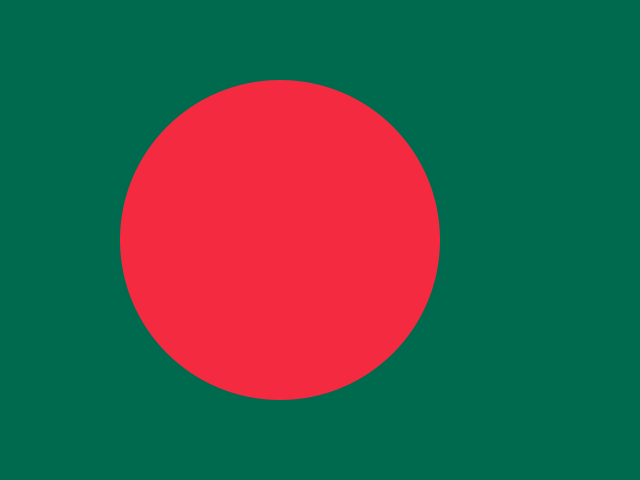
Highest of 98Bangladesh
89.041%01the 2023 edition · position · derived
The highest and the lowest
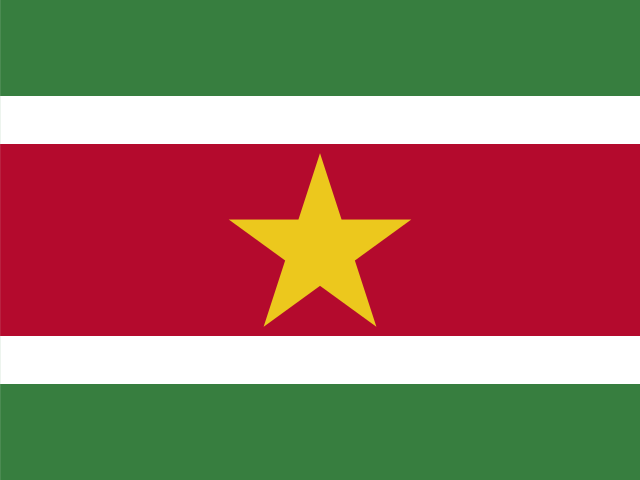
The three countries with the highest values of 98 compared, the three with the lowest, and the highest on each continent. This statistic has no better end, so no country is shown as leading.
- 1
- 2
- 3
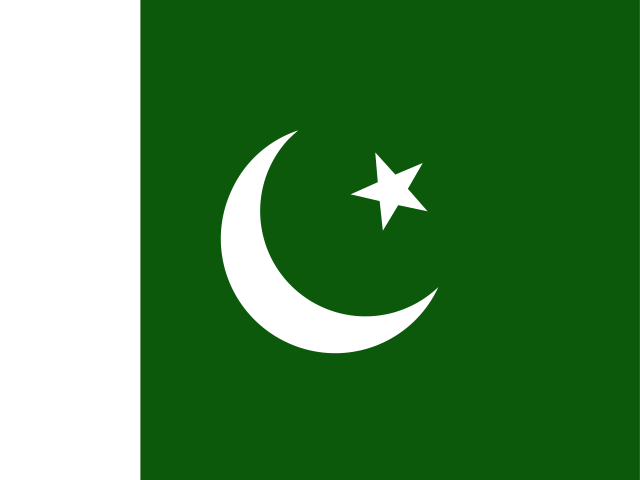
Highest on each continent
- Africa
 Mauritius15.705%
 - AmericasSuriname74.359%
- AsiaBangladesh89.041%
- Europe
 Malta33.868%
 - Oceania
 New Zealand6.297%
2 of 21 measured
- Every region
02Every measured country
Irrigated farmland on a map
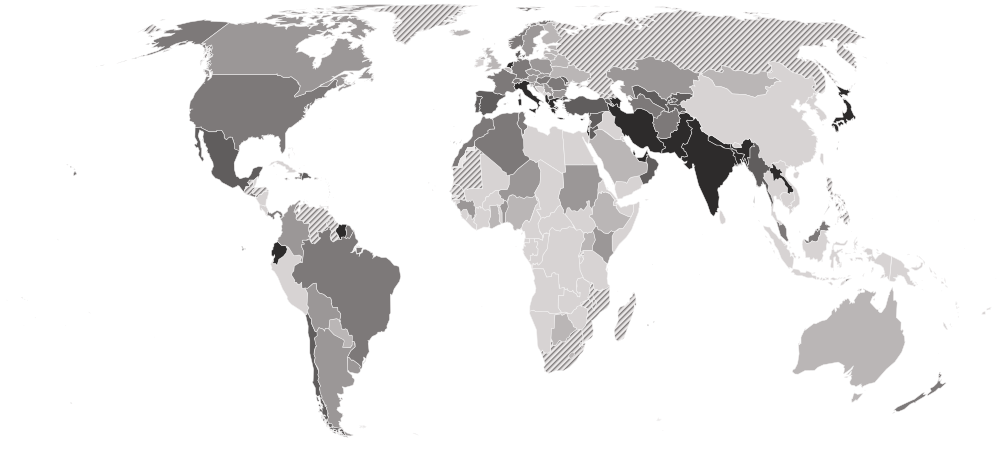
Each country is shaded by its value, in five groups holding the same number of countries. Hover a country for its value, or select it to open its profile. Below the map, each continent’s middle country.
Darker is a higher value. This statistic has no better end, so the shades describe size, not success.
- 0.003–0.535%
- 0.574–1.688%
- 1.801–6.425%
- 6.581–15.705%
- 16.938–89.041%
- Hatched: a reading from before 2013, listed but not compared (23)
- No reading in the 2023 edition
- Asia
13.205%
the middle country, of 29 measured · 52 members
Bangladesh89.041% Mongolia0.047%
Highest and lowest reading in Asia.
- Americas
2.939%
the middle country, of 16 measured · 48 members
Suriname74.359% Paraguay0.483%
Highest and lowest reading in Americas.
- Europe
1.652%
the middle country, of 36 measured · 49 members
Malta33.868% Iceland0.003%
Highest and lowest reading in Europe.
- Africa
0.618%
the middle country, of 15 measured · 55 members
Mauritius15.705% Botswana0.010%
Highest and lowest reading in Africa.
- Oceania
2 of 21 measured — too few for a middle: Australia, New Zealand.
New Zealand6.297% Australia0.535%
Highest and lowest reading in Oceania.
- Every region
18 sub-regions, highest middle country first
- Southern Asia
38.353%
the middle country, of 6 measured · 9 members
Bangladesh89.041% Afghanistan5.979%
Highest and lowest reading in Southern Asia.
- Southern Europe
14.930%
the middle country, of 10 measured · 17 members
Malta33.868% Slovenia0.664%
Highest and lowest reading in Southern Europe.
- Western Asia
10.961%
the middle country, of 12 measured · 19 members
 Israel36.106%
 Saudi Arabia0.436%
Highest and lowest reading in Western Asia.
- Central Asia
9.693%
the middle country, of 5 measured · 5 members
 Tajikistan14.647%
 Kazakhstan0.830%
Highest and lowest reading in Central Asia.
- Western Europe
2.292%
the middle country, of 7 measured · 9 members
 Netherlands21.575%
 Luxembourg0.276%
Highest and lowest reading in Western Europe.
- South America
1.571%
the middle country, of 9 measured · 12 members
Suriname74.359%Paraguay0.483%Highest and lowest reading in South America.
- Eastern Europe
0.871%
the middle country, of 9 measured · 10 members
 Moldova8.730%
 Ukraine0.240%
Highest and lowest reading in Eastern Europe.
- Western Africa
0.574%
the middle country, of 5 measured · 16 members
 Benin1.144%
 Ghana0.291%
Highest and lowest reading in Western Africa.
- Northern Europe
0.383%
the middle country, of 10 measured · 13 members
 Denmark6.868%Iceland0.003%
Highest and lowest reading in Northern Europe.
- Australia and New Zealand
2 of 2 measured — too few for a middle: Australia, New Zealand.
New Zealand6.297%Australia0.535%Highest and lowest reading in Australia and New Zealand.
- Caribbean
2 of 24 measured — too few for a middle: Dominican Republic, Haiti.
 Dominican Republic11.170%
 Haiti3.868%
Highest and lowest reading in Caribbean.
- Central America
3 of 8 measured — too few for a middle: El Salvador, Mexico, Panama.
 Mexico6.581%
 Panama1.801%
Highest and lowest reading in Central America.
- Eastern Africa
4 of 19 measured — too few for a middle: Ethiopia, Kenya, Mauritius, Uganda.
Mauritius15.705% Uganda0.073%
Highest and lowest reading in Eastern Africa.
- Eastern Asia
2 of 8 measured — too few for a middle: Japan, Mongolia.
 Japan32.300%Mongolia0.047%
Highest and lowest reading in Eastern Asia.
- Northern Africa
4 of 6 measured — too few for a middle: Algeria, Morocco, Sudan, Tunisia.
 Morocco5.959%
 Sudan1.390%
Highest and lowest reading in Northern Africa.
- Northern America
2 of 4 measured — too few for a middle: Canada, United States.
 United States5.101%
 Canada1.560%
Highest and lowest reading in Northern America.
- South-eastern Asia
4 of 11 measured — too few for a middle: Brunei, Laos, Malaysia, Myanmar.
 Laos19.281%
 Malaysia5.157%
Highest and lowest reading in South-eastern Asia.
- Southern Africa
2 of 5 measured — too few for a middle: Botswana, Lesotho.
 Lesotho0.053%Botswana0.010%
Highest and lowest reading in Southern Africa.
03The whole field at once
The spread
98 countries, one dot each, on one scale — further right is a higher value. Half the countries are above 3.764%; a quarter are above 13.021%, and a quarter below 0.699%. The bar in each row marks that continent’s middle country.
Log scale: each gridline is ten times the one before, so countries of very different sizes can be seen on one line.
04All 121 ever measured
Every country
In order, highest value first. “=” marks a position shared with another country. Food and Agriculture Organization of the United Nations (FAO) ranks nobody on this measure; the position is derived here by ordering the published values. Neither end is the good end. A low share is normal wherever rainfall is reliable, and a high one can mean either productive, well-watered agriculture or dependence on an aquifer that is being drained faster than it refills.
Showing 25 of 121 countries







Values for the 2023 edition.
05In this edition
Irrigated farmland in records
The extremes of the statistic. A record reached by more than one country names none of them.
Highest reading
89.041%
Irrigated share of agricultural land (%)
Lowest reading
0.003%
Irrigated share of agricultural land (%)
06The measure
About irrigated farmland
This is how much of a country's farmland is irrigated rather than rain-fed. Irrigation is what turns water into food — and what leaves a farming system exposed when the water runs short.
What the number is: Irrigated share of agricultural land (%).
07Where it fits
Connections
Its part in the Country Index, the statistics whose values line up most closely with it across countries, and others on the same subject.
In the Country Index
Context, with no vote
This statistic is published in full under Development & Human Capital and Environment & Sustainability, but does not help decide any Country Index standing.
Development & Human CapitalEnvironment & SustainabilityWhich statistics vote, and why
Moves with
Where irrigated farmland is higher, these tend to be higher too.
- Livestock DensityFAO · 96 countries in commonρ 0.50
- Water StressKeyFAO · 96 countries in commonρ 0.44
- Water Withdrawal by SectorFAO · 91 countries in commonρ 0.41
Moves against
Where irrigated farmland is higher, these tend to be lower.
- Arable Land per PersonFAO · 97 countries in commonρ −0.48
Rank correlation (ρ, from −1 to 1) across countries, on each statistic’s newest edition, out of 87 statistics sharing at least 80 countries with this one. Two statistics that move together do not cause each other.
08Keep reading
Explore further
The data, edition by edition
09Questions
Irrigated farmland: questions and answers
Which country has the highest irrigated farmland?
Bangladesh, at 89.041%, among the 98 countries compared in the 2023 edition.
Which country has the lowest irrigated farmland?
Iceland, at 0.003%, among the 98 countries compared in the 2023 edition.
How many countries does the Agricultural Irrigated Land cover?
98 in the 2023 edition, and 121 at least once across all editions.
What is the world average irrigated farmland?
This site does not calculate a world average, which would depend on how countries are weighted. In the middle country of the 98 compared in the 2023 edition, the figure was 3.764%.
Is this Food and Agriculture Organization of the United Nations (FAO)’s own ranking?
No. Food and Agriculture Organization of the United Nations (FAO) publishes the values but ranks nobody; the position on this page is derived by Nations Inquiry by ordering the published values, and equal values share a position.
How often is the Agricultural Irrigated Land published?
This site holds one edition, describing 2023.
Where does the data come from, and can I download it?
From Food and Agriculture Organization of the United Nations (FAO), under CC BY 4.0. From FAO's AQUASTAT via the World Bank's indicator API. Taken as one reading per country: no single year reaches 80 countries, while 121 have reported at some point. Every edition is available on this site’s Datasets pages as a full table, unrounded.
10Method
Sources, method and citation
Source
Agricultural Irrigated Land — Food and Agriculture Organization of the United Nations (FAO)
From FAO's AQUASTAT via the World Bank's indicator API. Taken as one reading per country: no single year reaches 80 countries, while 121 have reported at some point.
Newest edition
Report year 2023Data year not recorded
Cite the source as: FAO. AQUASTAT. Rome: Food and Agriculture Organization of the United Nations.
Licence: CC BY 4.0, checked 2026-09-10.
How this page reads the numbers
- Food and Agriculture Organization of the United Nations (FAO) ranks nobody on this measure. The position is derived by Nations Inquiry by ordering the published values; equal values share a position.
- This statistic has no better end, so the page describes higher and lower values and never calls a country a leader.
- A country is named at an end only when it holds that value alone. Where several share it, the page says how many and names none first.
- The file gives each country’s most recent reading, so the rows are from different years. Readings from before 2013 are listed but left out of every comparison on this page.
- Values are stored exactly as published and trimmed only for display. “The middle country” is the median of the countries measured, not a world average.
The full note on this data
121 countries, each from its own most recent reading (2001–2023), from FAO's AQUASTAT via the World Bank's indicator API (AG.LND.IRIG.AG.ZS). Irrigation is the link between the water measures and the agriculture measures already on the site: it is what turns water into food, and what makes a farming system vulnerable when the water runs short. ⚠ NEITHER END IS BETTER — a low share is entirely normal wherever rain is reliable, and a high one can mean productive agriculture or dependence on a shrinking aquifer. ⚠ ONE READING PER COUNTRY rather than annual editions, and this is why the row was deferred in batch 7 and built in batch 8: read year by year the series reaches 61 countries at best, and read as one reading each it reaches 121. The SHAPE was the limit, not the data. Each row carries its own year. The FAO ranks nobody; the POSITION is a SIZE ORDER derived here and labelled as ours.
Cite this page
Nations Inquiry (2026). Irrigated farmland by country: Agricultural Irrigated Land, data from Food and Agriculture Organization of the United Nations (FAO). https://nationsinquiry.com/statistics/irrigated-land