Loading…

Photo: Slashme · CC BY-SA 3.0 · via Wikimedia Commons, shown in greyscale
Topic 03 of 12 · Country Index 2026

Nigeria: Work & Labour
Can people find work, and on what terms?
Nigeria is placed 16th of 182 countries on work & labour in the Country Index 2026, from 4 of its 4 key statistics. Readings behind it: Employment-to-Population Ratio 79.99 (2025); Labour Income Share 75.13 (2025).
Work & Labour
16th
of 182 countries placed
Placed from 4 of 4 key statistics
01The evidence
The 4 key statistics that decide it
Only these place Nigeria on work & labour — one vote each. Every value is the publisher’s own, read at the edition the Country Index 2026 used; the grey ticks are every other country in that edition, lowest on the left.
Key 1 of 4
Employment-to-Population Ratio
International Labour Organization (ILO)
Why it is a key: How much of the working-age population is actually in work — the half of the picture unemployment hides, because people who stop looking stop being counted.
2025 edition · data for 2025 · CC BY 4.0
79.99
Employed share of the population aged 15+ (%)
Higher is better
Nigeria: 79.99. Across the 182 countries in this edition, values run from 21.21 (São Tomé and Príncipe) to 86.9 (Qatar); the world median is 57.72.
- World median
- 57.72
- Best in Western Africa
- 79.99 Nigeria
- Land neighbours
- Benin 75.14 · Cameroon 62.82 · Niger 79.43 · Chad 58.81
Each grey tick is one of 182 countries in the 2025 edition.
Key 3 of 4
Unemployment Rate
International Labour Organization (ILO)
Why it is a key: The share of people looking for work who cannot find it.
2025 edition · data for 2025 · CC BY 4.0
3.064
Unemployment (% of labour force)
Lower is better
Nigeria: 3.064. Across the 182 countries in this edition, values run from 0.13 (Qatar) to 34.2 (Eswatini); the world median is 5.084.
- World median
- 5.084
- Best in Western Africa
- 0.394 Niger
- Land neighbours
- Benin 1.589 · Cameroon 3.602 · Niger 0.394 · Chad 1.057
Each grey tick is one of 182 countries in the 2025 edition.
Key 4 of 4
Vulnerable Employment
International Labour Organization (ILO)
Why it is a key: How much work is own-account or unpaid family labour, carrying no contract and no protection.
2025 edition · data for 2025 · CC BY 4.0
66.48
Vulnerable employment (% of total employment)
Lower is better
Nigeria: 66.48. Across the 182 countries in this edition, values run from 0.456 (Qatar) to 90.22 (Chad); the world median is 28.67.
- World median
- 28.67
- Best in Western Africa
- 34.26 Cabo Verde
- Land neighbours
- Benin 78.53 · Cameroon 67.56 · Niger 83.73 · Chad 90.22
Each grey tick is one of 182 countries in the 2025 edition.
02Over time
Which way Nigeria is moving
Each key’s published value, edition by edition, beside the world median. The Country Index 2026 is the first edition of the standing, so the standing itself has no history to chart yet.
Employment-to-Population Ratio
Employed share of the population aged 15+ (%) · higher is better
NigeriaWorld median
Nigeria fell from 80.08 in 2000 to 79.99 in 2025; the world median went from 55.86 to 57.72.
Every year’s figures
Year Nigeria World median 2025 79.99 57.720 2024 80.05 57.694 2023 80.02 58.158 2022 78.16 57.688 2021 75.81 56.066 2020 74.78 55.691 2019 76.79 57.871 2018 76.85 56.911 2017 76.98 56.738 2016 77.21 56.845 2015 77.45 56.788 2014 77.62 56.774 2013 77.84 56.229 2012 78.01 56.289 2011 78.06 56.297 2010 78.24 56.212 2009 78.45 56.255 2008 78.51 57.308 2007 78.69 56.933 2006 78.89 56.685 2005 79.11 56.129 2004 79.48 55.465 2003 79.67 55.630 2002 79.90 55.843 2001 79.94 56.018 2000 80.08 55.861 Labour Income Share
Labour income share of GDP (%) · higher is better
NigeriaWorld median
Nigeria rose from 65.27 in 2004 to 75.13 in 2025; the world median went from 46.01 to 46.23.
Every year’s figures
Year Nigeria World median 2025 75.13 46.230 2024 75.14 46.060 2023 75.28 45.900 2022 73.60 45.615 2021 74.88 45.433 2020 73.98 47.267 2019 74.78 46.277 2018 72.21 46.187 2017 70.93 46.467 2016 65.83 46.798 2015 66.97 46.876 2014 69.35 47.281 2013 68.90 46.887 2012 67.72 46.231 2011 65.45 45.679 2010 64.51 46.024 2009 64.67 47.071 2008 65.12 45.312 2007 65.32 45.246 2006 65.62 45.670 2005 65.72 46.265 2004 65.27 46.012 Unemployment Rate
Unemployment (% of labour force) · lower is better
NigeriaWorld median
Nigeria fell from 3.953 in 2000 to 3.064 in 2025; the world median went from 6.918 to 5.084.
Every year’s figures
Year Nigeria World median 2025 3.064 5.08 2024 3.045 5.15 2023 3.074 5.21 2022 3.827 5.34 2021 5.404 6.04 2020 5.714 6.38 2019 5.206 5.36 2018 5.069 5.35 2017 4.830 5.59 2016 4.499 5.90 2015 4.134 6.41 2014 3.900 6.58 2013 3.711 6.71 2012 3.761 6.79 2011 3.770 6.90 2010 3.744 7.04 2009 3.763 6.67 2008 3.792 5.79 2007 3.794 6.00 2006 3.749 6.50 2005 3.727 7.09 2004 3.590 6.80 2003 3.637 6.95 2002 3.669 6.91 2001 3.900 6.96 2000 3.953 6.92 Vulnerable Employment
Vulnerable employment (% of total employment) · lower is better
NigeriaWorld median
Nigeria fell from 73.91 in 2000 to 66.48 in 2025; the world median went from 35.67 to 28.67.
Every year’s figures
Year Nigeria World median 2025 66.48 28.67 2024 66.74 29.04 2023 66.96 29.33 2022 67.25 29.67 2021 67.42 30.01 2020 67.96 30.54 2019 66.90 29.98 2018 67.14 30.15 2017 67.44 29.93 2016 67.75 29.91 2015 67.89 30.26 2014 68.05 30.47 2013 68.37 31.14 2012 68.68 31.00 2011 68.99 31.41 2010 69.50 32.37 2009 70.11 32.59 2008 70.44 31.76 2007 70.89 33.47 2006 71.31 34.27 2005 71.73 34.66 2004 72.23 35.51 2003 72.84 35.90 2002 73.44 35.96 2001 73.81 35.27 2000 73.91 35.67
03In context
Nigeria beside its neighbours
A position reads best beside the countries around it. Every position below is a place among all 182 countries on work & labour, never a place within the region.
1st182ndNot placed · 42 countries with too few key statisticsNo data
Nigeria and the countries it borders
The standing is each country’s place among all 182 placed on the topic; the other columns are the publishers’ own values, read at the edition the standing used.
| Country | Standing | Employment-to-Population RatioEmployed share of the population aged 15+ (%) | Labour Income ShareLabour income share of GDP (%) | Unemployment RateUnemployment (% of labour force) | Vulnerable EmploymentVulnerable employment (% of total employment) |
|---|---|---|---|---|---|
| Nigeria | 16th | 79.99 | 75.13 | 3.064 | 66.48 |
 Benin Benin | 70th | 75.14 | 39.95 | 1.589 | 78.53 |
 Niger Niger | =95th | 79.43 | 27.76 | 0.394 | 83.73 |
 Cameroon Cameroon | 97th | 62.82 | 44.37 | 3.602 | 67.56 |
 Chad Chad | =117th | 58.81 | 39.11 | 1.057 | 90.22 |
“—” means the publisher gives no reading for that country in that edition. A country needs readings on enough keys to be placed.
Across Western Africa
Every country in the sub-region, by its place among all 182.



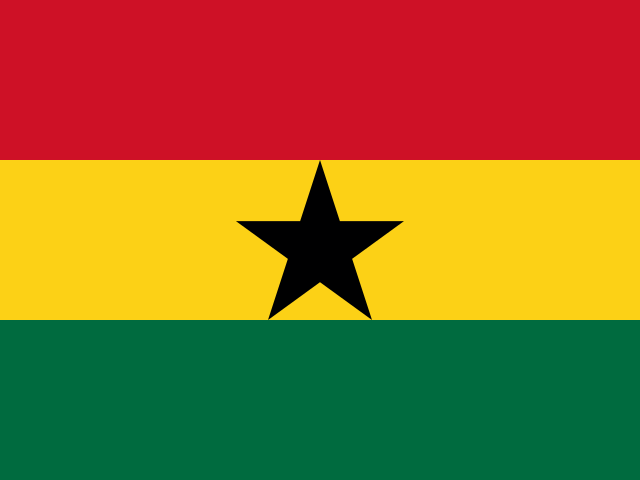
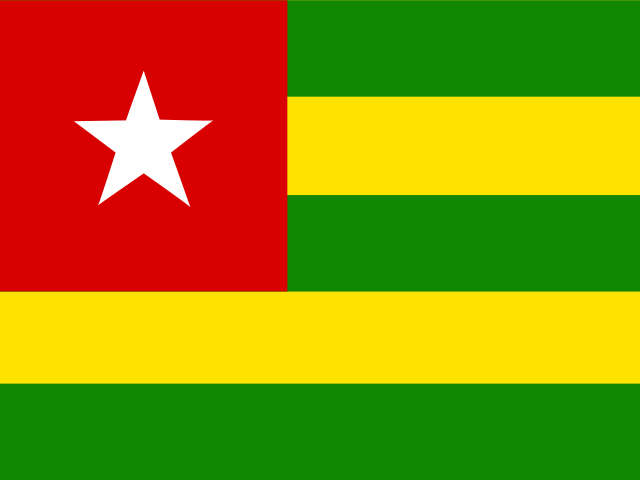



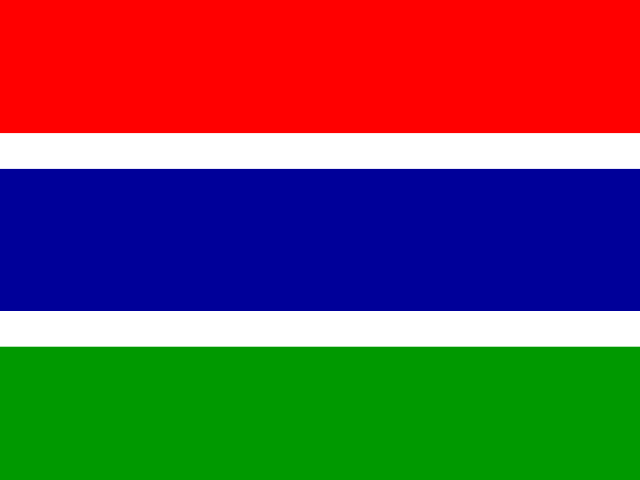

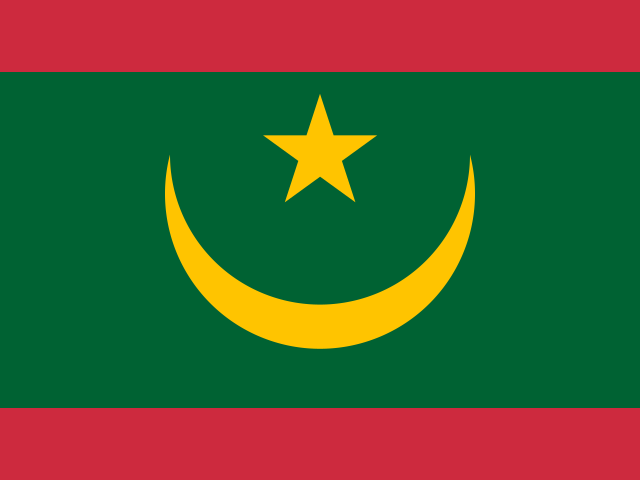
Placed either side on work & labour
The countries immediately above and below Nigeria in the topic’s list.




04Context, no vote
Where Nigeria is ahead of the world, and behind
17 more statistics filed under work & labour, published in full and deliberately given no vote in the standing. Select a row for the publisher, the rank and the links.
Ahead of the world median5
Statistics on which Nigeria does better than the middle country measured.
Female Labour Force Participation RateILO · 2025 · world median 53.3680.753.36▲ Improved since 2015
Nigeria: 80.7 · world median 53.36 · Women aged 15+ in the labour force (%). International Labour Organization (ILO), 2025 edition, data for 2025.
Published values in that edition run from 4.663 to 82.91; higher is better.
Position 3rd of 182 — derived here by ordering the published values, 1st = best. The publisher ranks no country on this.
Labour Force Participation RateILO · 2025 · world median 61.6682.5261.66No real change since 2015
Nigeria: 82.52 · world median 61.66 · Population aged 15+ in the labour force (%). International Labour Organization (ILO), 2025 edition, data for 2025.
Published values in that edition run from 23.34 to 87.01; higher is better.
Position 5th of 182 — derived here by ordering the published values, 1st = best. The publisher ranks no country on this.
Youth Unemployment RateILO · 2025 · world median 12.835.3412.83▲ Improved since 2015
Nigeria: 5.34 · world median 12.83 · Unemployment, ages 15-24 (% of youth labour force). International Labour Organization (ILO), 2025 edition, data for 2025.
Published values in that edition run from 0.457 to 76.77; lower is better.
Position 155th of 182 — derived here by ordering the published values, 1st = worst. The publisher ranks no country on this.
Youth Not in Education, Employment or TrainingILO · 2024 · world median 14.3111.9114.31▲ Improved since 2016
Nigeria: 11.91 · world median 14.31 · Youth not in education, employment or training (%). International Labour Organization (ILO), 2024 edition, data for 2024.
Published values in that edition run from 3.975 to 65.73; lower is better.
Position 64th of 97 — derived here by ordering the published values, 1st = worst. The publisher ranks no country on this.
Female Share of Senior and Middle ManagementILO · 2024 · world median 35.8637.8635.86No earlier reading
Nigeria: 37.86 · world median 35.86 · Women in senior and middle management (% of managers). International Labour Organization (ILO), 2024 edition, data for 2024.
Published values in that edition run from 7.226 to 56.69; higher is better.
Position 34th of 86 — derived here by ordering the published values, 1st = best. The publisher ranks no country on this.
Behind the world median6
Statistics on which Nigeria does worse than the middle country measured.
Firms with a Female Top ManagerWorld Bank Group · 2025 · world median 19.1614.2719.16No earlier reading
Nigeria: 14.27 · world median 19.16 · Firms with a female top manager (%). World Bank Group, 2025 edition, data for 2025.
Published values in that edition run from 1.429 to 62.9; higher is better.
Position 122nd of 179 — derived here by ordering the published values, 1st = best. The publisher ranks no country on this.
Working Poverty RateILO · 2025 · world median 4.88527.914.885No real change since 2015
Nigeria: 27.91 · world median 4.885 · Employed people living in extreme poverty (%). International Labour Organization (ILO), 2025 edition, data for 2025.
Published values in that edition run from 0.007 to 86.02; lower is better.
Trade Union DensityILO · 2020 · world median 16.689.94316.68No earlier reading
Nigeria: 9.943 · world median 16.68 · Employees who are trade union members (%). International Labour Organization (ILO), 2020 edition, data for 2020.
Published values in that edition run from 0.2 to 91.42; higher is better.
Position 103rd of 139 — derived here by ordering the published values, 1st = best. The publisher ranks no country on this.
GDP per Person EmployedWorld Bank Group · 2025 · world median 47,38417,12047,384▼ Worsened since 2015
Nigeria: 17,120 · world median 47,384 · GDP per person employed (constant 2021 international $). World Bank Group, 2025 edition, data for 2025.
Published values in that edition run from 2,456 to 262,554; higher is better.
Position 132nd of 168 — derived here by ordering the published values, 1st = best. The publisher ranks no country on this.
Labour Productivity per Hour WorkedILO · 2025 · world median 22.165.622.16▼ Worsened since 2015
Nigeria: 5.6 · world median 22.16 · Output per hour worked (constant 2021 international $ at PPP). International Labour Organization (ILO), 2025 edition, data for 2025.
Published values in that edition run from 0.92 to 164.65; higher is better.
Position 155th of 182 — derived here by ordering the published values, 1st = best. The publisher ranks no country on this.
Informal Employment RateILO · 2025 · world median 36.8392.7536.83No earlier reading
Nigeria: 92.75 · world median 36.83 · Informal employment (% of total employment). International Labour Organization (ILO), 2025 edition, data for 2025.
Published values in that edition run from 0.857 to 94.44; lower is better.
Position 5th of 97 — derived here by ordering the published values, 1st = worst. The publisher ranks no country on this.
No better end6
These describe the shape of a country — more is not better or worse, only different — so they are never ahead or behind.
Self-Employment RateILO · 2025 · world median 31.8486.1531.84No real change since 2015
Nigeria: 86.15 · world median 31.84 · Self-employed (% of total employment). International Labour Organization (ILO), 2025 edition, data for 2025.
Published values in that edition run from 0.832 to 91.56.
Position 5th of 182 — derived here by ordering the published values, counted from the highest value. The publisher ranks no country on this.
Employment in AgricultureILO · 2025 · world median 14.3833.5314.38No real change since 2015
Nigeria: 33.53 · world median 14.38 · Employment in agriculture (% of total employment). International Labour Organization (ILO), 2025 edition, data for 2025.
Published values in that edition run from 0.095 to 85.34.
Position 50th of 182 — derived here by ordering the published values, counted from the highest value. The publisher ranks no country on this.
Average Weekly Hours WorkedILO · 2025 · world median 38.8939.5338.89Moved since 2015
Nigeria: 39.53 · world median 38.89 · Average weekly hours actually worked per employed person. International Labour Organization (ILO), 2025 edition, data for 2025.
Published values in that edition run from 23.64 to 54.7.
Position 87th of 182 — derived here by ordering the published values, counted from the highest value. The publisher ranks no country on this.
Employment in IndustryILO · 2025 · world median 18.8817.0118.88Moved since 2015
Nigeria: 17.01 · world median 18.88 · Employment in industry (% of total employment). International Labour Organization (ILO), 2025 edition, data for 2025.
Published values in that edition run from 3.103 to 39.44.
Position 113th of 182 — derived here by ordering the published values, counted from the highest value. The publisher ranks no country on this.
Public Sector EmploymentWorld Bank Group · 2022 · world median 15.018.01515.01No earlier reading
Nigeria: 8.015 · world median 15.01 · Public sector employment (% of total employment). World Bank Group, 2022 edition, data for 2022.
Published values in that edition run from 1.672 to 47.1.
Position 96th of 135 — derived here by ordering the published values, counted from the highest value. The publisher ranks no country on this.
Employment in ServicesILO · 2025 · world median 59.5149.4659.51Moved since 2015
Nigeria: 49.46 · world median 59.51 · Employment in services (% of total employment). International Labour Organization (ILO), 2025 edition, data for 2025.
Published values in that edition run from 11.56 to 92.17.
Position 130th of 182 — derived here by ordering the published values, counted from the highest value. The publisher ranks no country on this.
No current reading for Nigeria
Fatal Occupational Injuries. Listed rather than hidden, so the page can be checked against it.
05Country Index 2026
Work & Labour among Nigeria’s 12 topics
Work & Labour is Nigeria’s best-placed topic of 12. Strongest first; each marker sits at the position divided by that topic’s field, so fields of different sizes compare fairly.
- Work & Labour16th of 1824/4 keys
- Environment & Sustainability88th of 1613/3 keys
- Governance & Institutions114th of 1935/5 keys
- Peace & Security112th of 1773/3 keys
- Democracy & Civil Liberties128th of 1983/3 keys
- Mobility & Connectivityjoint 107th of 1473/3 keys
- Economy & Innovationjoint 114th of 1503/3 keys
- Education & Knowledgejoint 150th of 1823/4 keys
- Gender & Equality157th of 1783/3 keys
- Development & Human Capital175th of 1943/3 keys
- Risk & Resilience176th of 1913/3 keys
- Health & Wellbeing193rd of 2014/4 keys
06The top of the list
Who leads on work & labour
The three countries placed highest of 182, and the leaders Nigeria can most readily be measured against.
 1
1 Iceland
Northern Europe
1st of 182 · 4 of 4 keys
Photo: Hansueli Krapf · CC BY-SA 3.0, greyscale
 2
2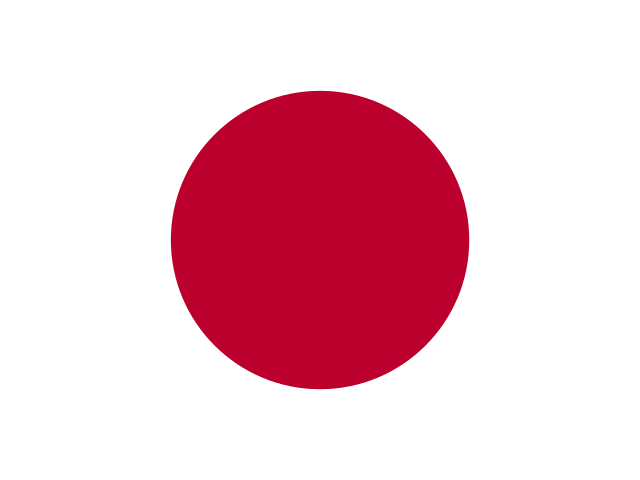 Japan
JapanEastern Asia
2nd of 182 · 4 of 4 keys
Photo: JurriaanH · CC BY-SA 3.0, greyscale
 3
3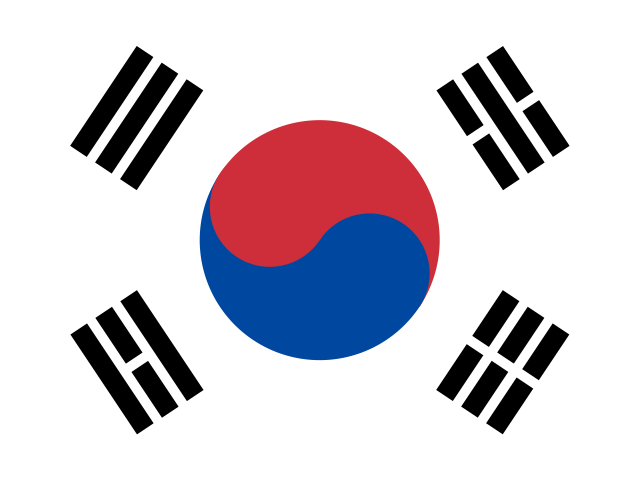 South Korea
Eastern Asia
3rd of 182 · 4 of 4 keys
Photo: Unknown author · CC BY-SA 2.0, greyscale


Placed highest nearby
Highest in Africa
Nigeria16th4/4 keys
Positions out of 182 placed on the topic. A country needs readings on enough keys to be placed, and the top of the list is often held on fewer of them.
07Analysis
Charts and analysis about Nigeria and work & labour

On work & labour
Countries in Asia with the highest average salaries 2024
Thirteen Asian countries by gross average monthly wage, each carrying its WORLD rank rather than an Asian one — so the numbers skip, from 11th place to 45th.

On work & labour
Countries With The Highest Average Salaries in 2024
The ten highest-paying countries of 2024, their bars coloured by continent, and six more added for comparison — from Australia in 13th place to India in 85th.

On work & labour
Countries With The Lowest Average Salaries in 2024
The bottom ten of 196 countries, and six more added for comparison. Niger, Madagascar and Liberia are all published at US$47 a month and still carry three different ranks.
08Questions
Nigeria on work & labour: questions answered
Every answer is built from the numbers on this page, so none can say something the page does not.
How does Nigeria rank on work & labour?
Nigeria is placed 16th of 182 countries on Work & Labour in the Country Index 2026, from 4 of its 4 key statistics (Employment-to-Population Ratio, Labour Income Share, Unemployment Rate and Vulnerable Employment). The position is this site’s ordering of published statistics, not a rank any publisher printed.
What is the latest Employment-to-Population Ratio figure for Nigeria?
79.99 in 2025 (employed share of the population aged 15+ (%)), according to International Labour Organization (ILO). The world median in the same edition was 57.72.
What is the latest Labour Income Share figure for Nigeria?
75.13 in 2025 (labour income share of GDP (%)), according to International Labour Organization (ILO). The world median in the same edition was 46.23.
How does Nigeria compare with Cameroon on work & labour?
Cameroon is placed 97th of 182, and Nigeria 16th. Employment-to-Population Ratio: Cameroon 62.82, Nigeria 79.99; Labour Income Share: Cameroon 44.37, Nigeria 75.13; Unemployment Rate: Cameroon 3.602, Nigeria 3.064; Vulnerable Employment: Cameroon 67.56, Nigeria 66.48.
How have Nigeria’s work & labour figures changed?
Employment-to-Population Ratio fell from 80.08 in 2000 to 79.99 in 2025; Labour Income Share rose from 65.27 in 2004 to 75.13 in 2025; Unemployment Rate fell from 3.953 in 2000 to 3.064 in 2025; Vulnerable Employment fell from 73.91 in 2000 to 66.48 in 2025.
Which work & labour statistics are missing for Nigeria?
No current reading is published for Nigeria on Fatal Occupational Injuries. They are listed rather than hidden, so the evidence on the page can be checked against it.
09Keep reading
Explore further
Nigeria, topic by topic
- Governance & Institutions114th of 193
- Economy & Innovation=114th of 150
- Education & Knowledge=150th of 182
- Health & Wellbeing193rd of 201
- Development & Human Capital175th of 194
- Environment & Sustainability88th of 161
- Gender & Equality157th of 178
- Democracy & Civil Liberties128th of 198
- Peace & Security112th of 177
- Risk & Resilience176th of 191
- Mobility & Connectivity=107th of 147
- The full Nigeria profile
Nearby, on work & labour
The key statistics, for every country
10Method
Method, sources and how to cite
What this topic does not measure
Wages in money terms are not a key here, because pay figures are hard to compare fairly across countries with very different prices. Labour productivity, working hours, youth unemployment and the balance between farming, industry and services are published on this page as context. The size and growth of the wider economy belong to Economy & Innovation.
How the Work & Labour standing is decided, step by step
A standing is a place in a list, not a mark out of anything. This one is part of the Country Index 2026, and it is worked out like this.
- A few key indicators decide it; the rest are context. 4 indicators on this topic are keys and 18 are charted alongside them without a vote. That split is the point: if every statistic voted, importing five more of one kind would quietly change what the topic is about.
- Each key is read at one edition. All of them describe 2025.
- Every country’s published value is turned into a place within that one key’s own field, and then expressed as a share of that field — how far down this key’s list the country sits, rather than how many countries are above it. Keys where a higher published number is worse (terrorism, hunger, disaster risk) are turned round first, so the good end is always the same end.
- Dividing by the field first is the whole reason this works. A place carries the size of its list inside it: 22nd of 44 and 108th of 215 are the same showing, and averaging the numbers 22 and 108 says loudly that they are not. Fields on this site run from about 44 countries to about 215, so averaging raw places would reward a country for happening to be measured in small ones. Dividing each place by its own field removes the size and leaves only the showing.
- The shares are averaged, plainly. One key, one vote — no key is weighted above another, because any weighting would be this site’s opinion presented as a measurement. Countries are then put in order by that average, and the average itself is never published. It is our arithmetic with nothing anchoring it, so printing it would invite it to be read as a measurement somebody made. The position it produces, the band, and the keys it was built from are all published instead — every one of them checkable against the tables on this page.
- A country needs 2 of this topic’s 4 keys — half, rounded up, and never fewer than 2. A standing built from one reading, printed beside one built from four, is two different things sharing a column heading. 182 countries clear the bar here.
- A key has to earn its vote every edition. It must measure at least 120 countries (below that it starts measuring who was surveyed rather than the world), it must not have more than 10% of its field tied at either end, and it must not repeat another key in the same topic — Spearman correlation above 0.92 counts as repeating. A topic needs at least 2 surviving keys to place anyone at all; this one has 4.
- A standing is relative, and the grouping is ours. It says where a country places against the others measured alongside it, so it moves when they move. The publishers listed on this page did not agree to be read together, and each measures its subject its own way: the underlying numbers are theirs, the ordering on top is this site’s — the same method as the rest of the Country Index, applied to one subject instead of all of them.
The key statistics and their licences
- Employment-to-Population Ratio — International Labour Organization (ILO), CC BY 4.0
- Labour Income Share — International Labour Organization (ILO), CC BY 4.0
- Unemployment Rate — International Labour Organization (ILO), CC BY 4.0
- Vulnerable Employment — International Labour Organization (ILO), CC BY 4.0
The other 17 statistics on this page come from 2 publishers, each named beside its numbers, with every edition and licence on the datasets pages.
The standing itself is part of the Country Index 2026, published under CC BY-SA 4.0.
Photographs
Nigeria’s banner and the countries placed highest, from their profiles: Wikimedia Commons, shown in greyscale, each used under the licence named.
- Nigeria (banner) — Slashme, CC BY-SA 3.0
- Iceland — Hansueli Krapf, CC BY-SA 3.0
- Japan — JurriaanH, CC BY-SA 3.0
- South Korea — Unknown author, CC BY-SA 2.0
Cite this page
Nations Inquiry (2026). Nigeria: Work & Labour — standing and statistics, Country Index 2026. https://nationsinquiry.com/countries/nigeria/work