
Photo: Entropy1963 · CC0 · via Wikimedia Commons, shown in greyscale
Topic 04 of 18 · Country Index 2026
Gibraltar: Education & Knowledge
How far does a country's schooling carry its children?
Gibraltar is placed joint 67th of 198 countries on education & knowledge in the Country Index 2026, from 2 of its 4 key statistics. Readings behind it: Out-of-School Rate, Primary 1.58 (2024); Participation in Organised Learning One Year Before Primary 87.41 (2024).
Share
Education & Knowledge
joint67th
of 198 countries placed
Placed from 2 of 4 key statistics
Not placed in the Country Index 2026 overall: measured on too few topics.
- 1.58Out-of-School Rate, Primary, 2024Out-of-school rate, primary age (%)
- 87.41Participation in Organised Learning One Year Before Primary, 2024Children one year before primary entry age in organised learning (%)
- —Upper Secondary Completion Rate, 2025No reading for this country
- —Government Spending on Education, 2023No reading for this country
01The evidence
The 4 key statistics that decide it
Only these place Gibraltar on education & knowledge — one vote each. Every value is the publisher’s own, read at the edition the Country Index 2026 used — or, for a survey-based key, each country’s latest reading; the grey ticks are every other country it was compared with, lowest on the left.
Key 1 of 4
Out-of-School Rate, Primary
UNESCO Institute for Statistics (UIS)
Why it is a key: Primary-age children who are not in school at all: the floor of an education system.
Latest reading per country, 2014–2024 · Gibraltar’s is from 2024 · CC BY-SA 4.0
1.58
Out-of-school rate, primary age (%)
Lower is better
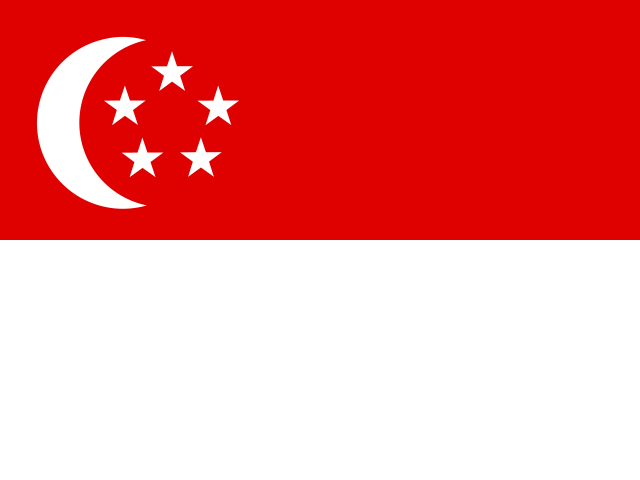
Gibraltar: 1.58. Across the 192 countries at their latest reading, values run from 0.004 (United Arab Emirates) to 65.6 (Equatorial Guinea); the world median is 3.691.
- World median
- 3.691
- Best in Southern Europe
- 0.11 Greece
Each grey tick is one of 192 countries at its latest reading, 2014–2024.
Key 2 of 4
Participation in Organised Learning One Year Before Primary
UNESCO Institute for Statistics (UIS)
Why it is a key: Whether children take part in organised learning in the year before primary school — whether an education system reaches them before it starts.
Latest reading per country, 2014–2024 · Gibraltar’s is from 2024 · CC BY-SA 4.0
87.41
Children one year before primary entry age in organised learning (%)
Higher is better
Gibraltar: 87.41. Across the 187 countries at their latest reading, values run from 3.411 (Yemen) to 100 (United Arab Emirates); the world median is 85.9.
- World median
- 85.9
- Best in Southern Europe
- 99.93 Portugal
Each grey tick is one of 187 countries at its latest reading, 2014–2024.
Key 3 of 4
Upper Secondary Completion Rate
UNESCO Institute for Statistics (UIS)
Why it is a key: How far a schooling system carries the young people who get through primary — the only key here that measures anything past childhood.
2025 edition · data for 2025 · CC BY-SA 4.0
No reading
Upper secondary completion rate (%)
Higher is better
UIS publishes no 2025 figure for Gibraltar, so the standing rests on the other keys.
Across the 164 countries in this edition, values run from 2.13 (South Sudan) to 99.27 (South Korea); the world median is 64.87.
- World median
- 64.87
- Best in Southern Europe
- 98.2 Croatia
Each grey tick is one of 164 countries in the 2025 edition.
Key 4 of 4
Government Spending on Education
UNESCO Institute for Statistics (UIS)
Why it is a key: What a state chooses to spend on education, as a share of its economy — the input, where the other two keys measure reach.
2023 edition · data for 2023 · CC BY-SA 4.0
No reading
Government expenditure on education (% of GDP)
Higher is better
UIS publishes no 2023 figure for Gibraltar, so the standing rests on the other keys.
Across the 123 countries in this edition, values run from 0 (Somalia) to 16.39 (Kiribati); the world median is 3.709.
- World median
- 3.709
- Best in Southern Europe
- 3.404 Serbia
Each grey tick is one of 123 countries in the 2023 edition.
02Over time
Which way Gibraltar is moving
Each key’s published value, edition by edition, beside the world median. The Country Index 2026 is the first edition of the standing, so the standing itself has no history to chart yet.
Out-of-School Rate, Primary
Out-of-school rate, primary age (%) · lower is better
GibraltarWorld median
Gibraltar fell from 25.37 in 1981 to 1.58 in 2024; the world median went from 19.36 to 3.691.
Every year’s figures
Year Gibraltar World median 2024 1.6 3.691 2023 2.3 3.393 2022 — 3.002 2021 — 3.330 2020 — 2.678 2019 — 2.758 2018 — 2.439 2017 — 2.907 2016 — 2.954 2015 — 3.052 2014 — 3.904 2013 — 3.413 2012 — 3.408 2011 — 3.626 2010 — 3.491 2009 — 3.577 2008 — 3.878 2007 — 4.029 2006 — 4.338 2005 — 4.571 2004 — 3.791 2003 — 4.412 2002 — 4.144 2001 — 4.051 2000 — 8.642 1999 — 14.907 1994 — 10.957 1986 — 15.521 1985 — 13.598 1984 — 13.841 1983 — 15.832 1981 25.4 19.356 Participation in Organised Learning One Year Before Primary
Children one year before primary entry age in organised learning (%) · higher is better
GibraltarWorld median
Gibraltar fell from 97.25 in 2019 to 87.41 in 2024; the world median went from 88.76 to 85.9.
Every year’s figures
Year Gibraltar World median 2024 87 85.9 2023 95 87.6 2022 90 87.7 2021 99 87.0 2020 — 88.3 2019 97 88.8 2018 — 89.6 2017 — 87.4 2016 — 87.9 2015 — 88.2 2014 — 89.2 2013 — 88.0 2012 — 85.4 2011 — 86.2 2010 — 86.1 2009 — 84.8 2008 — 85.8 2007 — 86.7 2006 — 84.0 2005 — 82.2 2004 — 81.8 2003 — 78.3 2002 — 80.0 2001 — 80.8 2000 — 66.3
03In context
Gibraltar beside its neighbours
A position reads best beside the countries around it. Every position below is a place among all 198 countries on education & knowledge, never a place within the region.
Gibraltar and Southern Europe
Gibraltar has no land border, so the table compares it with its sub-region. The standing is each country’s place among all 198 placed on the topic; the other columns are the publishers’ own values, read at the edition the standing used.
| Country | Standing | Out-of-School Rate, PrimaryOut-of-school rate, primary age (%) | Participation in Organised Learning One Year Before PrimaryChildren one year before primary entry age in organised learning (%) | Upper Secondary Completion RateUpper secondary completion rate (%) | Government Spending on EducationGovernment expenditure on education (% of GDP) |
|---|---|---|---|---|---|
 Greece Greece | 2nd | 0.11 | 99.53 | 95.22 | — |
 Croatia Croatia | 12th | 1.812 | 99.32 | 98.2 | — |
 Portugal Portugal | 15th | 0.508 | 99.93 | 83.1 | — |
 Slovenia Slovenia | 22nd | 1.447 | 95.37 | 93.2 | — |
 Spain Spain | 34th | 1.237 | 98.58 | 74.82 | — |
 Montenegro Montenegro | 45th | 0.218 | 84.17 | 88.97 | — |
 Italy Italy | 46th | 2.056 | 95.2 | 87.5 | — |
 Albania Albania | 54th | 0.488 | 94.42 | 88.9 | 3.092 |
 Malta Malta | 59th | 2.638 | 93.49 | 83.98 | — |
| Gibraltar | =67th | 1.58 | 87.41 | — | — |
 San Marino San Marino | =72nd | 6.132 | 97.67 | — | — |
 Serbia Serbia | 95th | 3.333 | 86.21 | 82.76 | 3.404 |
 Andorra Andorra | 112th | 2.415 | 94.87 | — | 1.899 |
 North Macedonia North Macedonia | 122nd | 3.791 | 52.37 | 86.31 | — |
 Bosnia and Herzegovina Bosnia and Herzegovina | 136th | 2.097 | 37.49 | 66.46 | 3.246 |
 Kosovo Kosovo | not placed | — | — | — | — |
 Vatican City Vatican City | not placed | — | — | — | — |
“—” means the publisher gives no reading for that country in that edition. A country needs readings on enough keys to be placed.
Across Southern Europe
Every country in the sub-region, by its place among all 198.
Placed either side on education & knowledge
The countries immediately above and below Gibraltar in the topic’s list.


04Context, no vote
Where Gibraltar is ahead of the world, and behind
6 more statistics filed under education & knowledge, published in full and deliberately given no vote in the standing. Select a row for the publisher, the rank and the links.
Ahead of the world median2
Statistics on which Gibraltar does better than the middle country measured.
Pre-Primary Net Enrolment RateUIS · 2024 · world median 65.9396.9865.93▲ Improved since 2016
Gibraltar: 96.98 · world median 65.93 · Net enrolment rate, pre-primary (%). UNESCO Institute for Statistics (UIS), 2024 edition, data for 2024.
Published values in that edition run from 1.779 to 99.85; higher is better.
Position 14th of 120 — derived here by ordering the published values, 1st = best. The publisher ranks no country on this.
Primary Schools with Internet for TeachingUIS · 2024 · world median 98.6610098.66No real change since 2016
Gibraltar: 100 · world median 98.66 · Primary schools with internet access for teaching (%). UNESCO Institute for Statistics (UIS), 2024 edition, data for 2024.
Published values in that edition run from 0 to 100; higher is better.
Behind the world median2
Statistics on which Gibraltar does worse than the middle country measured.
Secondary School EnrolmentUIS · 2024 · world median 93.1978.5393.19▼ Worsened since 2016
Gibraltar: 78.53 · world median 93.19 · Gross secondary enrolment ratio (%). UNESCO Institute for Statistics (UIS), 2024 edition, data for 2024.
Published values in that edition run from 19.87 to 158.55; higher is better.
Position 88th of 109 — derived here by ordering the published values, 1st = best. The publisher ranks no country on this.
Qualified Teachers in Primary EducationUIS · 2024 · world median 93.66093.66▼ Worsened since 2016
Gibraltar: 0 · world median 93.66 · Primary teachers with the minimum qualifications their country requires (%). UNESCO Institute for Statistics (UIS), 2024 edition, data for 2024.
Published values in that edition run from 0 to 100; higher is better.
Level with the median, or no median to compare1
Primary Schools with ElectricityUIS · 2024 · world median 100100100No real change since 2016
Gibraltar: 100 · world median 100 · Primary schools with access to electricity (%). UNESCO Institute for Statistics (UIS), 2024 edition, data for 2024.
Published values in that edition run from 1.246 to 100; higher is better.
No better end1
These describe the shape of a country — more is not better or worse, only different — so they are never ahead or behind.
Scholarly ArticlesOurResearch · 2025 · world median 2,240122,240Moved since 2022
Gibraltar: 12 · world median 2,240 · Articles with at least one author at an institution in the country (full counting). OpenAlex (OurResearch), 2025 edition, data for 2025.
Published values in that edition run from 1 to 1,094,890.
No current reading for Gibraltar
Academic Freedom Index, Adult Literacy Rate, Bachelor's or Higher Attainment, Expected Years of Schooling, Female Share of Researchers, Female Share of STEM Graduates, Gender Parity Index, Tertiary Enrolment, Government Funding per Primary Student, Government Spending on Education, Harmonized Test Scores, Inbound Mobility Rate, Tertiary, Intergenerational Persistence in Education, Learning Poverty, Learning-Adjusted Years of School, Lower Secondary Completion Rate, Mean Years of Schooling, Minimum Proficiency in Mathematics, End of Lower Secondary, Minimum Proficiency in Mathematics, End of Primary, Minimum Proficiency in Reading, End of Lower Secondary, Minimum Proficiency in Reading, End of Primary, Nobel Prize Laureates by Country of Birth, Out-of-School Rate, Lower Secondary Age (last 2021), Outbound Mobility Ratio, Tertiary, PISA Mathematics Performance, PISA Reading Performance, PISA Science Performance, Primary Completion Rate, Pupils per Qualified Teacher, Primary (last 2023), Research and Development Spending, Researchers per Million Inhabitants, School Life Expectancy, Share of Graduates from ICT Programmes, Tertiary Enrolment Ratio, Trust in Scientists, Upper Secondary Attainment, Upper Secondary Completion Rate, Wealth Parity Index, Lower Secondary Completion and Youth Literacy Rate. Listed rather than hidden, so the page can be checked against it.
05Country Index 2026
Education & Knowledge among Gibraltar’s 2 topics
Education & Knowledge is Gibraltar’s best-placed topic of 2. Strongest first; each marker sits at the position divided by that topic’s field, so fields of different sizes compare fairly.
No standing on Governance & Institutions, Economy & Innovation, Work & Labour, Health & Wellbeing, Development & Human Capital, Environment & Sustainability, Gender & Equality, Democracy & Civil Liberties, Peace & Security, Risk & Resilience, Food & Agriculture, Poverty & Inequality, Energy, Digital & Technology: too few of those topics’ key statistics are published for this country.
06The top of the list
Who leads on education & knowledge
The three countries placed highest of 198, and the leaders Gibraltar can most readily be measured against.
 1
1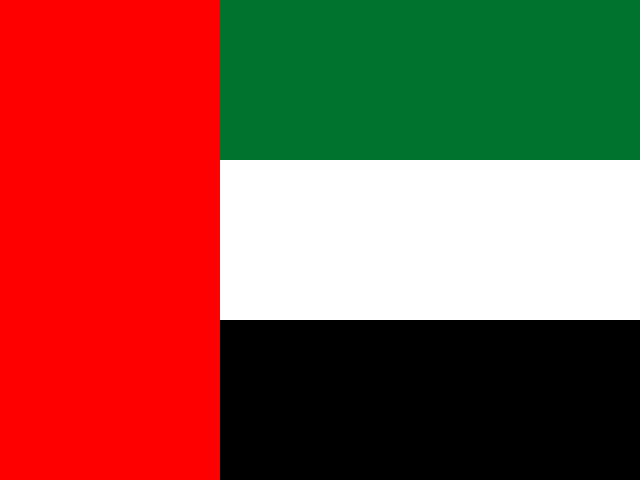 United Arab Emirates
Western Asia
1st of 198 · 2 of 4 keys
Photo: Unknown author · CC BY-SA 3.0, greyscale
 2Greece
Southern Europe
2nd of 198 · 3 of 4 keys
Photo: User:Ggia derivative work: Jjtkk · CC BY-SA 3.0, greyscale
 3
3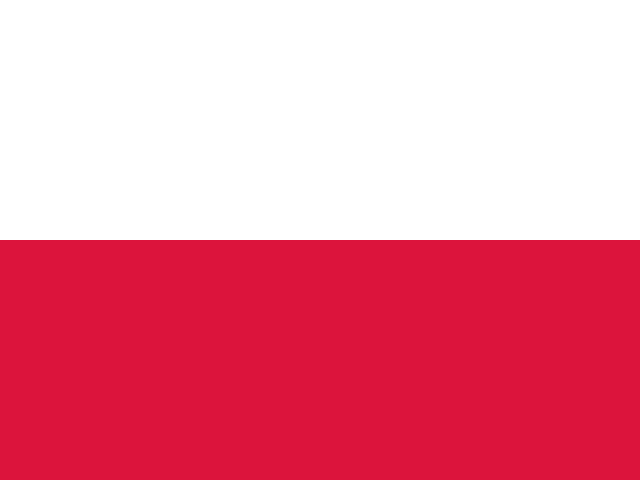 Poland
Eastern Europe
3rd of 198 · 3 of 4 keys
Photo: Ralf Lotys (Sicherlich) · CC BY 3.0, greyscale
Placed highest nearby
Highest placed on all 4 keys
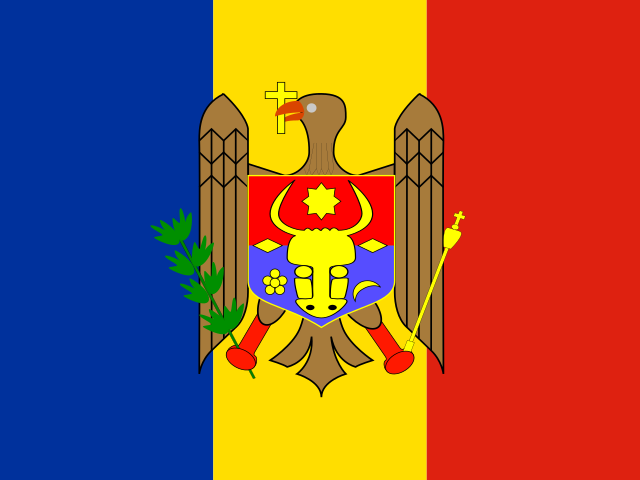 Moldova7th4/4 keys
Highest in Europe
Greece2nd3/4 keysThis page
Gibraltar=67th2/4 keys
Positions out of 198 placed on the topic. A country needs readings on enough keys to be placed, and the top of the list is often held on fewer of them.
07Questions
Gibraltar on education & knowledge: questions answered
Every answer is built from the numbers on this page, so none can say something the page does not.
How does Gibraltar rank on education & knowledge?
Gibraltar is placed joint 67th of 198 countries on Education & Knowledge in the Country Index 2026, from 2 of its 4 key statistics (Out-of-School Rate, Primary and Participation in Organised Learning One Year Before Primary). The position is this site’s ordering of published statistics, not a rank any publisher printed.
What is the latest Out-of-School Rate, Primary figure for Gibraltar?
1.58 in 2024 (out-of-school rate, primary age (%)), according to UNESCO Institute for Statistics (UIS). The world median in the same edition was 3.691.
What is the latest Participation in Organised Learning One Year Before Primary figure for Gibraltar?
87.41 in 2024 (children one year before primary entry age in organised learning (%)), according to UNESCO Institute for Statistics (UIS). The world median in the same edition was 85.9.
How have Gibraltar’s education & knowledge figures changed?
Out-of-School Rate, Primary fell from 25.37 in 1981 to 1.58 in 2024; Participation in Organised Learning One Year Before Primary fell from 97.25 in 2019 to 87.41 in 2024.
Which education & knowledge statistics are missing for Gibraltar?
No current reading is published for Gibraltar on Academic Freedom Index, Adult Literacy Rate, Bachelor's or Higher Attainment, Expected Years of Schooling, Female Share of Researchers, Female Share of STEM Graduates, Gender Parity Index, Tertiary Enrolment, Government Funding per Primary Student, Government Spending on Education, Harmonized Test Scores, Inbound Mobility Rate, Tertiary, Intergenerational Persistence in Education, Learning Poverty, Learning-Adjusted Years of School, Lower Secondary Completion Rate, Mean Years of Schooling, Minimum Proficiency in Mathematics, End of Lower Secondary, Minimum Proficiency in Mathematics, End of Primary, Minimum Proficiency in Reading, End of Lower Secondary, Minimum Proficiency in Reading, End of Primary, Nobel Prize Laureates by Country of Birth, Out-of-School Rate, Lower Secondary Age, Outbound Mobility Ratio, Tertiary, PISA Mathematics Performance, PISA Reading Performance, PISA Science Performance, Primary Completion Rate, Pupils per Qualified Teacher, Primary, Research and Development Spending, Researchers per Million Inhabitants, School Life Expectancy, Share of Graduates from ICT Programmes, Tertiary Enrolment Ratio, Trust in Scientists, Upper Secondary Attainment, Upper Secondary Completion Rate, Wealth Parity Index, Lower Secondary Completion and Youth Literacy Rate. They are listed rather than hidden, so the evidence on the page can be checked against it.
08Keep reading
Explore further
Gibraltar, topic by topic
Nearby, on education & knowledge
The key statistics, for every country
09Method
Method, sources and how to cite
What this topic does not measure
How much children actually learn is only partly covered. International test scores exist for a limited group of countries, and they are published here as context rather than used as a key, because a key must describe most of the world. Universities, research, and youth and adult literacy also appear as context.
How the Education & Knowledge standing is decided, step by step
A standing is a place in a list, not a mark out of anything. This one is part of the Country Index 2026, and it is worked out like this.
- A few key indicators decide it; the rest are context. 4 indicators on this topic are keys and 42 are charted alongside them without a vote. That split is the point: if every statistic voted, importing five more of one kind would quietly change what the topic is about.
- Each key is read at one edition. ⚠ The keys behind this standing do not all describe the same year — they run from 2023 to 2025, because publishers release on their own schedules. Read the standing as “how this country places now”, not as a snapshot of one year.
- Every country’s published value is turned into a place within that one key’s own field, and then expressed as a share of that field — how far down this key’s list the country sits, rather than how many countries are above it. Keys where a higher published number is worse (terrorism, hunger, disaster risk) are turned round first, so the good end is always the same end.
- Dividing by the field first is the whole reason this works. A place carries the size of its list inside it: 22nd of 44 and 108th of 215 are the same showing, and averaging the numbers 22 and 108 says loudly that they are not. Fields on this site run from about 44 countries to about 215, so averaging raw places would reward a country for happening to be measured in small ones. Dividing each place by its own field removes the size and leaves only the showing.
- The shares are averaged, plainly. One key, one vote — no key is weighted above another, because any weighting would be this site’s opinion presented as a measurement. Countries are then put in order by that average, and the average itself is never published. It is our arithmetic with nothing anchoring it, so printing it would invite it to be read as a measurement somebody made. The position it produces, the band, and the keys it was built from are all published instead — every one of them checkable against the tables on this page.
- A country needs 2 of this topic’s 4 keys — half, rounded up, and never fewer than 2. A standing built from one reading, printed beside one built from four, is two different things sharing a column heading. 198 countries clear the bar here.
- A key has to earn its vote every edition. It must measure at least 120 countries (below that it starts measuring who was surveyed rather than the world), it must not have more than 10% of its field tied at either end, and it must not repeat another key in the same topic — Spearman correlation above 0.92 counts as repeating. A topic needs at least 2 surviving keys to place anyone at all; this one has 4.
- A standing is relative, and the grouping is ours. It says where a country places against the others measured alongside it, so it moves when they move. The publishers listed on this page did not agree to be read together, and each measures its subject its own way: the underlying numbers are theirs, the ordering on top is this site’s — the same method as the rest of the Country Index, applied to one subject instead of all of them.
The key statistics and their licences
- Out-of-School Rate, Primary — UNESCO Institute for Statistics (UIS), CC BY-SA 4.0
- Participation in Organised Learning One Year Before Primary — UNESCO Institute for Statistics (UIS), CC BY-SA 4.0
- Upper Secondary Completion Rate — UNESCO Institute for Statistics (UIS), CC BY-SA 4.0
- Government Spending on Education — UNESCO Institute for Statistics (UIS), CC BY-SA 4.0
The other 6 statistics on this page come from 2 publishers, each named beside its numbers, with every edition and licence on the datasets pages.
The standing itself is part of the Country Index 2026, published under CC BY-SA 4.0.
Photographs
Gibraltar’s banner and the countries placed highest, from their profiles: Wikimedia Commons, shown in greyscale, each used under the licence named.
- Gibraltar (banner) — Entropy1963, CC0
- United Arab Emirates — Unknown author, CC BY-SA 3.0
- Greece — User:Ggia derivative work: Jjtkk, CC BY-SA 3.0
- Poland — Ralf Lotys (Sicherlich), CC BY 3.0
Cite this page
Nations Inquiry (2026). Gibraltar: Education & Knowledge — standing and statistics, Country Index 2026. https://nationsinquiry.com/countries/gibraltar/education