What the Global Terrorism Index Measures
The Global Terrorism Index (GTI), produced each year by the Institute for Economics and Peace, scores 163 countries on a scale of 0 to 10 based on the impact of terrorism, the number of incidents, deaths, injuries and hostages, weighted across five years so that the lingering shadow of an attack is counted, not just the day it happened. A higher score means a heavier burden.
A quick note on naming, because it confuses almost everyone: this is the 2025 report, but the data inside it covers the calendar year 2024. So when you read “Global Terrorism Index 2025,” think “how terrorism played out in 2024.” Both labels point at the same numbers.
And one piece of perspective before the rankings. Terrorism is not the deadliest form of violence in the world; armed conflict, homicide and suicide each take far more lives every year. What sets terrorism apart is its unpredictability and its reach into the mind: a single attack is designed to frighten an entire society, not only the people it harms.
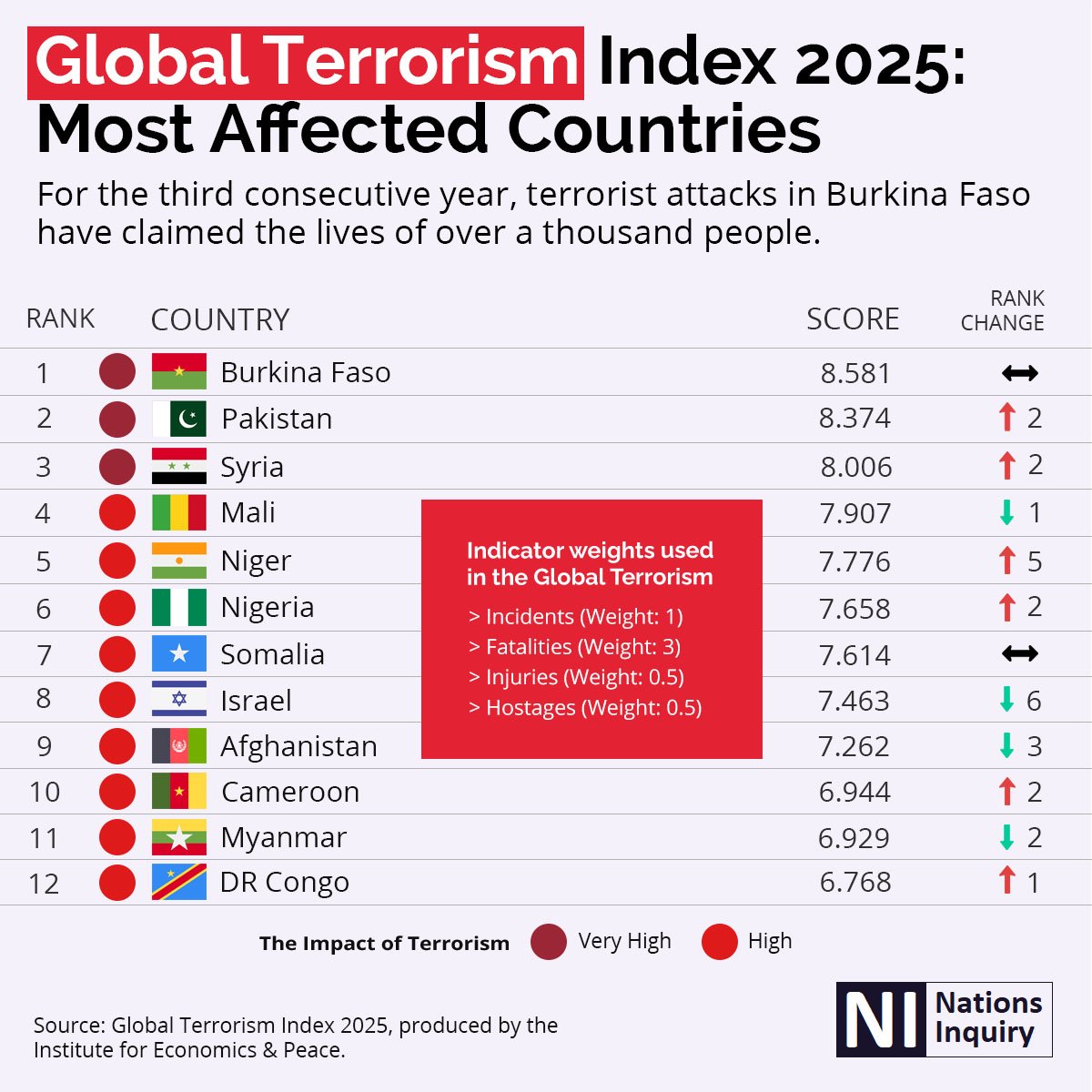
2024 in One Line: Fewer Countries, Deadlier Attacks
On paper, 2024 looked like an improvement. Deaths from terrorism fell to 7,555, down 13% from the year before. But that drop is almost entirely an illusion created by comparison: the previous year had been inflated by the single, exceptional Hamas attack of October 7, 2023. Strip that out, and 2024 would have been roughly as deadly as any year since 2017.
Look closer and the “improvement” thins further. The number of countries suffering at least one attack rose from 58 to 66, the widest spread since 2018. More countries got worse than got better, the first time that had happened in seven years. The headline number fell; the disease spread.
There is a second pattern that matters just as much: terrorism is becoming concentrated. Ten countries accounted for 86% of all terrorism deaths in 2024. The number of countries recording even one terrorism death has been falling steadily, from 57 in 2015 to 45 in 2024. The world is not sharing this pain evenly. It is piling it onto a shrinking list of already-broken states, while much of the globe records nothing at all.
How Terrorism Is Fueled
An imperial power’s appetite for other people’s land and resources rarely announces itself with an army first. It usually begins by finding a crack in a religious line, an ethnic grievance, a disputed border, and quietly widening it until neighbours who once shared markets and marriages begin to see each other as enemies.
This is the old divide-and-rule method, and it still works. Set two sides against each other, wait for both to wear themselves down, then arrive as the partner, the peace broker, or the arms supplier. A weakened nation guards its wealth poorly, and a frightened nation buys weapons in bulk. Both outcomes pay well for someone a long way from the bloodshed.
That is the uncomfortable logic sitting behind a great deal of modern conflict: an economy that profits from instability has little reason to want it to end. Insurgencies keep the order books full and the “security partnerships” flowing. When a war finally winds down, it isn’t only ordinary families who exhale; the industries that fed on that war begin to shrink too. Keep that in mind as you read the rankings below, because the map of terrorism is also, in large part, a map of who has been fought over.
The Sahel: The New Centre of Gravity
For years the story of terrorism was a Middle East story. It is not anymore. The centre has moved decisively to the Sahel, the band of fragile states below the Sahara, which now accounts for over half of all terrorism deaths worldwide, despite holding a small fraction of the world’s population. Five of the ten worst-affected countries sit in this one region.
Burkina Faso remains, for the second year running, the single most affected country on Earth, with 1,532 deaths. The number actually fell 21% from the year before, and attacks dropped by more than half, yet the country still accounts for roughly a fifth of all terrorism deaths on the planet. That combination tells its own grim story: fewer attacks, but far deadlier ones, averaging around fourteen deaths each. In one assault in August 2024, gunmen killed somewhere between 200 and 600 people in a single town, many of them women and children.
Niger shows how fragile any “improvement” in this region really is. Its deaths nearly doubled to 930, the largest increase anywhere in the world in 2024, and the worst year in the country’s recorded history. The deadliest single terrorist attack on the planet that year happened here: over 300 fighters killed 237 soldiers near the Malian border. Mali completes the tri-border core, where the frontiers of three struggling states meet and armed groups move across them as if the borders weren’t there.
It is worth asking why a region that barely registered on this index fifteen years ago became its epicentre. The report’s own answer is revealing. Western troops, French forces above all, have largely withdrawn after years of intervention. The military governments that replaced elected ones have turned away from the West and toward Russia and China, who offer security and money “with fewer conditions attached.” And underneath it all sits a scramble for resources: gold that funds armed groups on every side, and uranium, which Niger is the world’s seventh-largest producer of, outside powers are quietly competing to secure. The violence is real and local; the interests circling it are neither.
Pakistan: A Frontier It Did Not Draw Alone
Pakistan rose to second on the index, and on raw attacks, it led the world outright, with 1,099 incidents in 2024, the first time any country has crossed a thousand in a single year, and more than double the year before. Deaths climbed 45% to 1,081, the fifth straight year of increase.
For readers in this part of the world, none of this is abstract. The report ties the surge directly to the aftermath of the war next door: since the Taliban’s return to power in Afghanistan, militant groups operating across the border have struck with growing freedom, and 96% of Pakistan’s attacks fell in the two western frontier regions of Khyber Pakhtunkhwa and Balochistan. This is the long tail of a conflict that outside powers fought on this soil for decades and then left behind weapons, hardened fighters and unstable ground included.
Balochistan adds a second thread that runs straight through everything said at the top of this page. The Balochistan Liberation Army was behind the province’s deadliest attack of the year, a bombing at Quetta railway station. The group frames its violence explicitly around resource extraction, the taking of Balochistan’s minerals without fair return to the people who live above them, and it has increasingly targeted Chinese projects tied to the China–Pakistan Economic Corridor. Whatever one makes of the group, the grievance it exploits is the same one that recurs across this whole index: land and wealth pulled outward, and the anger left behind.
The Rest of the Top Ten
Syria climbed to third as the fall of the Assad regime opened a vacuum, and Islamic State stepped into it; attacks there rose sharply in the closing weeks of 2024. Nigeria (sixth) and Cameroon (tenth, back among the worst for the first time since 2019) reflect the grinding conflict around Lake Chad between Boko Haram and rival factions. Somalia (seventh) actually improved for a sixth straight year as government offensives pushed al-Shabaab back.
Two entries at the bottom of the top ten tell you how much a single event can distort the picture. Israel fell to eighth, with deaths dropping 98% from 1,160 to 18 because the extraordinary toll of one day in 2023 had passed. And Afghanistan slipped to ninth, its lowest-ever ranking, largely because the index no longer counts violence carried out by the Taliban now that they hold the state. Neither figure means those places found peace; the index is measuring a specific kind of violence, and the ground beneath it kept shifting.
Why the Wealthy West Sits Low
Scroll down the full table and the logic inverts. The United States, United Kingdom, France, Germany, Canada and Japan all sit far down the list. Terrorism deaths across Western democracies stayed near historic lows, even though the number of attacks ticked up and antisemitic and Islamophobic hate crimes rose sharply after the Gaza war began.
Reading the two halves of the table together is instructive. The countries that manufacture and export the weapons, that fund partners and intervene abroad, tend to experience very little terrorism at home. The countries that host the wars where those interventions and rivalries actually land carry almost all of the dead. The instability is genuine; it is simply rarely shared between those who profit from conflict and those who have to live inside it.
Reading the Chart
The full table below lists all 163 countries in the Global Terrorism Index 2025, each with its score and how far it moved from the previous year. Sharp climbs usually mark a country crossing from calm into conflict, Niger’s jump, or Oman and Jordan rising dozens of places. The 64 countries tied at the bottom with a score of zero are the quiet majority: places that recorded no measurable terrorism at all. That long, silent tail is worth noticing. Terrorism is not a fog that hangs equally everywhere. It gathers, overwhelmingly, where states have been hollowed out and fought over.
| Rank | Country | Score | Rank Change |
|---|---|---|---|
| 1 | Burkina Faso | 8.581 | — |
| 2 | Pakistan | 8.374 | ↑2 |
| 3 | Syria | 8.006 | ↑2 |
| 4 | Mali | 7.907 | ↓1 |
| 5 | Niger | 7.776 | ↑5 |
| 6 | Nigeria | 7.658 | ↑2 |
| 7 | Somalia | 7.614 | — |
| 8 | Israel | 7.463 | ↓6 |
| 9 | Afghanistan | 7.262 | ↓3 |
| 10 | Cameroon | 6.944 | ↑2 |
| 11 | Myanmar | 6.929 | ↓2 |
| 12 | DR Congo | 6.768 | ↑1 |
| 13 | Iraq | 6.582 | ↓2 |
| 14 | India | 6.411 | — |
| 15 | Colombia | 6.381 | ↑1 |
| 16 | Russia | 6.267 | ↑21 |
| 17 | Mozambique | 6.251 | ↓2 |
| 18 | Iran | 6.056 | ↑7 |
| 19 | Kenya | 5.366 | ↓1 |
| 20 | Philippines | 5.166 | ↓1 |
| 21 | Chile | 5.162 | ↓4 |
| 22 | Yemen | 5.08 | ↑1 |
| 23 | Chad | 5.032 | ↓2 |
| 24 | Togo | 5.004 | ↑2 |
| 25 | Palestine | 4.93 | ↓4 |
| 26 | Benin | 4.802 | ↓2 |
| 27 | Germany | 4.748 | ↑13 |
| 28 | Thailand | 4.63 | ↑1 |
| 29 | Egypt | 4.416 | ↓9 |
| 30 | Indonesia | 4.17 | ↓2 |
| 31 | Burundi | 4.043 | ↑1 |
| 32 | Türkiye | 3.968 | ↓2 |
| 33 | Uganda | 3.702 | ↓6 |
| 34 | United States | 3.517 | ↓3 |
| 35 | Bangladesh | 3.03 | ↓1 |
| 36 | Greece | 2.928 | ↓1 |
| 37 | Oman | 2.927 | ↑57 |
| 38 | Jordan | 2.913 | ↑40 |
| 39 | Czechia | 2.906 | ↓6 |
| 40 | France | 2.712 | ↓2 |
| 41 | United Kingdom | 2.639 | ↑2 |
| 42 | Algeria | 2.415 | ↑4 |
| 43 | Tunisia | 2.184 | ↓4 |
| 44 | Peru | 2.062 | ↓3 |
| 45 | Ukraine | 2.003 | ↑12 |
| 46 | Australia | 1.973 | ↑13 |
| 47 | Poland | 1.962 | ↑33 |
| 48 | Canada | 1.87 | ↑5 |
| 49 | China | 1.863 | ↑27 |
| 50 | Sweden | 1.842 | ↑22 |
| 51 | Angola | 1.657 | ↓6 |
| 52 | Malaysia | 1.626 | ↑35 |
| 53 | Libya | 1.612 | ↓11 |
| 54 | Senegal | 1.578 | ↓7 |
| 55 | Tanzania | 1.573 | ↓11 |
| 56 | Ecuador | 1.55 | ↑33 |
| 57 | Djibouti | 1.461 | ↓7 |
| 58 | Côte d'Ivoire | 1.454 | ↓9 |
| 59 | Brazil | 1.43 | ↓8 |
| 60 | Netherlands | 1.402 | ↑17 |
| 61 | Belgium | 1.347 | ↓7 |
| 62 | Switzerland | 1.265 | ↑12 |
| 63 | Spain | 1.256 | ↓8 |
| 64 | Lebanon | 1.237 | ↓6 |
| 65 | Bosnia and Herzegovina | 1.218 | ↑29 |
| 66 | Norway | 1.198 | ↓10 |
| 67 | United Arab Emirates | 1.178 | ↑18 |
| 68 | Nepal | 1.113 | ↓20 |
| 69 | Slovakia | 1.023 | ↓1 |
| 70 | Tajikistan | 0.999 | ↑1 |
| 71 | Central African Republic | 0.957 | ↓10 |
| 72 | Finland | 0.949 | ↑22 |
| 72 | Japan | 0.949 | ↓6 |
| 74 | Italy | 0.929 | ↓14 |
| 75 | Saudi Arabia | 0.845 | ↓13 |
| 76 | Argentina | 0.801 | ↓13 |
| 77 | Ethiopia | 0.787 | ↓13 |
| 78 | Kosovo | 0.782 | ↓13 |
| 79 | Armenia | 0.72 | ↓6 |
| 79 | Denmark | 0.72 | ↑15 |
| 81 | Venezuela | 0.71 | ↓14 |
| 82 | Austria | 0.582 | ↓12 |
| 82 | Mexico | 0.582 | ↓13 |
| 82 | Serbia | 0.582 | ↑12 |
| 82 | South Korea | 0.582 | ↑12 |
| 86 | Cambodia | 0.423 | ↑8 |
| 86 | Latvia | 0.423 | ↑8 |
| 86 | Lithuania | 0.423 | ↑7 |
| 89 | Cyprus | 0.347 | ↓14 |
| 90 | Azerbaijan | 0.233 | ↓10 |
| 90 | Belarus | 0.233 | ↓10 |
| 90 | Ireland | 0.233 | ↓11 |
| 90 | Uzbekistan | 0.233 | ↓10 |
| 94 | New Zealand | 0.217 | ↓42 |
| 95 | Iceland | 0.123 | ↓10 |
| 96 | Eswatini | 0.087 | ↓8 |
| 97 | Paraguay | 0.073 | ↓13 |
| 98 | Bahrain | 0.059 | ↓8 |
| 98 | Uruguay | 0.059 | ↓7 |
| 100 | Albania | 0 | — |
| 100 | Bhutan | 0 | — |
| 100 | Bolivia | 0 | — |
| 100 | Botswana | 0 | — |
| 100 | Bulgaria | 0 | — |
| 100 | Costa Rica | 0 | — |
| 100 | Croatia | 0 | — |
| 100 | Cuba | 0 | — |
| 100 | Dominican Republic | 0 | — |
| 100 | El Salvador | 0 | — |
| 100 | Equatorial Guinea | 0 | — |
| 100 | Eritrea | 0 | — |
| 100 | Estonia | 0 | — |
| 100 | Gabon | 0 | — |
| 100 | Georgia | 0 | — |
| 100 | Ghana | 0 | — |
| 100 | Guatemala | 0 | — |
| 100 | Guinea | 0 | — |
| 100 | Guinea-Bissau | 0 | — |
| 100 | Guyana | 0 | — |
| 100 | Haiti | 0 | — |
| 100 | Honduras | 0 | — |
| 100 | Hungary | 0 | — |
| 100 | Jamaica | 0 | — |
| 100 | Kazakhstan | 0 | — |
| 100 | Kuwait | 0 | — |
| 100 | Kyrgyz Republic | 0 | — |
| 100 | Laos | 0 | — |
| 100 | Lesotho | 0 | — |
| 100 | Liberia | 0 | — |
| 100 | Madagascar | 0 | — |
| 100 | Malawi | 0 | — |
| 100 | Mauritania | 0 | — |
| 100 | Mauritius | 0 | — |
| 100 | Moldova | 0 | — |
| 100 | Mongolia | 0 | — |
| 100 | Montenegro | 0 | — |
| 100 | Morocco | 0 | — |
| 100 | Namibia | 0 | — |
| 100 | Nicaragua | 0 | — |
| 100 | North Korea | 0 | — |
| 100 | North Macedonia | 0 | — |
| 100 | Panama | 0 | — |
| 100 | Papua New Guinea | 0 | — |
| 100 | Portugal | 0 | — |
| 100 | Qatar | 0 | — |
| 100 | Republic of the Congo | 0 | — |
| 100 | Romania | 0 | — |
| 100 | Rwanda | 0 | — |
| 100 | Sierra Leone | 0 | — |
| 100 | Singapore | 0 | — |
| 100 | Slovenia | 0 | — |
| 100 | South Africa | 0 | — |
| 100 | South Sudan | 0 | — |
| 100 | Sri Lanka | 0 | — |
| 100 | Sudan | 0 | — |
| 100 | Taiwan | 0 | — |
| 100 | The Gambia | 0 | — |
| 100 | Timor-Leste | 0 | — |
| 100 | Trinidad and Tobago | 0 | — |
| 100 | Turkmenistan | 0 | — |
| 100 | Vietnam | 0 | — |
| 100 | Zambia | 0 | — |
| 100 | Zimbabwe | 0 | — |